This Road Leads to Kofola

Melnik: looking back from the track

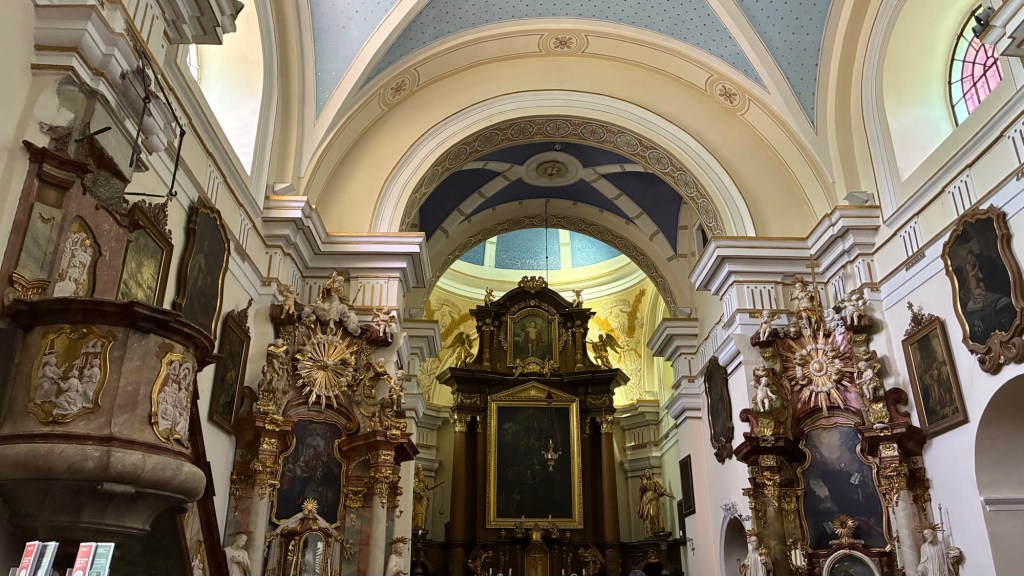
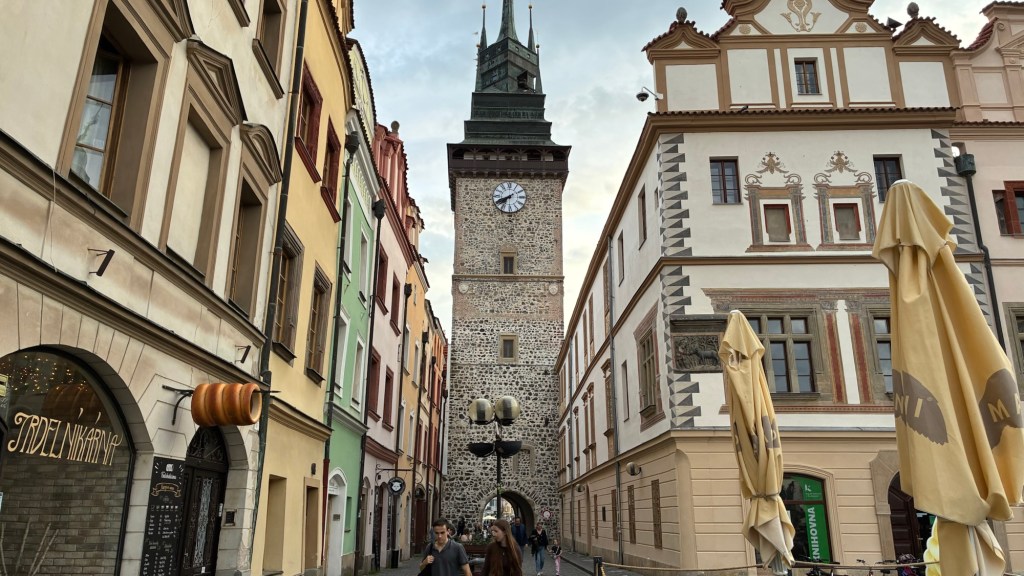
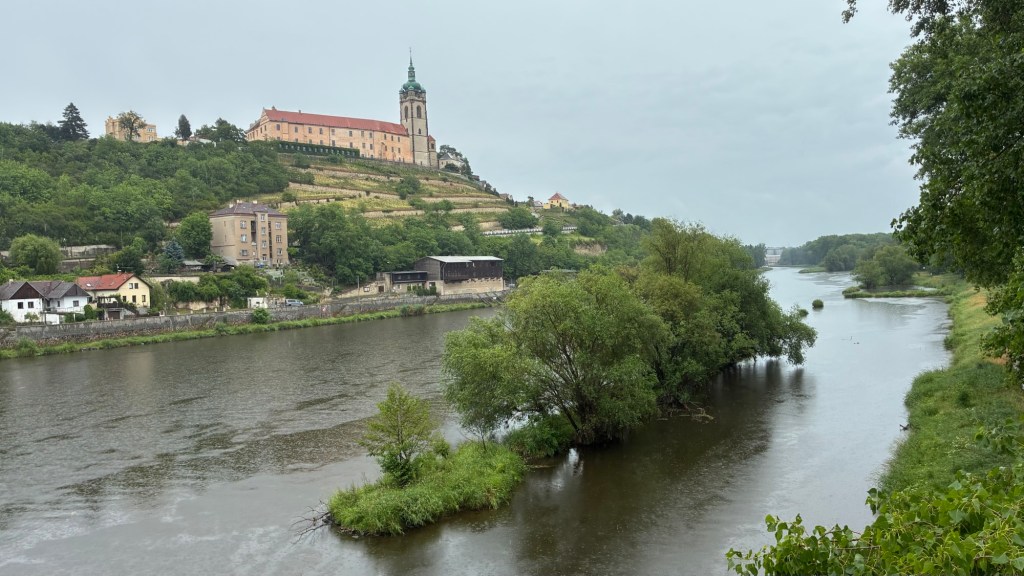
Nearly 300 kilometres into our ride, the historic city of Mělník rises above the confluence of the Elbe and the Vltava. The final climb is barely 50 metres, but at the end of a day’s riding over uncertain surfaces, it takes on Alpine proportions. By the time we had crawled up and bounced across two kilometres of medieval cobblestones, we were rattled to the bones.
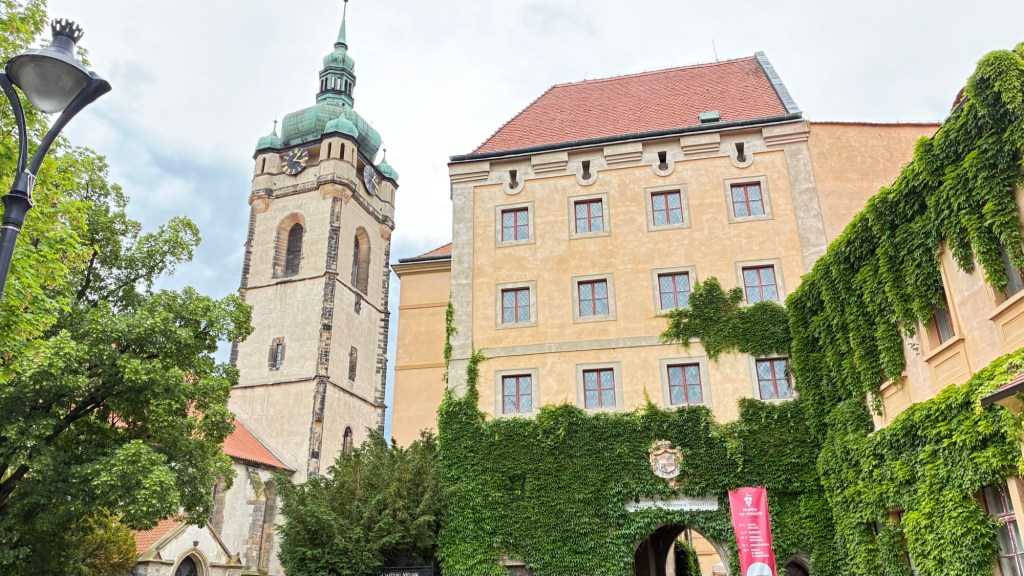
Melnik Chateau

At the centre of the town square, three monumental women cluster around a giant wine jug in the 1930s sculpture Vinobraní (The Grape Harvest), celebrating Mělník’s thousand-year-old wine industry. Vineyards surround the town, overlooked by a 10th-century château perched above the meeting of the rivers.
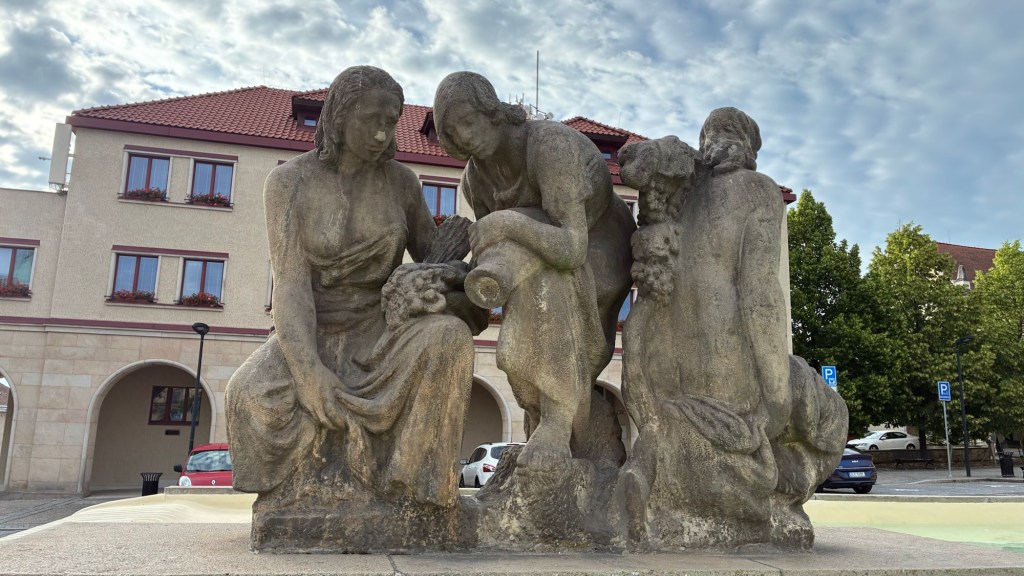
Vinobrani

A magnificent wine bar occupies a strategic position in the château complex.

At this point, thirsty cyclists are expected to choose between local wine and local beer. For most visitors, the choice is difficult. For my fellow-traveller—known to the reader of this blog as Sidekick—it is impossible. Like all serious travellers, he seeks authenticity in local food and drink. Unlike most travellers, however, he is a teetotaller.
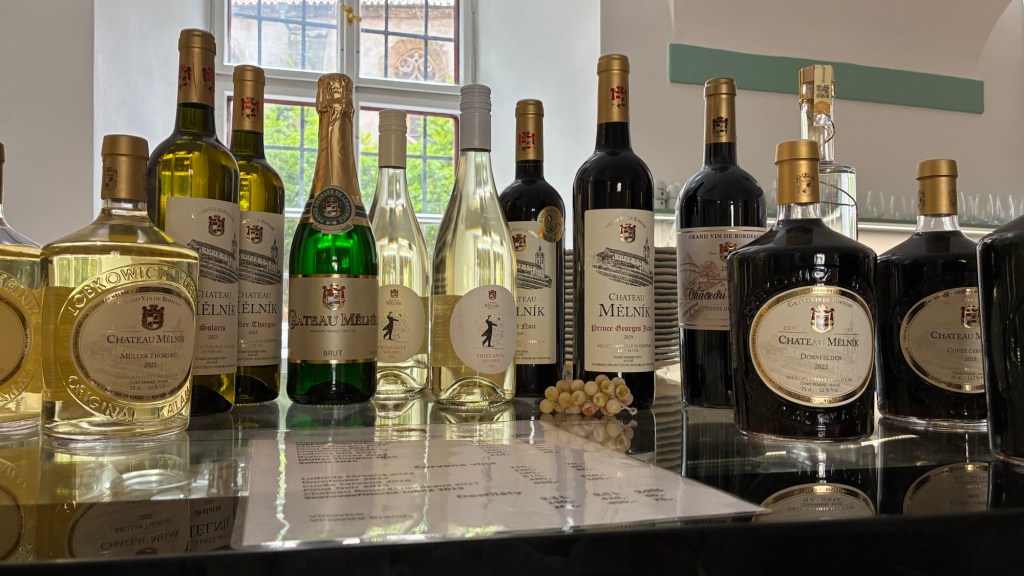
Melnik Chateau wines on display: nothing for the Teetotaller

This creates a recurring problem throughout Europe. Every village has a local ale that is naturally the ‘finest in the world’. Every region has its own wine. Every town has a centuries-old alcoholic beverage whose provenance is discussed at exhausting length. But ask for something local and non-alcoholic and you almost hear Europe’s famed drinking culture grinding to a halt.

Last year, while cycling through Slovakia along the Danube, Sidekick discovered Kofola.
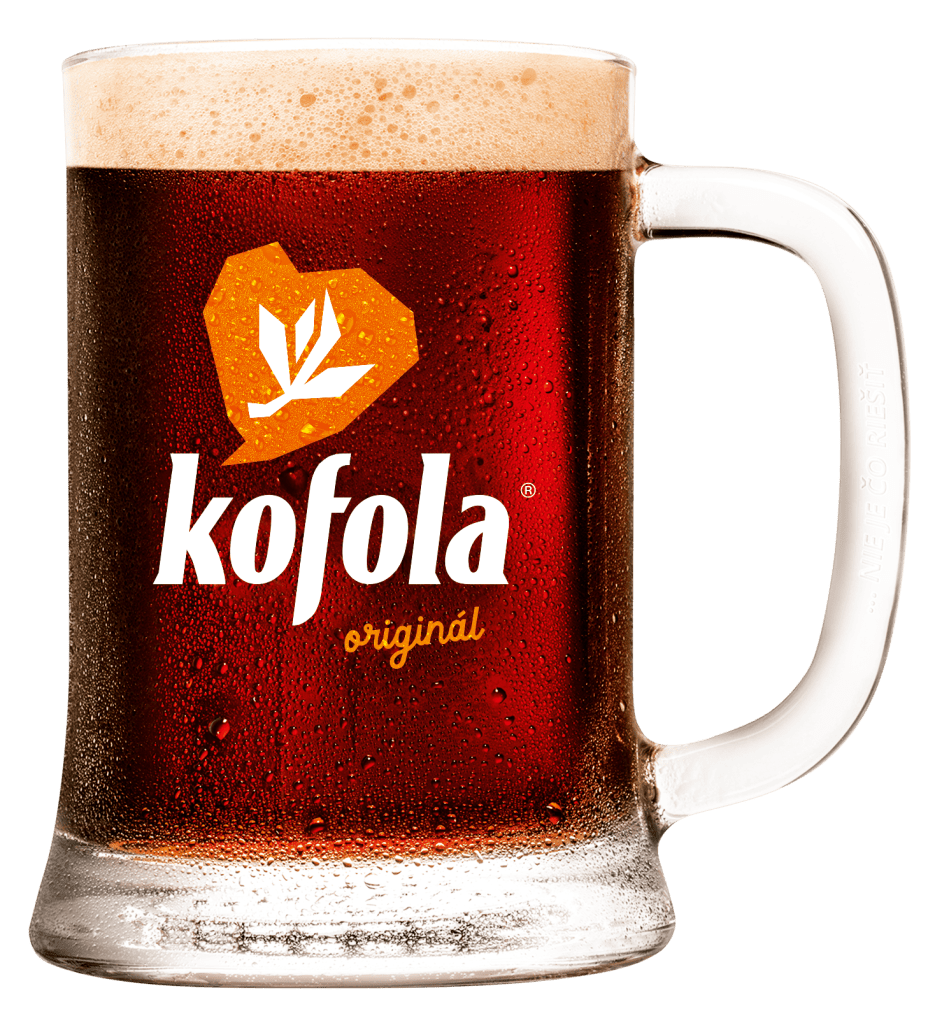
Photo: From the manufacturer’s website

Village cafés had it. Restaurants had it. Roadside kiosks had it. It emerged from taps alongside beer. By the time we left Slovakia he had become convinced that Kofola was not merely a drink but regional pride—bottled and carbonated.

Created in communist Czechoslovakia in 1960 as a domestic alternative to Western cola drinks, Kofola quickly became part of everyday life. It looked vaguely like Coca-Cola, tasted nothing like it, and by the 1970s was reportedly available everywhere from pubs to post offices.

Naturally, when we arrived in Prague—the city where Kofola was conceived—Sidekick hoped for a reunion. He did not have to wait long.
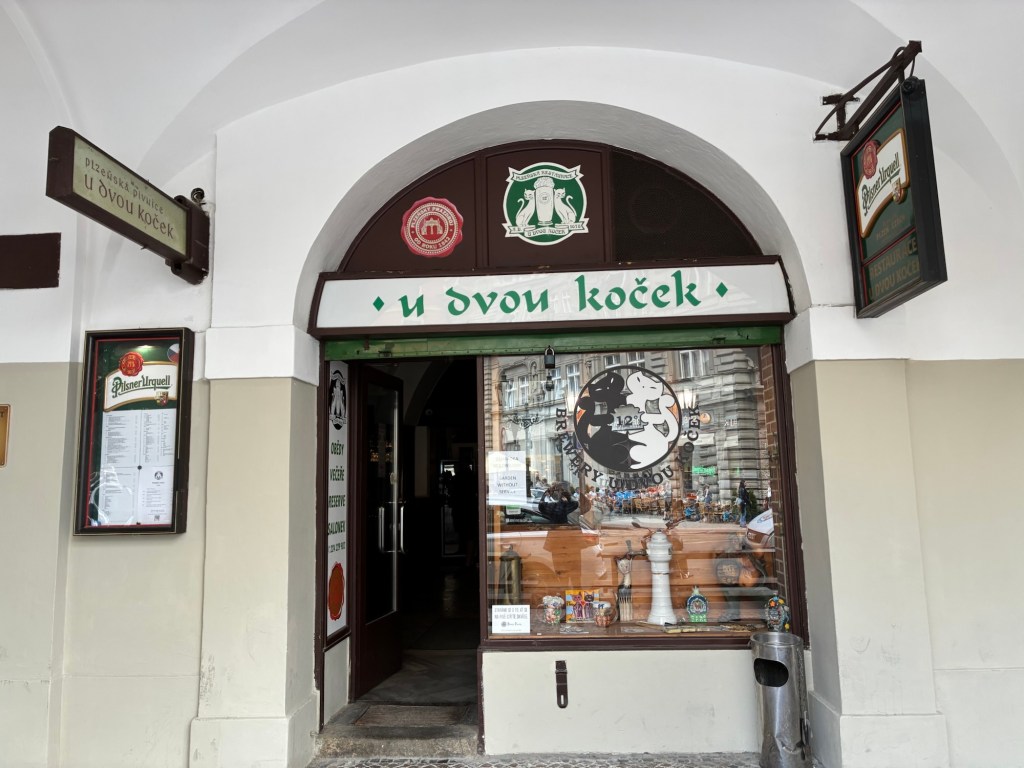
Historic restaurant in Prague: U Dvou Kocek

On our first full day in the city, we were taken to lunch at U Dvou Koček by the Indonesian-born Czech pop singer Rony Marton (but that’s another story). Dating back to the 1600s, the restaurant once catered to communist-era political elites and later appeared in the hit Czech comedy Run, Waiter Run.

This venerable old institution proudly continues to serve Kofola. To Sidekick, this confirmed the drink’s status as one of history’s great survivors.

Away from Prague, however, Kofola became harder to find. Restaurants offered Coca-Cola and Pepsi. Bars offered enough beer to float a fleet of warships. Kofola appeared only intermittently, and generally not in smaller cafés and roadside stalls.

The Velvet Revolution of 1989 had brought political freedom and consumer choice to the Czechs. It also brought Coca-Cola, supermarkets and a flood of Western brands. Kofola’s sales collapsed. For a time, it looked as though the old socialist cola might go the way of the Communist Party.
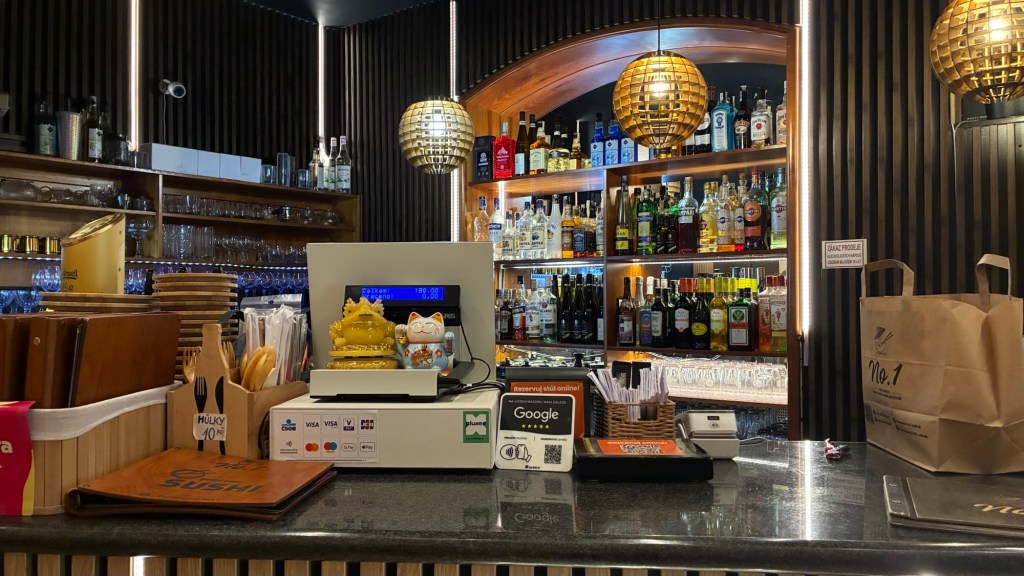
At No.1, our nearest cheap eat in Melnik: plenty to drink but…

By the time we rolled into Mělník, Sidekick had grave concerns.

Our hotel stood less than a hundred metres from the town square and, quite literally, next door to the château and church. None of the half-dozen restaurants on our street served Kofola. The one kiosk in the square sporting Kofola umbrellas had already closed for the evening.
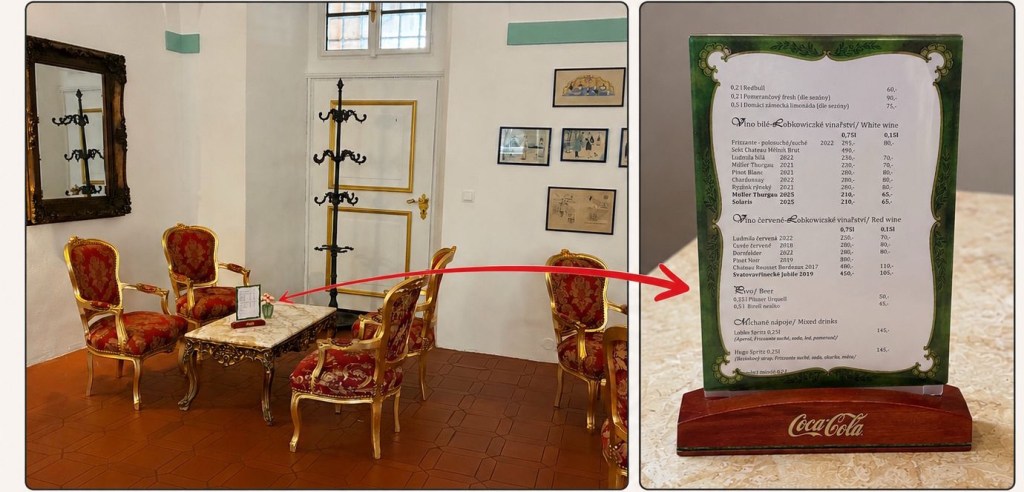
The message is clear

Inside the château’s elegant wine café, gilded chairs surrounded marble tables beneath high white vaults. The décor suggested hunting parties, sweeping gowns and inherited titles. The Coca-Cola advertisements on every table asserted something else — Globalisation wasn’t merely knocking at the castle gate. It had booked all the tables inside.

Sidekick’s solution was to turn to that modern bastion of consumer choice: the supermarket. Google Maps revealed a Tesco hypermarket just 800 metres from the château gate. But a very long way down hill. Down we went any way, ignoring premonitions about the climb back.
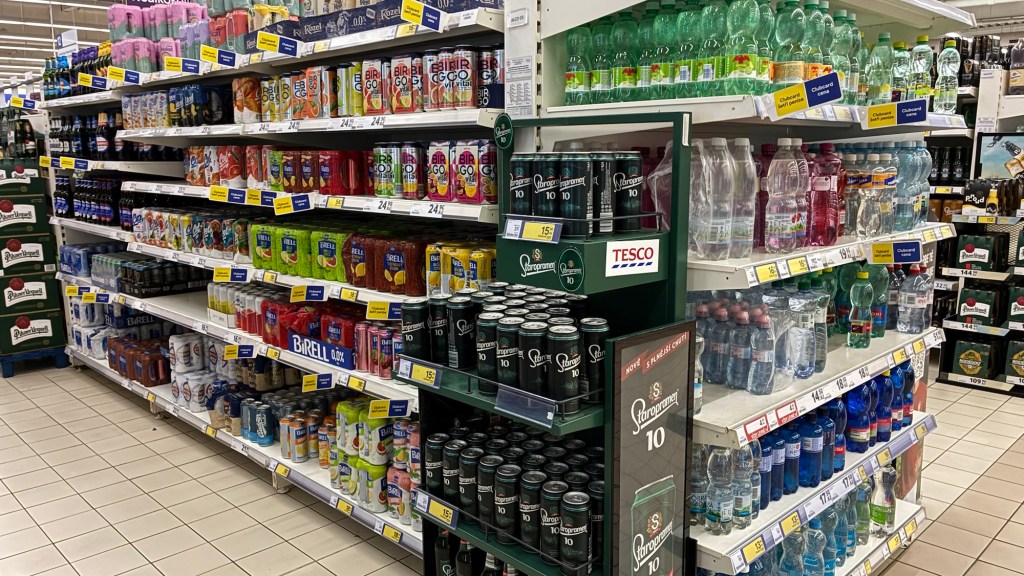
Every imaginable drink

The search began: First came Coca-Cola. Then more Coca-Cola. Then Pepsi. Then energy drinks promising to improve everything from athletic performance to environmental impact. Then an entire continent of beer—beers that had won international awards; beers that had fought international wars.
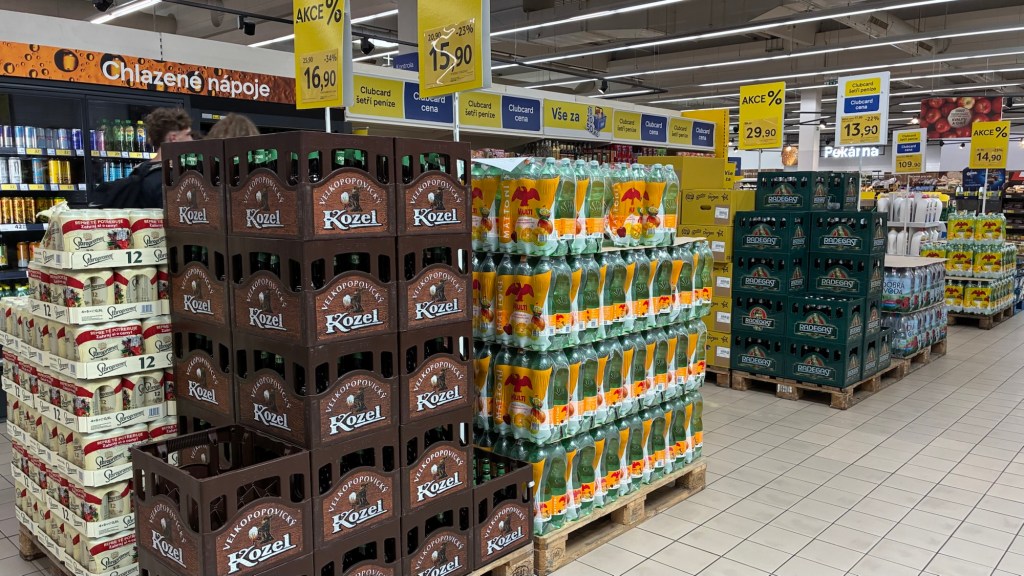
No shortage of local ales

But no Kofola. Eventually, after photographing thirteen separate drinks displays, I gave up.

An elderly employee was stocking a fridge.

“Kofola?” I asked.
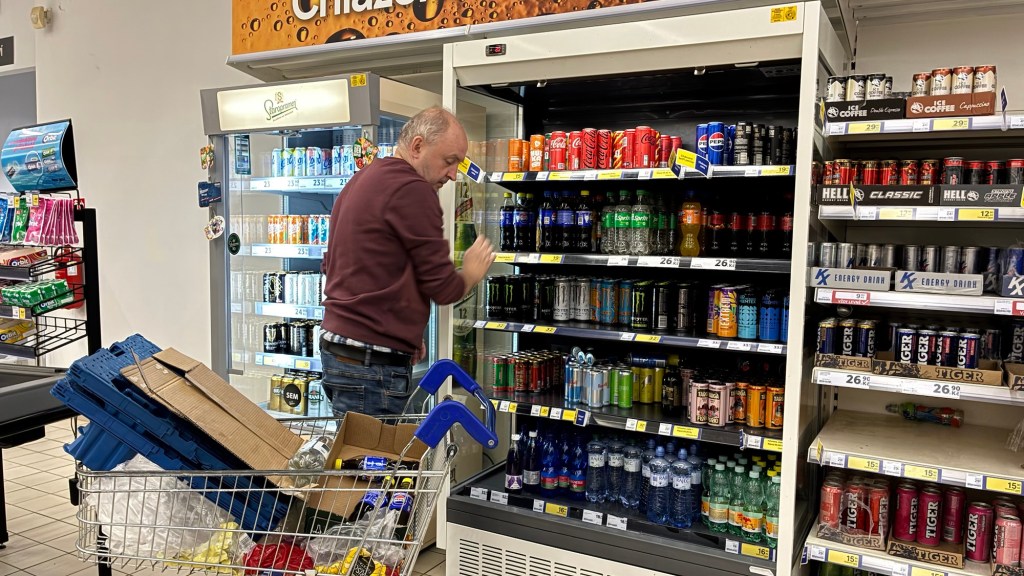
The elder employee looks for a cold Kofola at my request

He corrected my pronunciation, shifted a few Coke bottles and revealed several small bottles of Kofola.

I gestured: “Big?”

He pointed somewhere up towards the ceiling at the far end of the supermarket.

I followed the pointed finger towards the fluorescent lights. And there they were! Several large plastic bottles of classic and sugar-free Kofola, at the far corner aisle, on the top shelf, well-beyond the line of sight of not just the height-challenged (eg. Me) but even 6 ft tall humans like Sidekick.
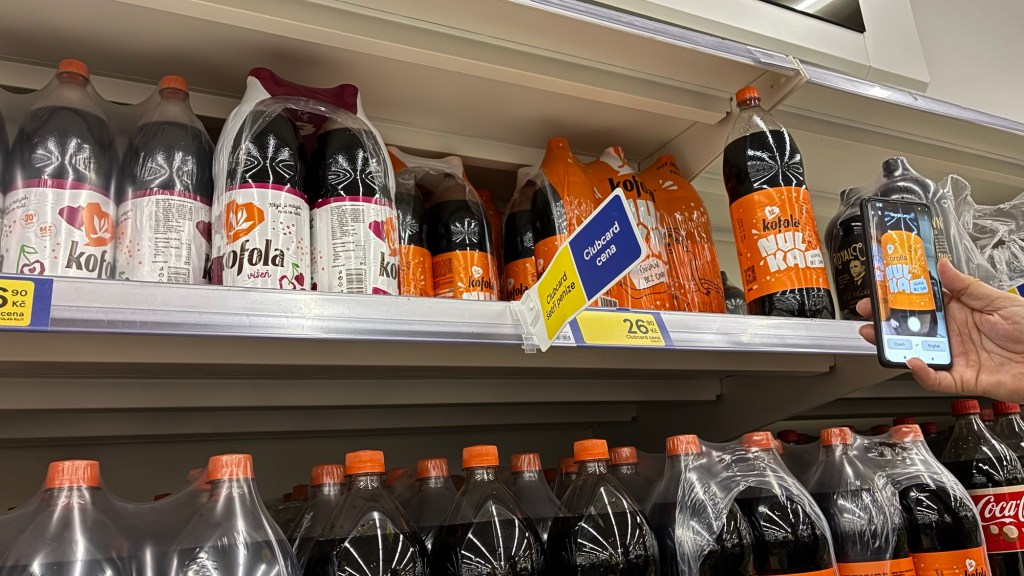
Shelved way above the head of the average punter

Not extinct. Perhaps not even endangered. But clearly, struggling for territory in the supermarket ecosystem.

Kofola had survived. In the early 1990s, when many assumed the brand was doomed, it was rescued by Kostas Samaras, whose family had migrated to Czechoslovakia after the Greek Civil War. The new owners quickly realised that competing with Coca-Cola was futile. There was no need. Kofola’s advantage was that it wasn’t Coca-Cola.

It was Czech, nostalgic, stubbornly local and tasted wonderfully unique! Instead of fighting the global giants, the new owners embraced its special identity and thus got the business back on its wheels.
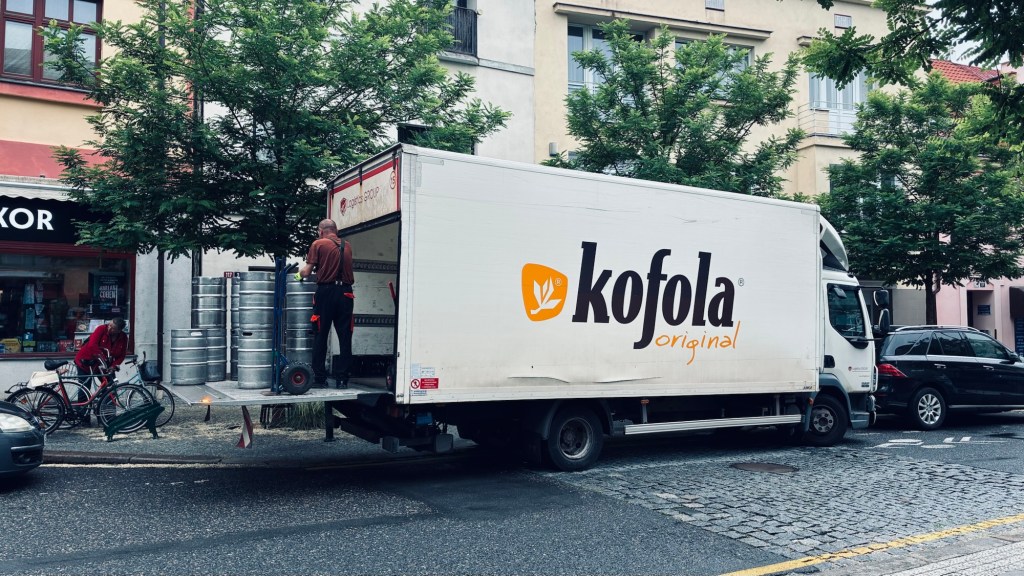
Kofola delivery at Nymburk, Bohemia

Which is how, after cycling nearly 300 kilometres through Czechia, we found ourselves standing in a supermarket in Mělník celebrating the survival of a soft drink. Outside stood vineyards that had produced wine for centuries.
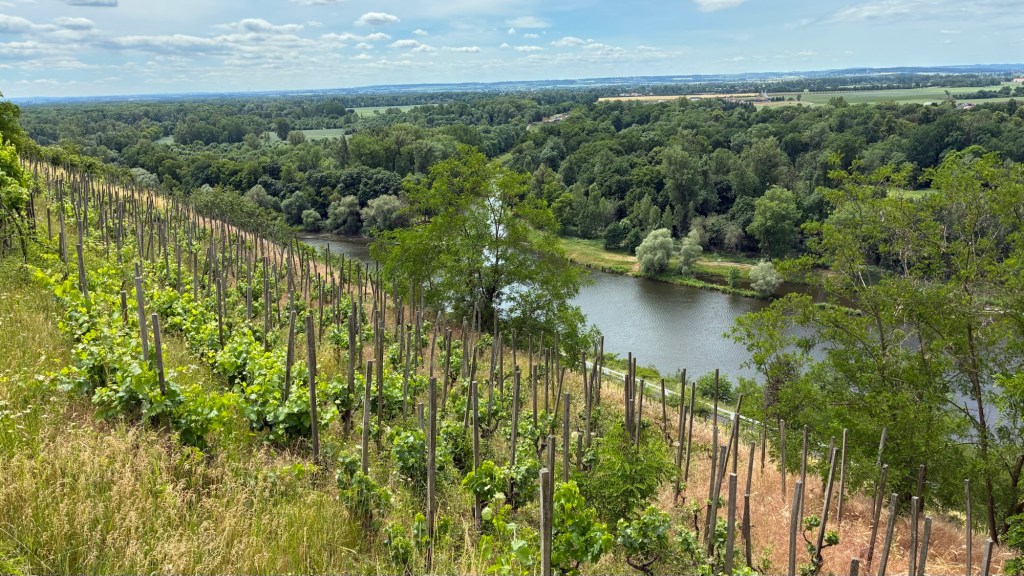
Melnik’s historic vineyards and primeval waters

Just before we climbed back up to one of the most beautiful historic town centres in Bohemia, we drank to a revolution that had survived communism, capitalism and globalisation.

It was still alive, albeit backed into a corner, at aisle 27 or thereabouts in Tesco.
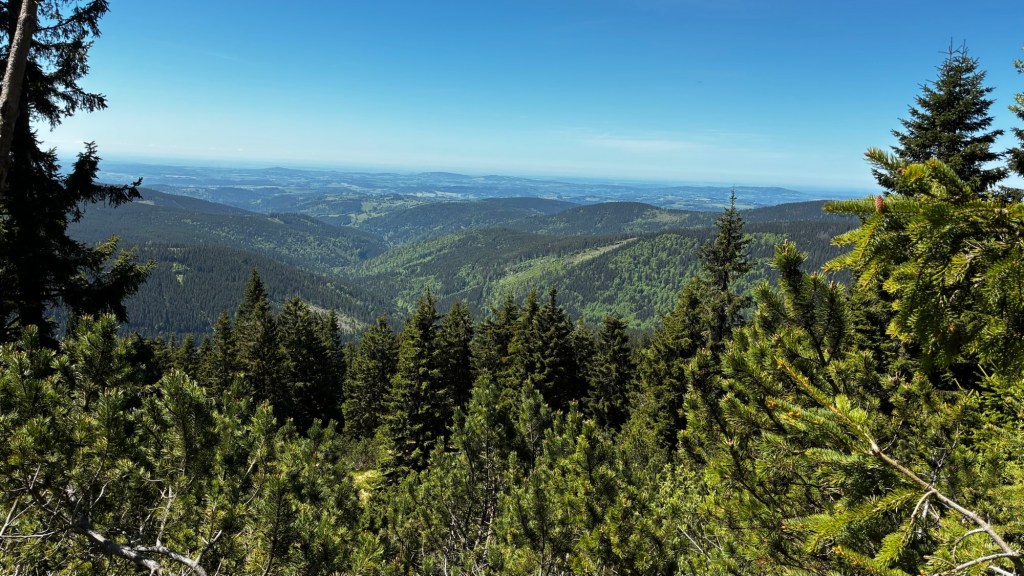
Following the Elbe: Slow Riders, Impatient River 

‘পরের কোনও পর্যটক বাঁচবে, তাই
কোথায় হাঁটি, কোথায় থামি… লিখে গেলাম।’ Srijato

Another traveller will arrive, so
where I walk, where I stop… I inscribe.

The River

Mountains on the border of Czechia and Poland

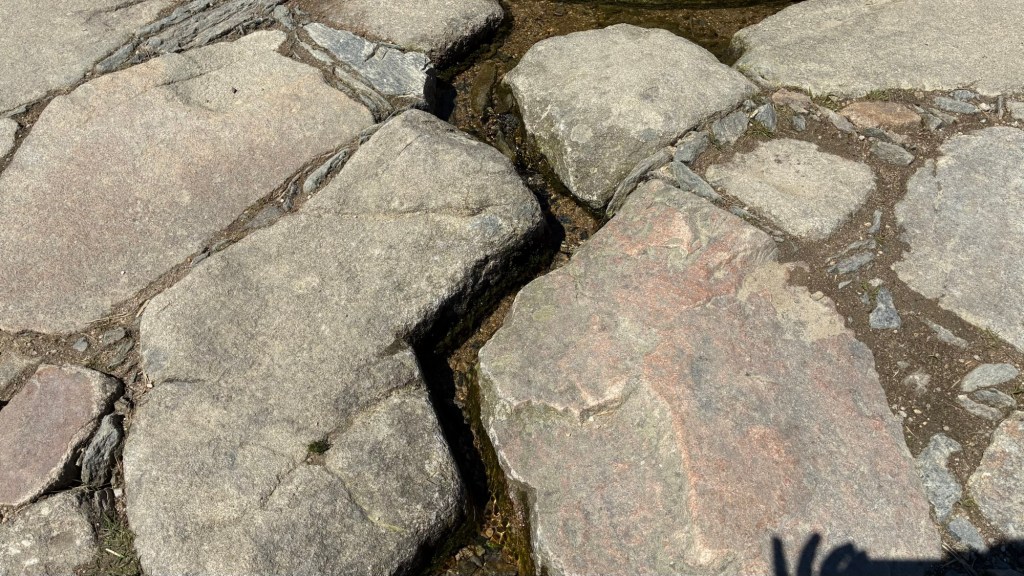
We are on the high moorland of the Giant Mountains nearly 1,400 metres above sea level, wondering how on earth this insignificant seepage through cracks in the stones will somehow gather enough strength to become one of Europe’s great waterways—crossing the breadth of Czechia and Germany before entering the North Sea some 1,200 kilometres away.

Unconvincing trickle!

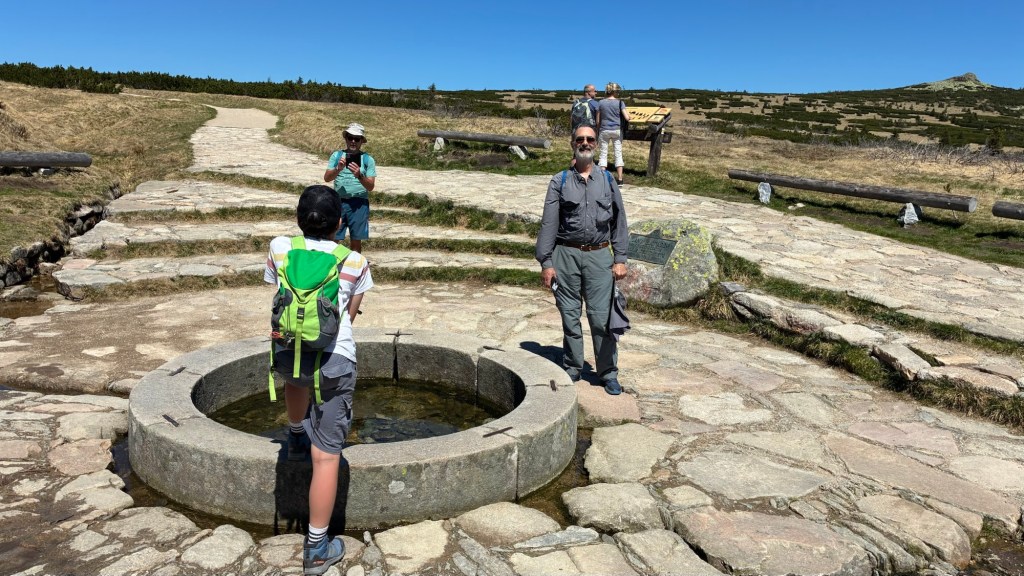
Pramen Labe, the Elbe’s official birthplace, is marked by a circular stone well and prominent signage. It takes quite some digging to discover that this is not where the river actually first surfaces. The marked site serves the traveller’s needs rather than a hydrological one: it gives us a place to arrive, a point from which our journey can begin, while leaving the river to be born in peace in a protected peat bog further west, undisturbed by human feet.

Pramen Labe – Obligatory tourist photo

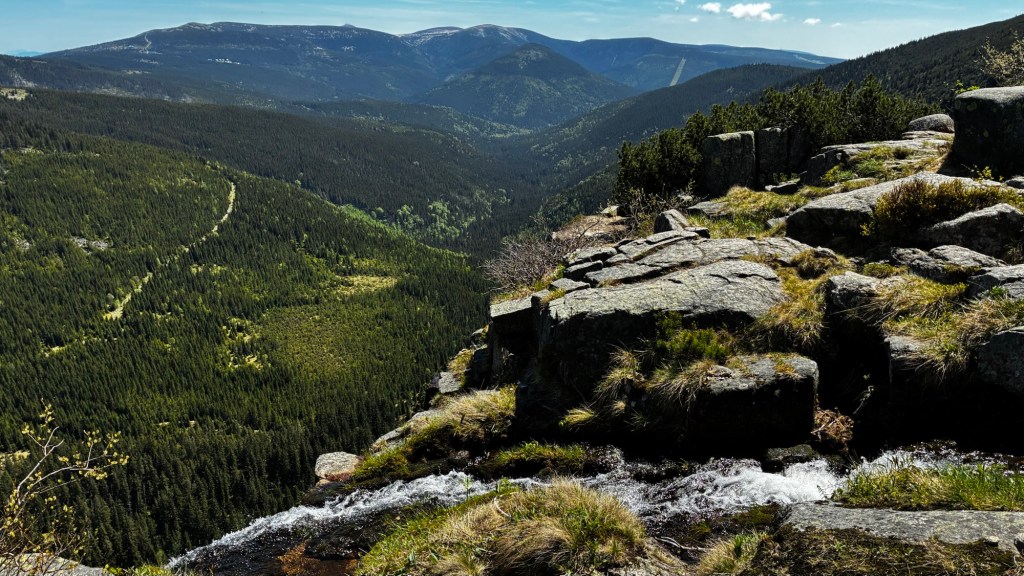
The river seems impatient. Barely a kilometre from the official source, it is already hurling itself over black granite, dropping somewhere between 30 and 45 metres—depending, I suppose, on how they measure a waterfall—before continuing through another two hundred metres of rapids into the valley below.

The Elbe Falls: you have to be there to see its magic

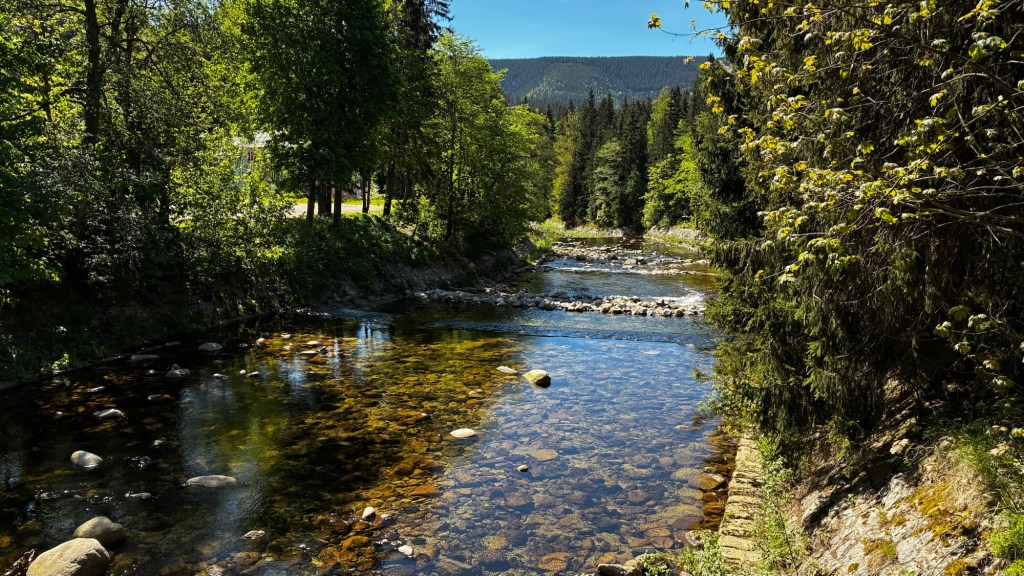
Last year, while cycling beside the Danube, we watched a great river gather itself slowly over many days of riding. The Elbe, by contrast, appears in a hurry to grow. Just eight kilometres from its source—and a thousand vertical metres lower—in the little town of Špindlerův Mlýn, it is already a gushing stream, at times ten metres wide.

Elbe, as a mountain stream

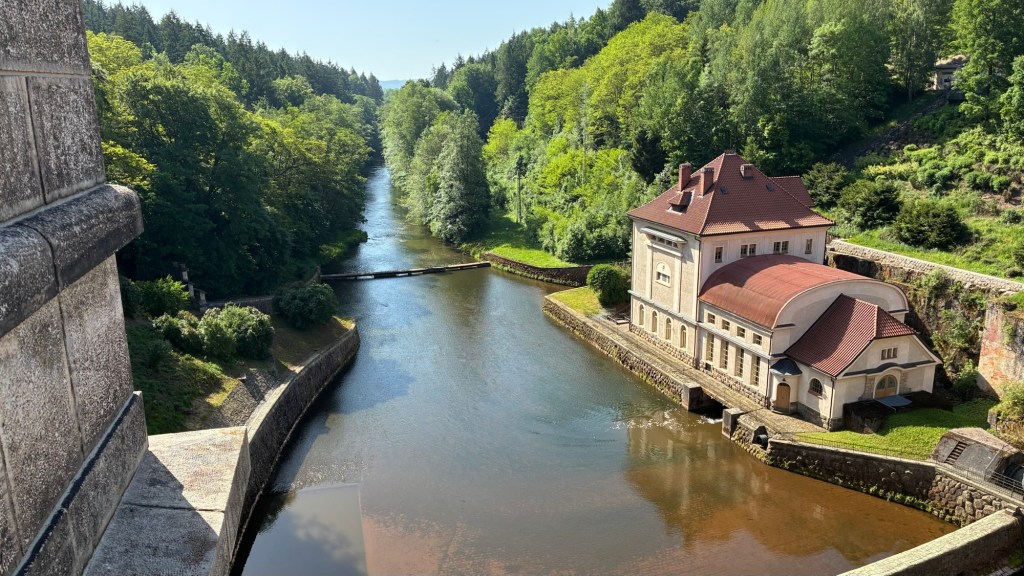
Historically, snowmelt and heavy mountain rains had the river surging through these valleys and periodically causing devastating floods. Dams built in the early twentieth century eventually curbed some of those excesses.

The Royal Forest Dam, whose architecture is as pretty as the surroundings

Even so, by the time we are another hundred kilometres downstream at Hradec Králové, an old Bohemian dowry town once ruled by queens, the river is more than twenty metres wide. Soon afterwards, swollen by the Chrudimka, it doubles its girth again. And so it goes.

The Hike

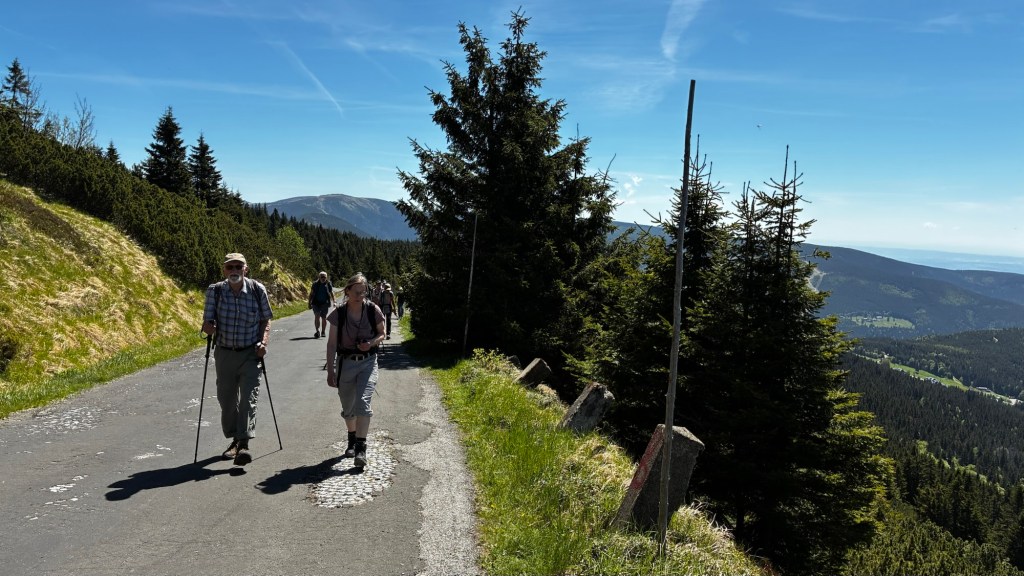
Crowds walking up to Pramen Labe

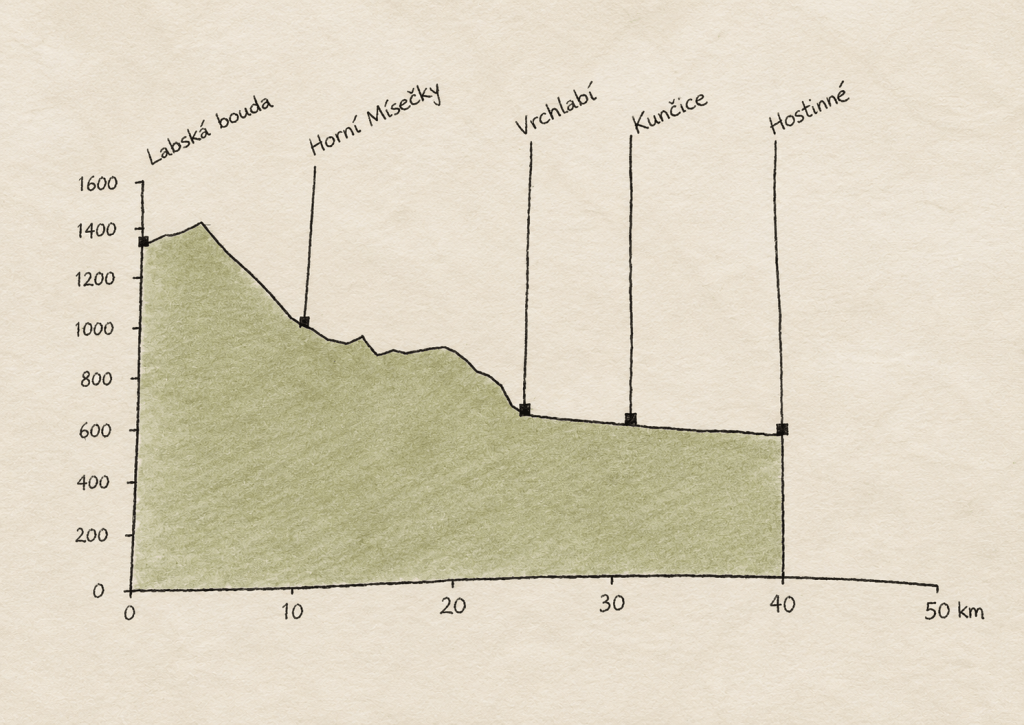
For us, the actual cycling began at Vrchlabí, about twenty kilometres downstream from Pramen Labe.

We had considered cycling all the way to the ceremonial source from Vrchlabí railway station, as the Elbe Cycle Route Guidebook (henceforth, “the Book”) recommends. But after several days of negotiations involving maps, gradients and public transport timetables, we concluded that riding a thousand metres uphill was quite beyond us. Having since watched a couple of cyclists labour through the final stages of the climb to Pramen Labe, I can say with some confidence that we made the correct decision.

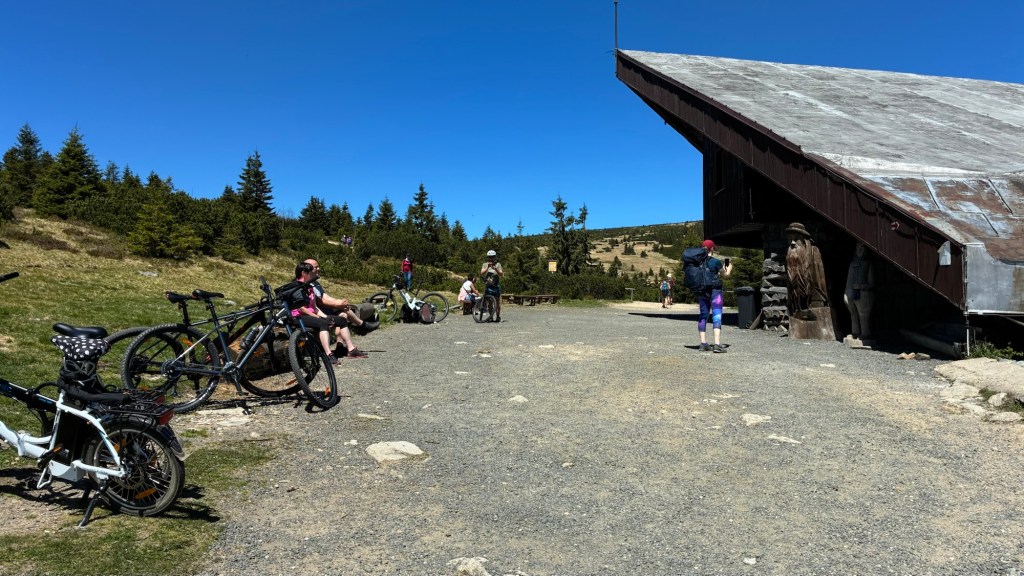
Cyclists parking at Labska Bouda– walkers only beyond this point

A six-kilometre hike involving five hundred metres of ascent to obtain the obligatory photographs of an official beginning seemed challenge enough. After that, the route would be downhill most of the way—or so the Book promised.

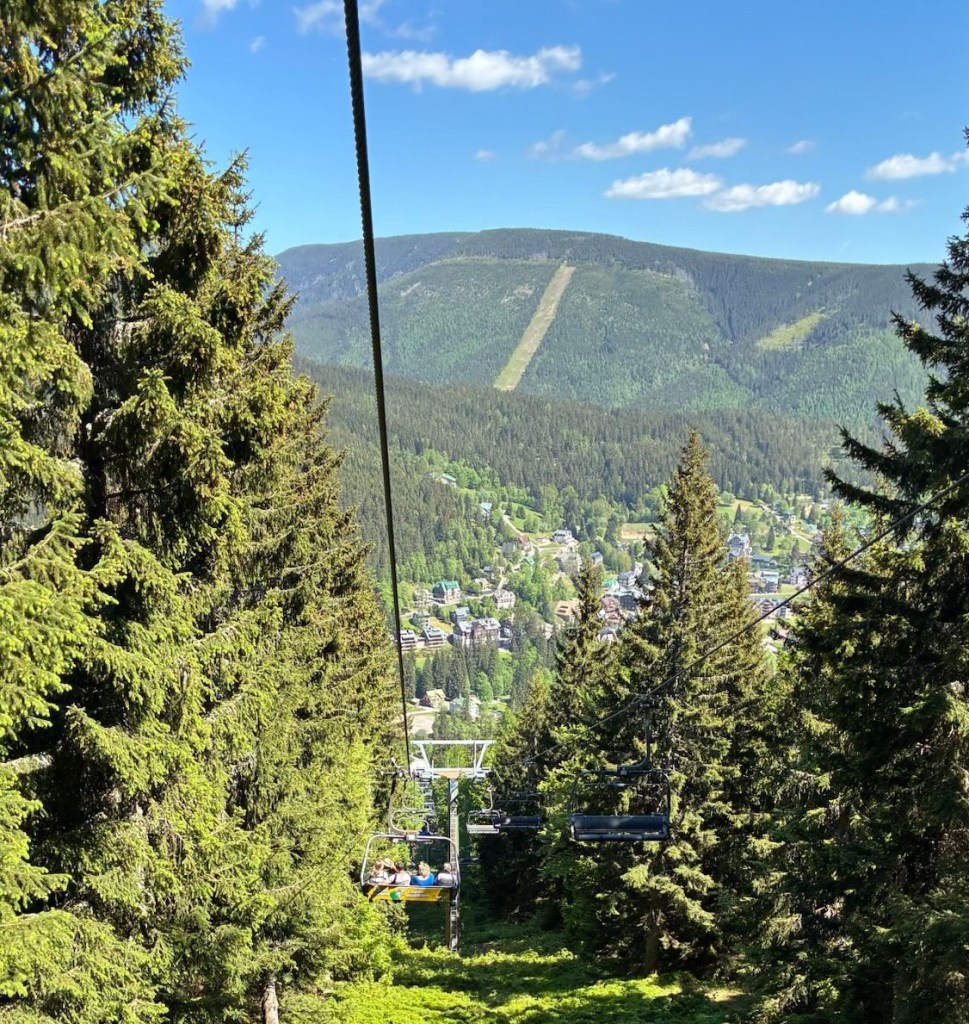
Ski lifts which take the walkers part way up the hills

The Giant Mountains are breathtaking in both the figurative and literal sense.

The Ride: The First Hundred Kilometres

Starting off from the little resort town of Vrchlabi

A hundred kilometres of riding brings us to Pardubice, where I began writing these notes. Any town at which you choose to stop seems to possess a medieval castle, church, monastery or some other grand structure dating from somewhere between the tenth and eighteenth centuries.

Zirec church runs interesting projects and was open, unlike many others

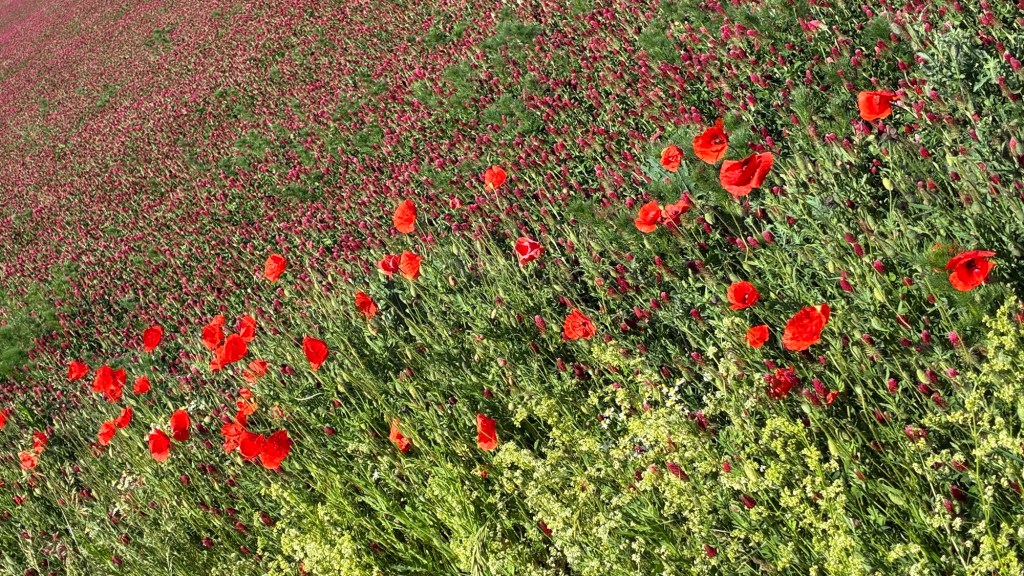
In late May, summer is beginning to shoulder spring aside. Wild poppies line the roads. Swallows dart overhead, frustratingly difficult to capture in a photograph. The cherries are still green. The skies have been crystal clear. Most days the breeze has been an ally against the heat, although a capricious westerly can sometimes get a bit pushy.

Poppies: shot from camera mounted on handlebar, thus the angle

The promise of “downhill all the way” does not immediately materialise. Our second day of riding, from Hostinné to Jaroměř, included several long, slow climbs—particularly challenging on a busy road and with temperatures approaching thirty degrees. Naturally there are no photographs from those sections; one is generally too occupied with panting and cursing. Even the trucks are polite in Czechia, however. So the traffic never feels unsafe.

A Stop

Gateway to the old town centre in Pardubice

At the end of a forty or fifty-kilometre ride, it feels good simply to stop. But Pardubice, a regional capital of some 93,000 people and the largest town we had set foot in since Prague, seemed determined to make us feel particularly welcome. Our hotel room overlooked the fortress walls. Music drifted across in the evening air.

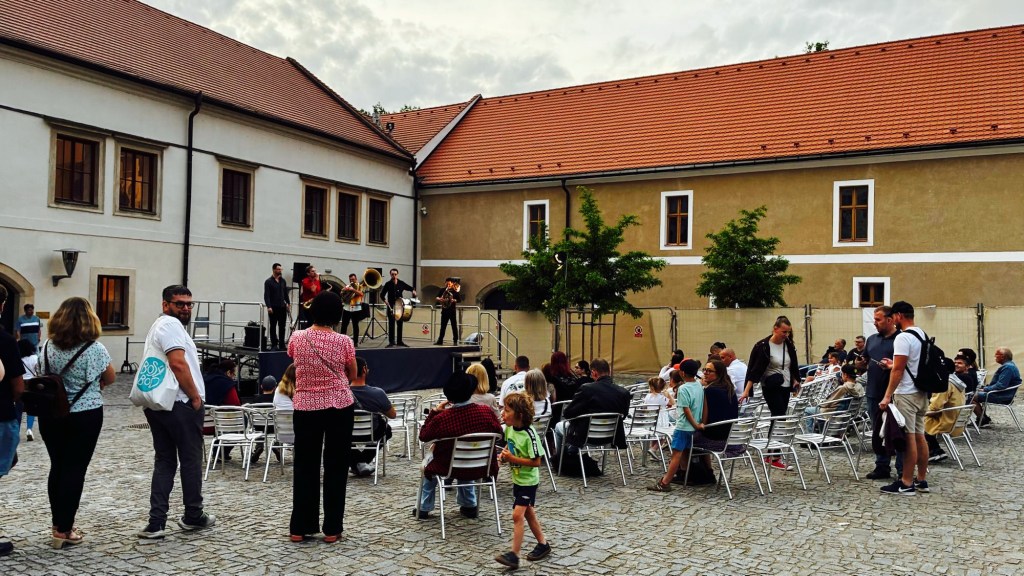
Band in the castle courtyard

Was the city putting on a show for us? But no, we had stumbled into Pardubice Museum Night.

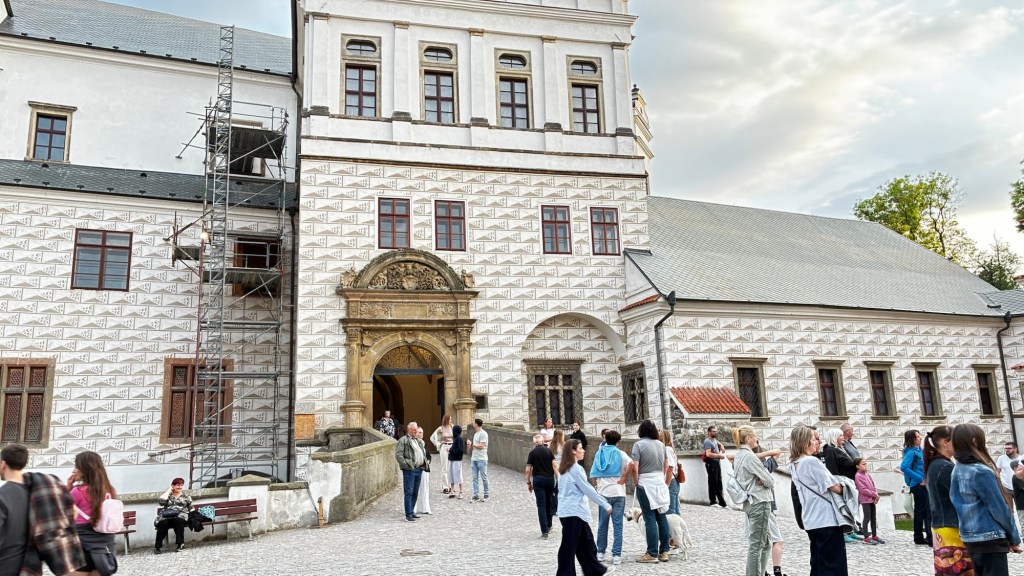
Pardubice Castle on ‘Museum Night’ 2026

One night in May, each year, the Pardubice Castle—originally a thirteenth-century moated fortress, later transformed into a Renaissance château—and the East Bohemian Museum housed within it remains open until eleven o’clock, with free admissions. Bands play in the courtyard, loudly enough to keep even the weariest cyclist awake.

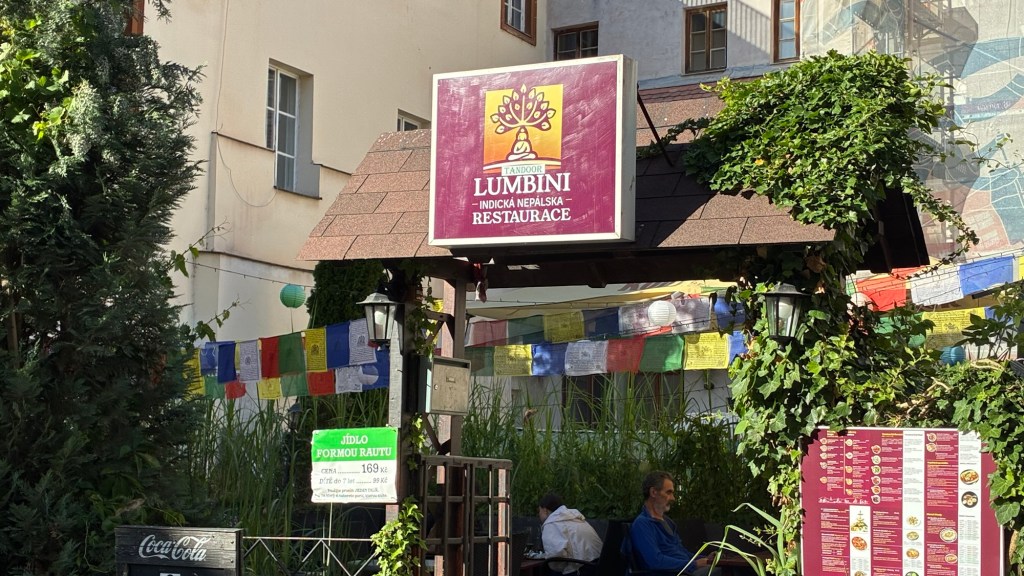
Lumbini in Czechia? This one is a cafe in Pardubice.

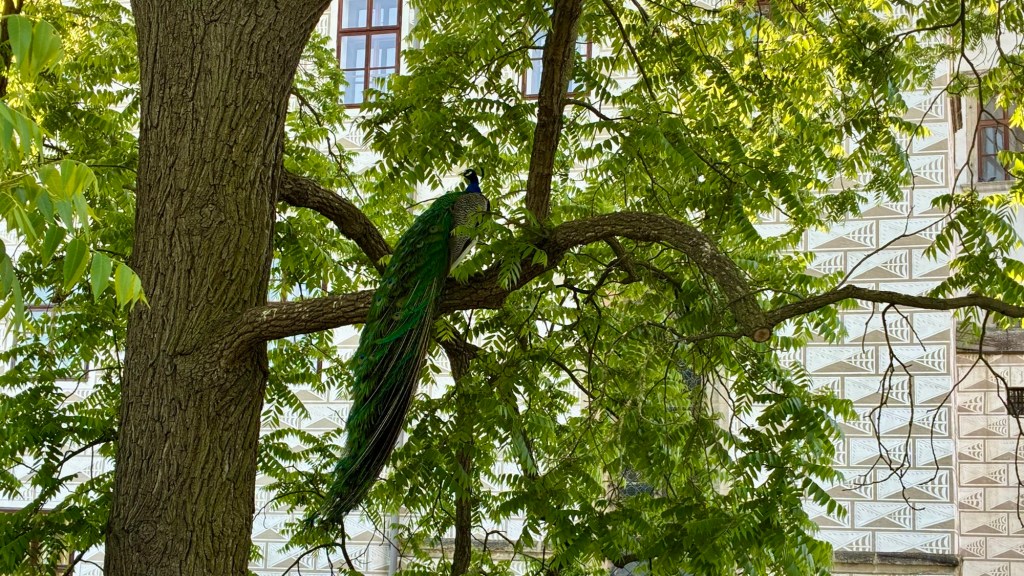
Several days later, Sidekick is still salivating over the dinner he ate at Pardubice’s only Nepali restaurant, Lumbini. Meanwhile, I am still trying to work out why a family of peacocks—decidedly not native to Bohemia—seem to have taken up residence inside a medieval castle-fortress-château.

A fine feathered South Asian a long way from his origins?

A renaissance mansion, free museum, live music, good food and inexplicable peacocks: this is a place refusing to disappear in the blur of the long distance cyclist’s one-night stops.

Czech and Balance

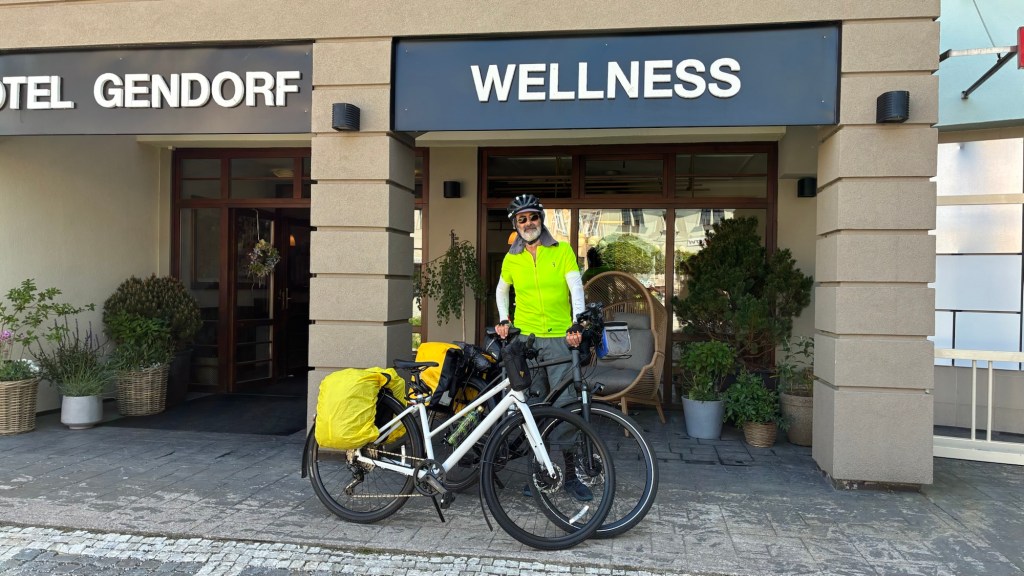
There comes a time when the universe tells you to slow down. In response, we have packed our panniers and set off once more to wobble along another European riverside on loaded bicycles — of course, at a pace officially classified as ‘sedate’.

Bikes, picked up from storage, serviced and loaded: we’re rollin’

Last year we cycled some 1400 kilometres from the source of the Danube to Budapest, despite having absolutely no previous experience of long-distance cycle touring. Some kind friends described this as admirable spontaneity. Others muttered darkly about cognitive decline.

In truth, we had only the vaguest idea of what we were doing. We simply pointed the bicycles east and kept pedalling. We eventually chickened out in Budapest because the lower Danube route had a scary reputation among cyclists: muddy tracks, missing signposts, feral dogs, and stretches where you apparently had to push your loaded bicycle across a mile of sand while inevitably reconsidering your life choices. We didn’t want to risk turning a bi-pedal road-trip into an orthopaedic incident.

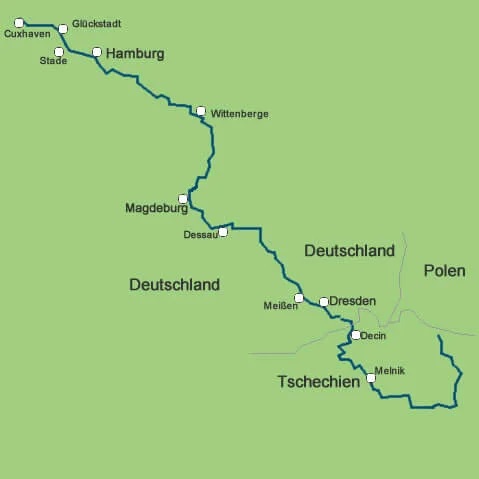
Still, we returned home convinced that we had not surrendered so much as strategically retreated to take on another ride another day. Soon enough we found ourselves drifting into discussions about padded shorts, tyre pressure and headwinds with the haunted intensity of veterans. Before long another river ride had begun to loom into view: Labe when it rises in the Krkonose (Giant) Mountains, Czechia, and Elbe as it wanders through Germany to the North Sea.

Another river looms : Elbe/Labe as seen on-line

Meanwhile, a war had broken out in the Middle East and Cycle Sidekick (CS), sensing a golden opportunity to derail the expedition entirely, threw himself into researching airline routes with the grim dedication of a NATO logistics officer.

Over several days he developed an increasingly elaborate set of safety criteria. No stopovers longer than six hours. No routes passing within cooee of either Russia or the Middle East. No airports likely to attract geopolitical attention. And so on.

I assumed this exercise would end with a solemn announcement that a Europe trip right now was unreasonably risky and that, regrettably, the expedition would need to be abandoned in favour of staying home and watching travel documentaries from the safety of the sofa.

Unfortunately for him, after days of determined pessimism, CS succeeded only in finding a route that satisfied all his own conditions: Perth to Amsterdam in roughly thirty hours with only minimal chances of international incident. His final respectable excuse had vanished.

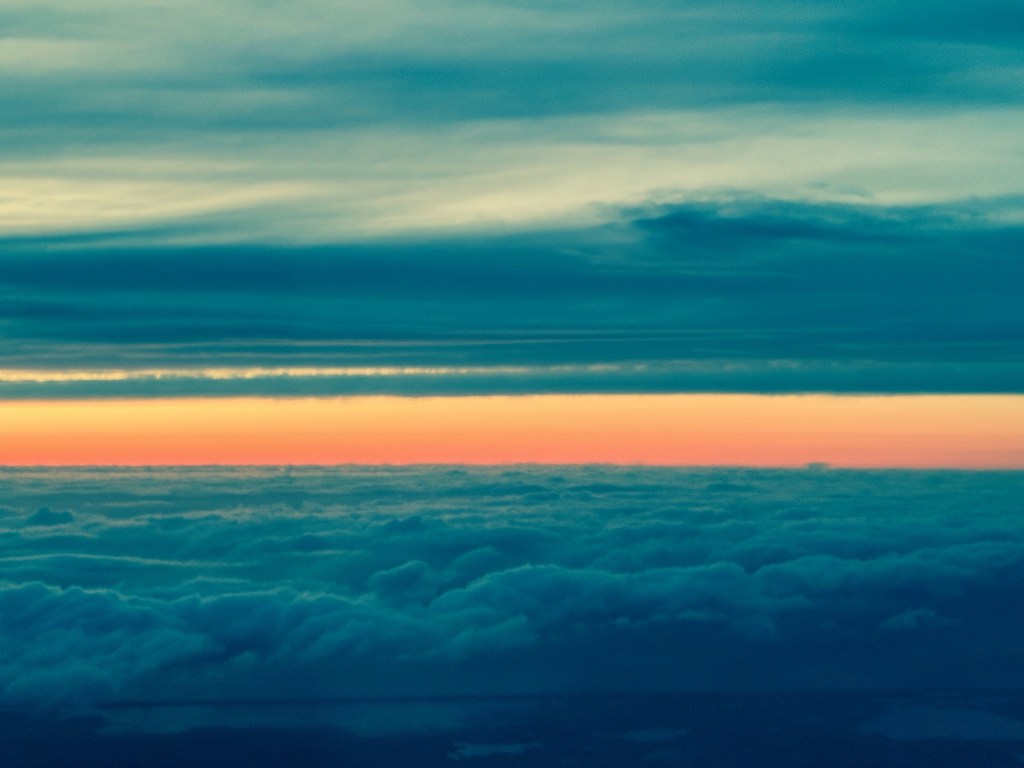
Perfect flight and a pretty sunset thrown in for good measure

There was now no turning back.

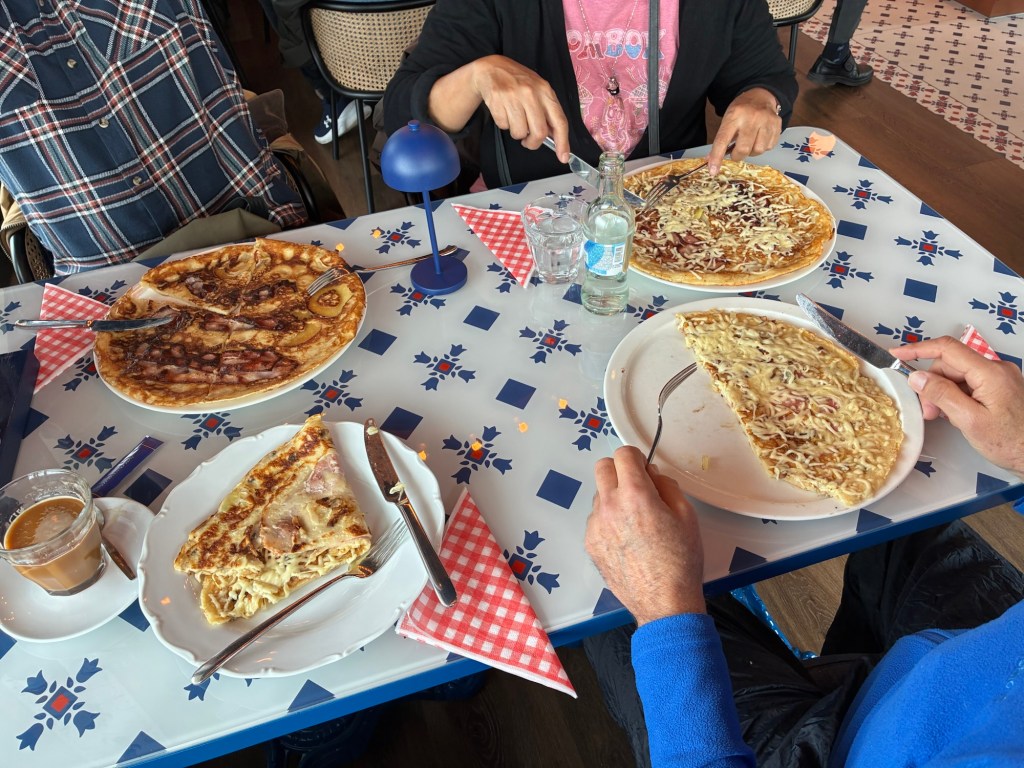
We were headed for the hills in Czechia, though not before a few days of serious carbo-loading in The Hague — which sounds considerably more athletic than eating Dutch pancakes while trying to recover from jet lag.

Carbo loading at Pannenkoekenhuis Oma Toos, Scheveningen

I had originally sold the Elbe route to CS on the basis of widespread cycling-community consensus that the path was mostly flat. Closer inspection of the route map shows that in cycling terminology ‘mostly flat’ actually means: ‘There is one catastrophic hill right at the beginning, but after that your suffering becomes more evenly distributed.’

Day one: ride up from Vrchlabi to Labska Bouda

Oh well, we’ll cross that hill when we get there.

We have also completed the familiar phase known as Acquiring Tiny Expensive Objects. These arrive in disproportionately enormous padded envelopes and rarely fit either the bicycle or the cyclist for whom they were allegedly designed. Clearly, the cycling industry survives largely by convincing baby boomers that they are only one titanium bit away from eternal youth.

And yet, at a stage of life when some of our contemporaries are investing seriously in adjustable medical beds with remote controls, tiny titanium thingummies somehow manage to signify rebellion. Besides, they are considerably cheaper and less environmentally damaging than buying a red Alfa Romeo.

Nah! Naaaahh😱

Which brings me finally to the matter of ‘balance’, which at our age is no longer merely a cycling skill but a comprehensive lifestyle challenge.

If you follow my blogs, you will see that performance metrics play no role in this expedition. In theory, we would like to complete the entire river — roughly 1100 kilometres from the Giant Mountains to the North Sea. In practice, I shall consider the enterprise a success if we manage to remain upright on our bikes from one hotel to the next for a few weeks, without requiring a major medical rescue.

This is the plan

And so, despite the creaky joints, the logistical anxieties, and the growing awareness that physical recovery now takes as long as the continental drift, we are once again strapping waterproof bags onto bicycles and heading into Central Europe armed with energy bars, anti-inflammatory gel and heroic assumptions about our backs and knees.

Nothing could possibly go wrong, right?