Out of Champagne

There are Champagne party signs all over Bar-sur-Aube and neighbouring villages.

Champagne Party 12-20 May

But your senses can feel a change on the way. Jacques (henceforth J) with whom a friendship was forged on another long walk, in the south of France (Camino Le Puy) has joined us in Bar-sur-Aube. He says the best champagnes are already behind us.
Made for walking

Even to my untrained pallet, the local wines and bubblies (and I try at least one local product daily, out of a sense of political correctness of course!) from around Bar-sur-Aube feel a little heavier while under my well-worn boots the roads are getting hillier.
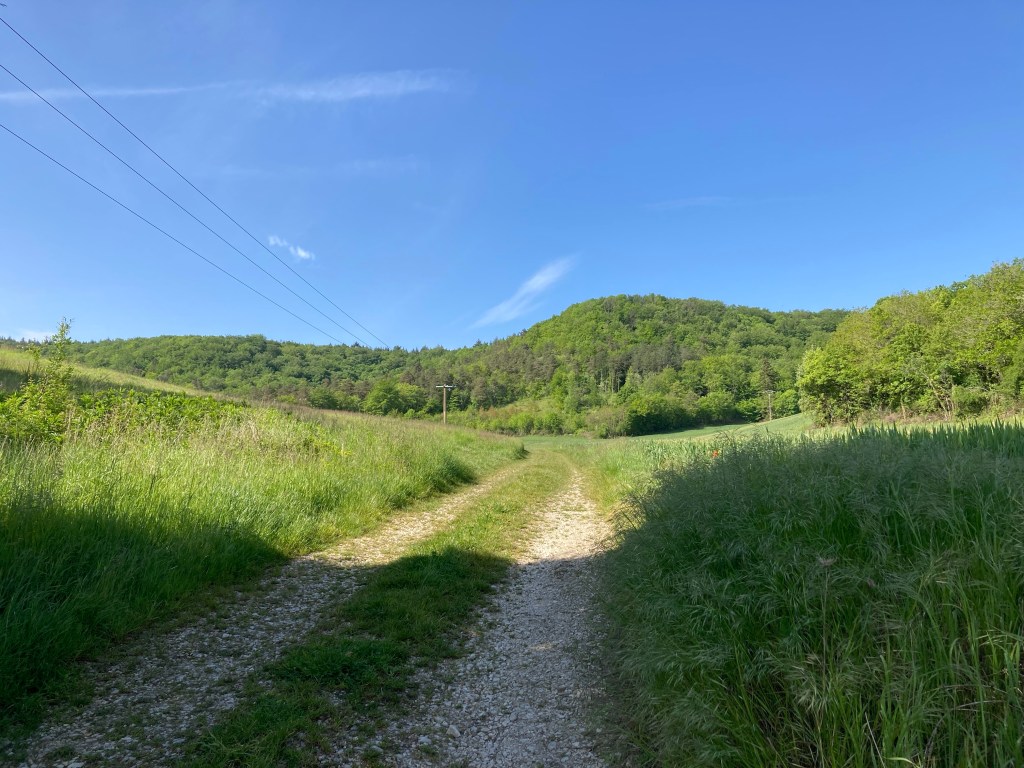
They don’t look like much in photos… but…

In inept hands such as mine, the camera fails to record these ups and downs as little more than molehills. But at the end of a day, after 20 kms or so, a 100 meter climb across that final half kilometre, off-track into your night’s accommodation in Saint-Ciergues, definitely feels like a mountain.
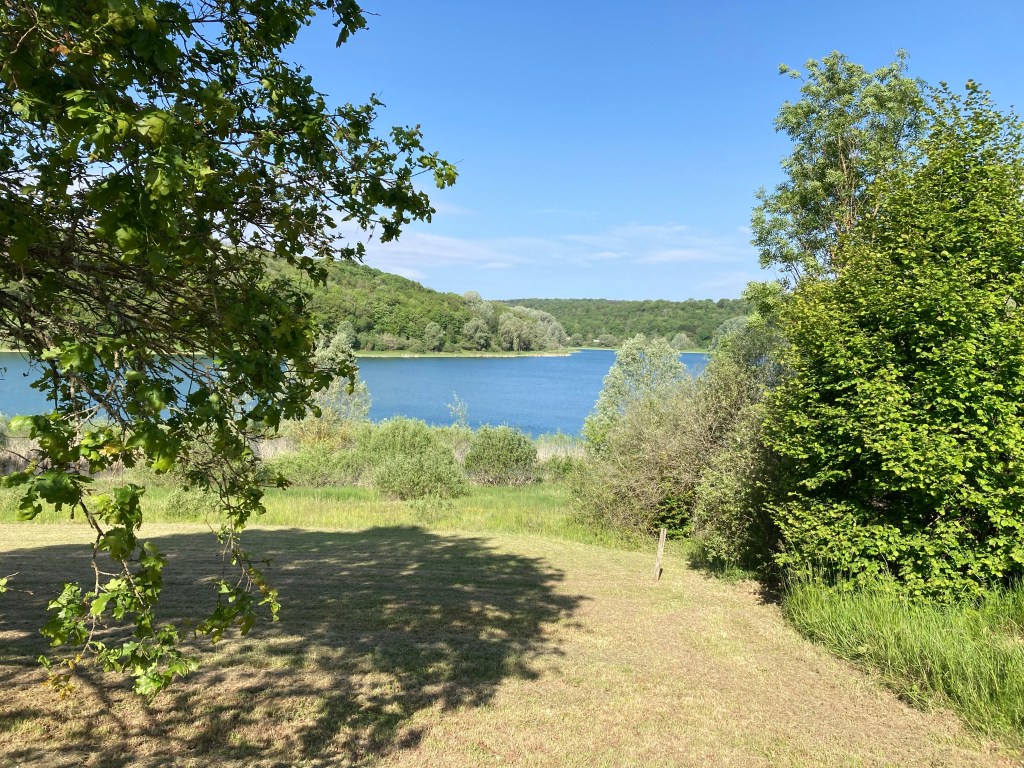
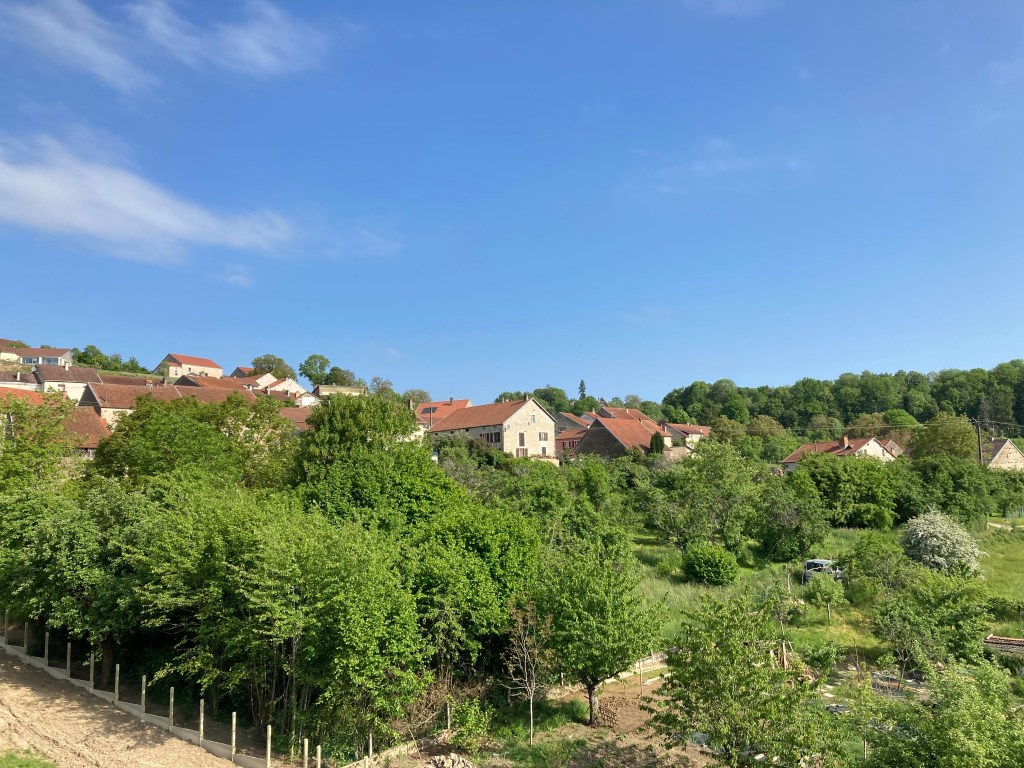
At the start of the climb from River La Mouche
To our accommodation at top of the hill in Saint-Ciergues

From Saint-Ciergues down to the Reservoir La Mouche, which supplies drinking water to the surrounding districts and up the next rise, the views are just as breath-taking.

I have seven photos taken from this spot alone🙄

Fortunately, from Saint-Ciergues to the walled city of Langres is a very short walk, but its’ picture-postcard appeal slows down our progress considerably by forcing yours truly to stop every few steps (how else is she going to share all this with you?).

Western gateway to the walled city of Langres

A final heart-stopping climb (mercifully short) brings you to the magnificent city of Langres, with three and a half kilometres of ramparts, opening out with 7 gates, one of them from the first century BC.

Remains of the Roman gates, first century BC

Its’ cathedral roof is like nothing we have ever seen in the hundreds of buildings we have photographed over the years, on our more than one thousand kilometres of pilgrim walks in France.

Unusual tile roofing

French fellow-walker, the extremely erudite J, explains it is a kind of tile roofing common in Bourgogne/Burgundy.

In Langres, we are indeed at the cross-roads. We are still in Champagne but edging into Bourgogne. Over the last few days the vineyards have given way to dairy farms – Fromage Langres is on the menu.
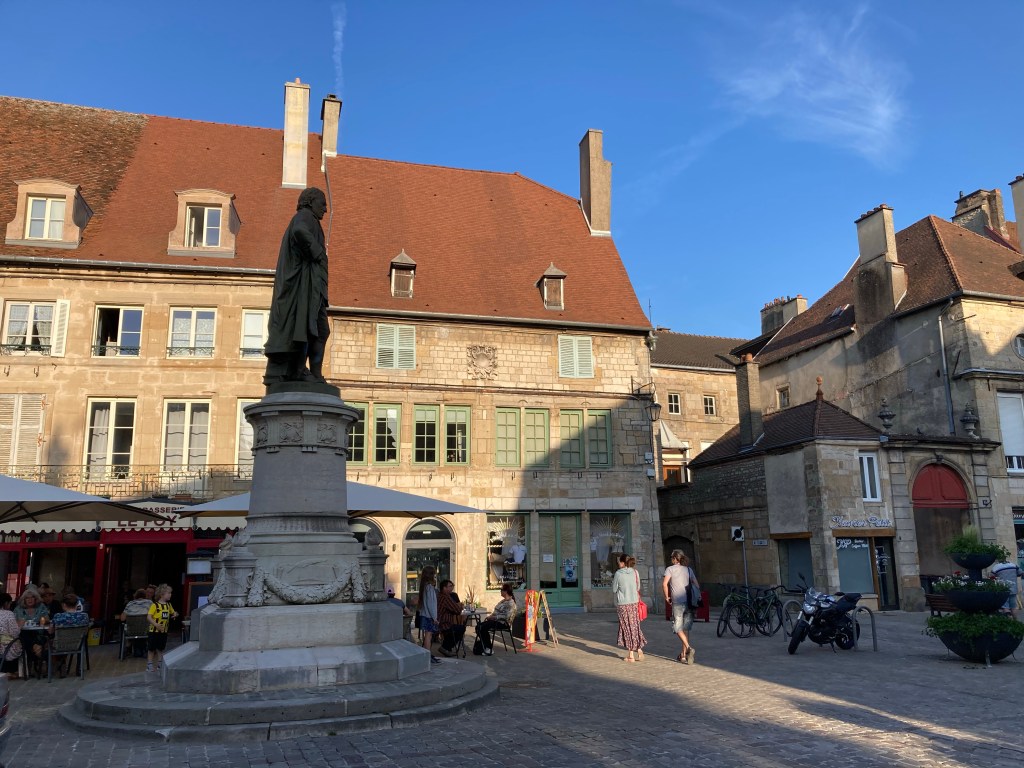
Diderot overlooking the main city square

The city is the birthplace of Diderot, one of the most radical 18th century philosophers, who argued vociferously against the church. His name everywhere, from streets to boulangeries. So J is a little mystified to find that the city has more than usual number of Catholic schools.

Most famously, the city contains the intersection of 12 Roman roads, some leading to that other destination of the modern pilgrim, Santiago de Compostela.

For a week now, roads to Santiago have crossed our path, tormenting me with a nostalgia for that past-perfect hike – reminding me of all the highs, the warmth, the laughter, tempting me to take one wrong turn and head for that other place – somewhere you have been before, a place that in your memory has become a comfort-zone.

But the Jura mountains, the mountains of the Jurassic times, are just ahead of us. You would not have walked 700 kilometres on a new road (well, new to you) to trade in the possibility of the new and the ‘might-be’ for what your mind has retrospectively remade as warm and fuzzy. As every hiker knows (or at least has to believe😊) the challenge of a climb, the surprise at every turn, the adrenaline when you reach the top, is the miracle that makes your water taste just as good as the finest wine!

Picture Perfect? Never quite…

Bubbly time thanks to Pat and Helene

Too much champagne is conducive to all sorts of good things: colour, beauty, fascination…. But not to the kind of clarity that is required for reporting correctly and sequentially about a walk.. So herewith just some images to bring you up-to-date in a summary manner, since that rainy post, which is now nearly ten days and 200 kilometres ago.

So lucky to catch the bird taking off!

Since that rain, we have walked in perfect weather – and how can weather be anything but perfect when it leads to a glass of champagne most afternoons? It is possible that the light takes on a special gentle glow after a half carafe of champagne (which I am forced to drink by myself in Chalon-en-Champagne as WB is a teetotaller) and there is a pot of gold at the end of the half-rainbow.

Chalon-en-Champagne

You have worked out by now that we are in, what most of us think of as, the Champagne Region. Officially, since 2016, it is part of the newly formed region of Grand Est, The average walker (and yours truly, Hurry Krishna, is so called, because she is definitely on the slow side) will probably spend 2 to 3 weeks in this region. At the point of writing this post, we are about two-thirds of our way through the Grand Est.

On the way to Vitry-le-Francois

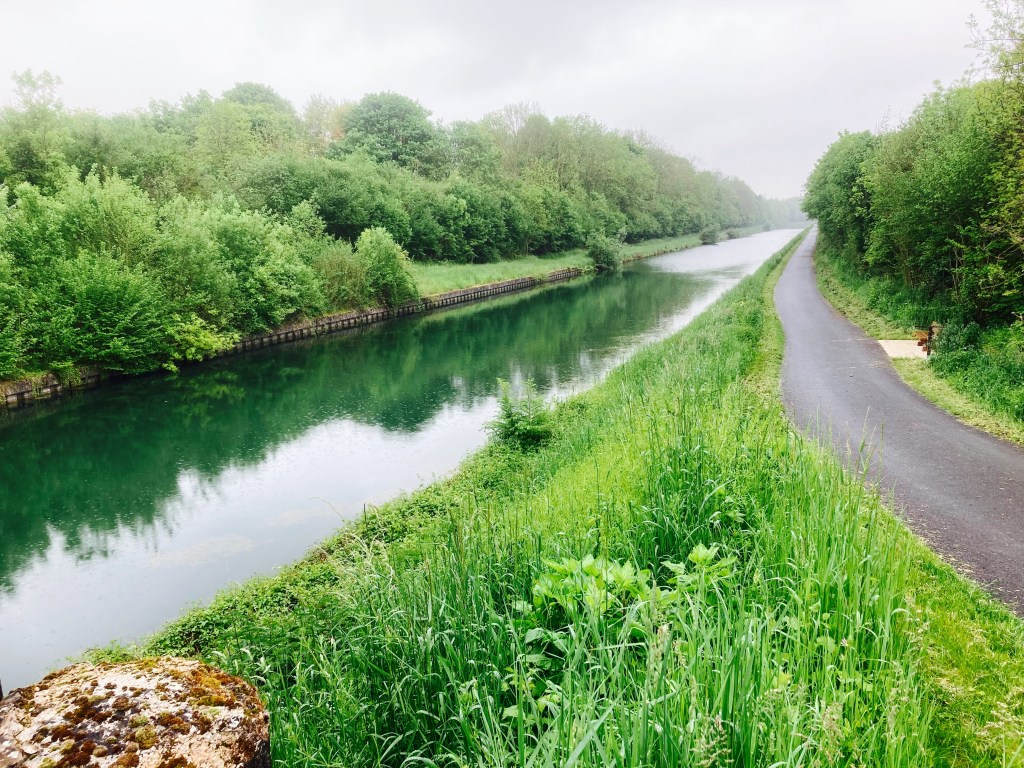
Some paths do leave you wondering whether long-distance hiking is a symptom of mental illness. But not here where Aisne, Marne and Aube rivers and their canals criss-cross your way. If you are like me, you will ignore the official route and spend three days walking along the tow-path of canals, some of it beautifully surfaced to serve as bicycle routes.

River through the trees – was it Marne?

At times you are caught between the canal on one side and the river shimmering through the trees on the other, and there is no way an i-phone camera (or even the best wide angle lense, if I had one or knew how to use it) will capture the whole perfect picture that your eyes can see in just that moment and then slide to the ghostly grey buildings on the other bank, without loosing the bigger picture painted in every shade of green, blue and white.

You are right, I took it in colour, but this is more how it felt…

Metres down the road, or may be the next day or the day after, or was it days in a row… white blossoms tumbled like cascades into the water below.

Taken somewhere along a waterway on 12 May

A single tiny bunch on a slender creeper climbing a tree provided a moment’s enchantment.

What flower is that?

The canals behind us, and just past the lovely town of Outines with its rather unique church, we are back amongst farms: lentils and barley mostly.

Outines: rare Church in ‘colombage’ style

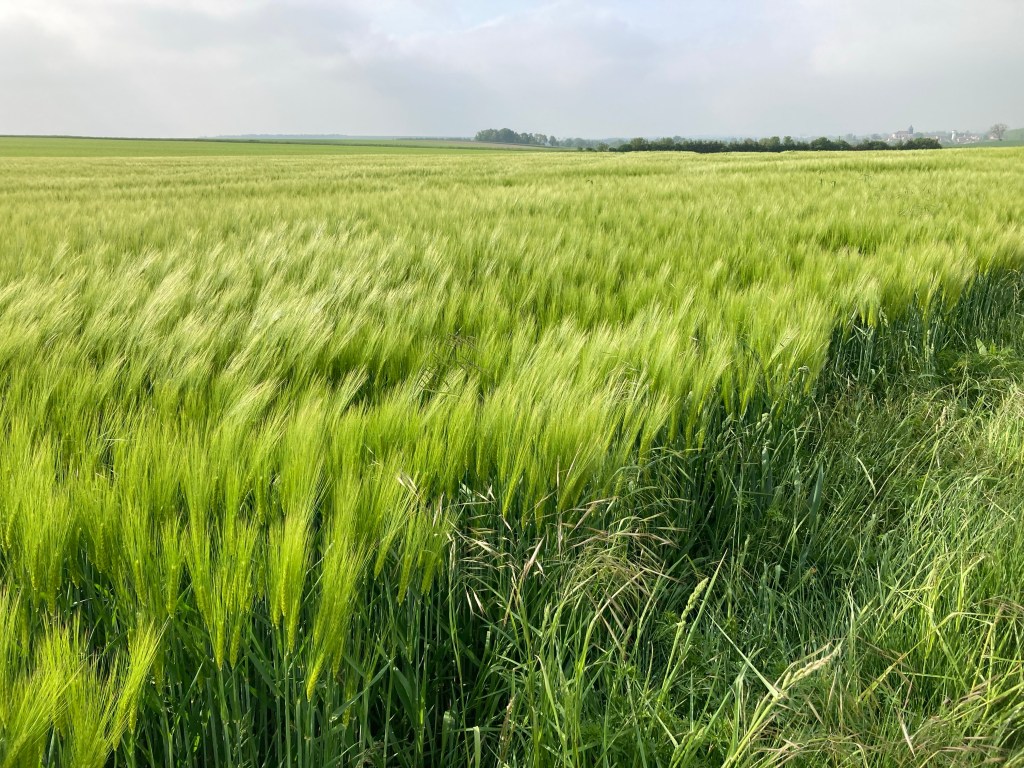
The high winds are turning the sheaves of barley into a green and gold waves.

Barley

Just as you are getting a little bored with the swaying barley, an elegant shape dances into view, skimming over the feathery plants. The silhouette of a leaping deer in the early afternoon sun disappears before I can get my camera. It rises again – closer now but faster, surfs across our line of vision and is gone.

It is perfect. But ‘picture perfect’ is such a lie. The moment of fascinaton necessarily escapes reproduction.

NB: For any fellow Bengali reading this: of course, the trope of the running deer as figure of enchantment, to be chased but never contained, is so well-known to us from the Sonar Horin song, as to be almost a cliche. And perhaps the song made that kind of deer sighting especially exciting. But for the record, I did not conjure it out of the song in a champagne fuelled haze. I know this, because Walking Buddy saw it too!

9 May 2023: Musing on a Very Wet Walk

One of the very few photos from a very wet day

This post is out of kilter for all sorts of reasons. I have failed to report on the whole business of moving from Hauts-de-France to the Champagne region. And there are relatively few photos to illustrate my rain-fed musings here as rain is not conducive to photo-taking.

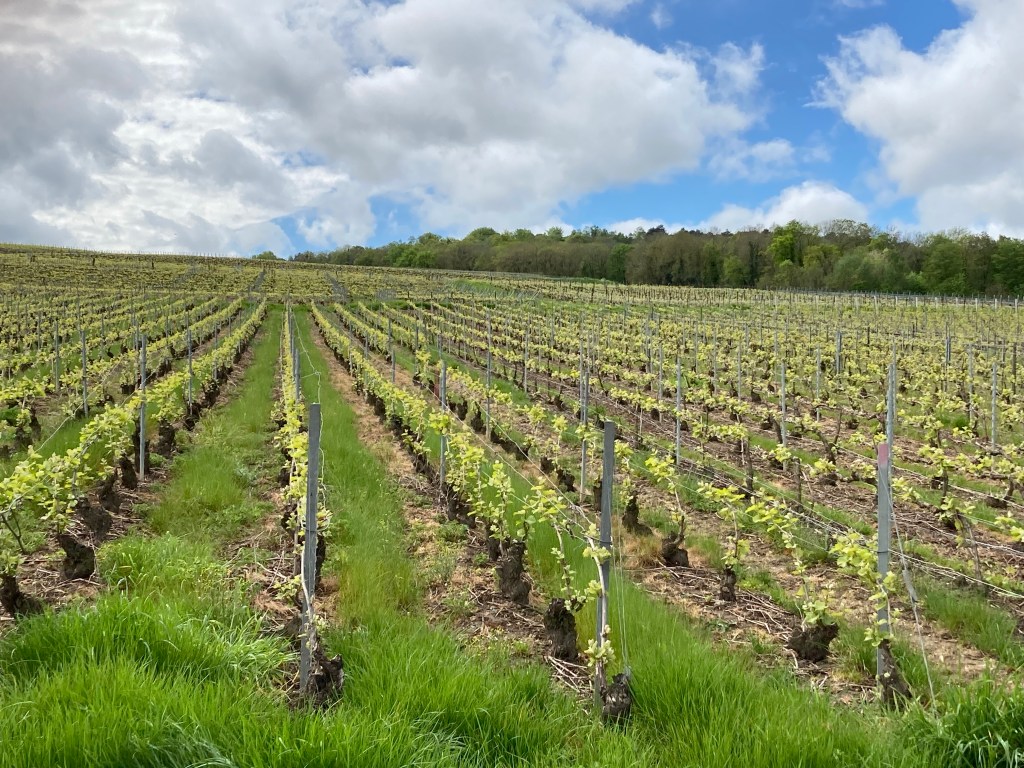
Vineyards as far as the eye can see: taken the day before the deluge

No doubt any mention of Champagne raises expectations of a good life and favourite quotes like ‘Too much of anything is bad, but too much champagne is just right.’ (Variously attributed to Mark Twain and Scott Fitzgerald by Google – hope someone will tell me who, if any famous writer, did really say that or has it been manufactured by some Ad agency?)

But all that will have to wait. Because I suddenly find myself with a possible answer to THE question, the one that every long distance walker is asked by friends, family and well-wishers: WHY? Why do you do this?

9 May was wet – seriously wet in the Marne department of North-Eastern France. A small group of walkers, six to be precise, found shelter for the night in the one gite in Conde-sur-Marne. Others (at least two) walked nearly 40 kms to the bigger town Chalon en Champagne, and at least one resorted to wild camping in wild weather.

Follow Mick for wild-camping and Palestine

I staggered into our gite at 3 pm, with what seemed to be half the soil of the district clinging to my boots. Then gratefully collapsed in front of a wood-fire heater with a huge warm cup of coffee. Everyone had sodden boots. Some had achy knees. But every one of the six people would be out on the road again the next day, walking 20 kilometres or more. It was just the kind of night to pop the question: why?

I remember asking the same question at the end of a long and sweltering day on another long walk in France. The question always elicits interesting, and perhaps seasonally variable answers.

Follow Phil and Mark on FB

Some walkers currently hiking the VF have a clear purpose: a life-long unionist is walking to raise awareness about Palestine; two life-long friends are walking to raise funds for ovarian cancer care – both their mothers (and mine, too) died of the disease. Fantastic projects.

But there is something wider, bigger, less tangible, in all these contemporary footfalls along old routes – perhaps something poetic which may be gleaned without necessarily being entirely comprehensible, understood in the ordinary sense.

In the first ever published essay dedicated explicitly and entirely to ‘Walking’ (The Atlantic, 1862), the naturalist philosopher, Henry David Thoreau associated the pleasure of walking with the love of nature and explicitly eschewed ‘roads’, writing ‘I do not travel in them (roads) much, … , because I am not in a hurry to get to any tavern or grocery or livery-stable or depot to which they lead.’

For those of us walking the Via Francigena, there is no real distinction between walking in woods and walking to get somewhere – indeed we are in a sense always walking to the next tavern and grocery – along the way we might just get hours in the forests, or on river banks, or on roads of the kind that Thoreau dismissed as being designed for horses! And we are, of course, going vastly longer distances than those Thoreau saw rushing down the street for a beer, indeed mostly quite a bit longer than Thoreau’s own four-hour daily walk in the woods. I wonder too if this Grand Old Man of Walking ever walked in pouring rain and then got up in the morning and slipped his feet into soggy boots to set off again.

I have, doubtless, said in earlier posts, when things confound, Bengalis turn to Tagore. And this rainy day on which I am bogged down to a slow crawl just happens to be Tagore’s birthday, the 25th day of Baishakh on the Bengali calendar, which this year falls on 9 May. Tagore’s birthday is an occasion for mass cultural festivities and a public holiday, in both Indian West Bengal and Bangladesh.

Bengalis expect rain in the month of Baishakh – it is monsoon now all over Bengal and the time of the deadly ‘baishakh storms’, কাল বৈশাখী.

Long walks are often introspective. Lots of rainy days and drizzly songs play on my mind as I trudge, eyes strained on slippery ground. Somewhere along the way, a gust of wind fetches up these song lines of childhood.

আমাদের খেপিয়ে বেড়ায় যে কোথায় লুকিয়ে থাকে রে?।
ছুটল বেগে ফাগুন হাওয়া কোন্‌ খ্যাপামির নেশায় পাওয়া,
ঘূর্ণা হাওয়ায় ঘুরিয়ে দিল সূর্যতারাকে ॥
কোন্‌ খ্যাপামির তালে নাচে পাগল সাগর-নীর।
সেই তালে যে পা ফেলে যাই, রইতে নারি স্থির।
চল্‌ রে সোজা, ফেল্‌ রে বোঝা, রেখে দে তোর রাস্তা-খোঁজা,
চলার বেগে পায়ের তলায় রাস্তা জেগেছে ॥

In my inadequate English, it might go something like this:

Who goads us this way, hiding away?
Like the wind that blows where madness grows,
A whirlwind sends the sun and stars astray. Crazed rhythms set oceans dancing.
Our steps match the beat, we cannot stay still. Walk on ahead, let go the burden, forget about finding the street, Our strides awaken the way beneath the feet.

Of course, this is neither a logical nor a full explanation of why so many of us, from so many different places on earth are walking a thousand miles or more through inclement weather and variable terrain. And I am pretty sure that Tagore did not intend to explain long-distance hiking! But as I am sloshing through the mud, rain obscuring my view, I can sense the mad magic that is made by footfall on the path, any path, almost regardless of place and surroundings. And magic can’t be explained, it can only be felt.

Marching Into Reims

As it turned out, the march to Rheims was nothing but a holiday excursion:…’. So wrote Mark Twain of Joan of Arc’s march into Reims, a bit unlikely as Joan was marching at the head several thousand armed men in July 1429.

The line does, however, describe entirely accurately our leisurely walk out of the Hauts-de-France region into Reims, at the heart of the Champagne district’s (more correctly in current official parlance, the Marne Department of the Grand Est Province) and the 12th largest city in France. It is also the largest city we traverse on our entire 1200 km hike on GR 145 from England, through France and Switzerland.

Black Madonna, Laon

Laon’s grand Cathedral waves the the modern pilgrim off with images of some ‘kickass women’ including Saint Teresa of Calcutta (better known as Mother Teresa) and a Black Madonna.

Black Madonna have colourful histories (puns not intended). They were often seen by medieval populations as immensely powerful, and of course, like all representations of female power, highly suspect. Laon’s original Black Madonna was destroyed in the French revolution. The current version, a relatively placid looking figure, was installed as far as I can tell, in the mid-19th century.

Just outside the Laon city walls, you can tumble down through narrow back alleys, between houses. Do you remember how it felt to run down a slippery slide when you were at primary school – rather than sit and slide like the good kids? Well that’s how it felt, except that as Leonard Cohen puts it, these days ‘I ache in the places I used to play’.

Knees notwithstanding, the sliding reduced the distance to Corbeny (our final stage in Hauts-de-France) by nearly 3 kms, to a more manageable 27 km, though we probably missed some stunning views reported by walkers who take the prescribed route out from Laon.

Chemin du Roi

A tedious 6 km on the edge of a road, then a long straight Chemin du Roi (King’s Road) through woods, and another tedious climb on a sealed road brought us to Corbeny and a perfect pilgrim accommodation, on Rue de Dames – a road built to facilitate women travelling for assignations with kings.

Champagne – vineyard

Following morning, we crossed River Ainse and entered the Champagne district.

It might be more apt to say that Champagne slowly dawned on us. First, a welcoming little epicerie in the tiny town of Cormicy, open just at the right time. And minutes later our first view of the acres and acres of grape vines.

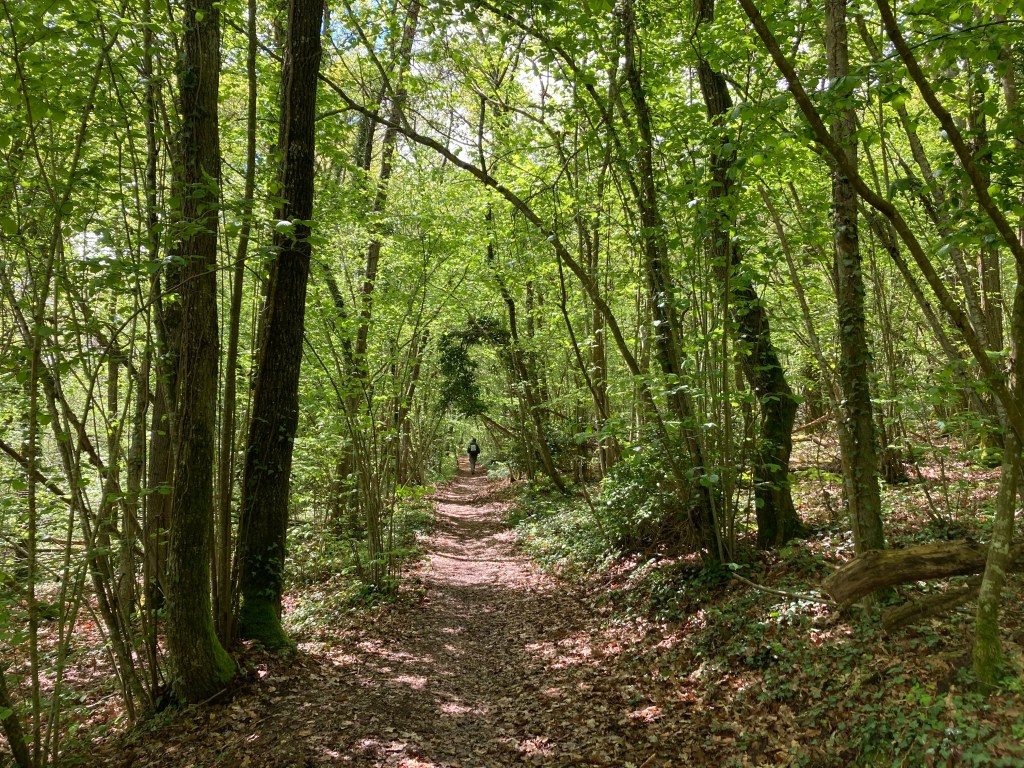
The dappled champagne light

Two more days of walking between vineyards, forests and along canals brought us to Reims.

Sunny Saturday in the buzzing city of Reims

After nearly a month of mostly tiny towns and villages, it was exciting to be in a great city built around opulent squares, historic buildings and brimming wth tourist attractions. So we took a day off walking, hoping to indulge in some cultural tourism.

But, but but… it is Sunday, it is rainy, and as Monday is VE Day National Holiday in France, almost everyone has shut shop and gone off for a long weekend to Greece 🙄 Yes, the excellent English speaking staff of the expensive hotel might just be able to find a Champagne tour which though exorbitant includes several complimentary bottles of the stuff… but stop! Walking Buddy is a teetotaller. Estimates of how much champagne one person can drink in a day or carry in her rucksack the next morning were not promising.

Reims city square

Reims, and indeed the region more broadly has much to attract the tourist generally and the walker specifically. But May might not be the best month to walk in any part of France. For the record, there are 14 days of prescribed national holidays in France, including the Christmas and New Year period. The remainder of the year has 11 National Days, of which 4 are in May. Every weekend in May is thus a long weekend and most things, including most eateries, are closed.

Chagall windows

Sunday, 7 May, there is nothing to do, but ponder on the famous UNESCO world-heritage listed Cathedral Notre Dame of Reims, where the Kings of France used to be crowned and whose biggest current tourist attraction seems to be the stained glass window designed by artist Marc Chagall.

The most famous name associated with this Cathedral is however Joan of Arc, who saved Reims from being razed by the English army.

A statue (from the 1850s) of a young woman on a horse, her sword unsheathed, graces the front of the cathedral. Her eyes are wide open, and I imagine, blazing.

Joan of Arc, Reims: Girl Power?

Joan was tried and burnt for heresy, aged 19. The key evidence against her was that she dressed in male clothes!! At her captors’ insistence she agreed to wear what the church regarded as proper women’s clothing. But later the judges visiting her cell found her again in her habitual soldiering gear. When challenged, she supposedly told them “It is both more seemly and proper to dress like this when surrounded by men, than wearing a woman’s clothes.”

Inside the Reims Cathedral, the 1902 marble and bronze figure of Joan is clearly in female clothing. She has been ‘frocked,’ she has been muted. In sainthood, she has been denied her choice of clothing. The up-turned eyes of the girl on the horse are now closed in surrender.

The young village girl who was cross-dressing and slaying bad guys long before Buffy the Vampire Slayer was imagined, who should have been the Patron Saint of Girl Power, has been re-cast as good little Saint Joan to be accommodated inside the constraints of the Catholic Church.

Saint Joan

On a day with little to do, Reims is a good place to think about how a defiant girl might be disciplined, punished and beatified – all to put her in her place as a woman.

A Mothers’ Day post about defiant women one meets on the VF

300 kms: Long Way to Walk for Foie Gras?

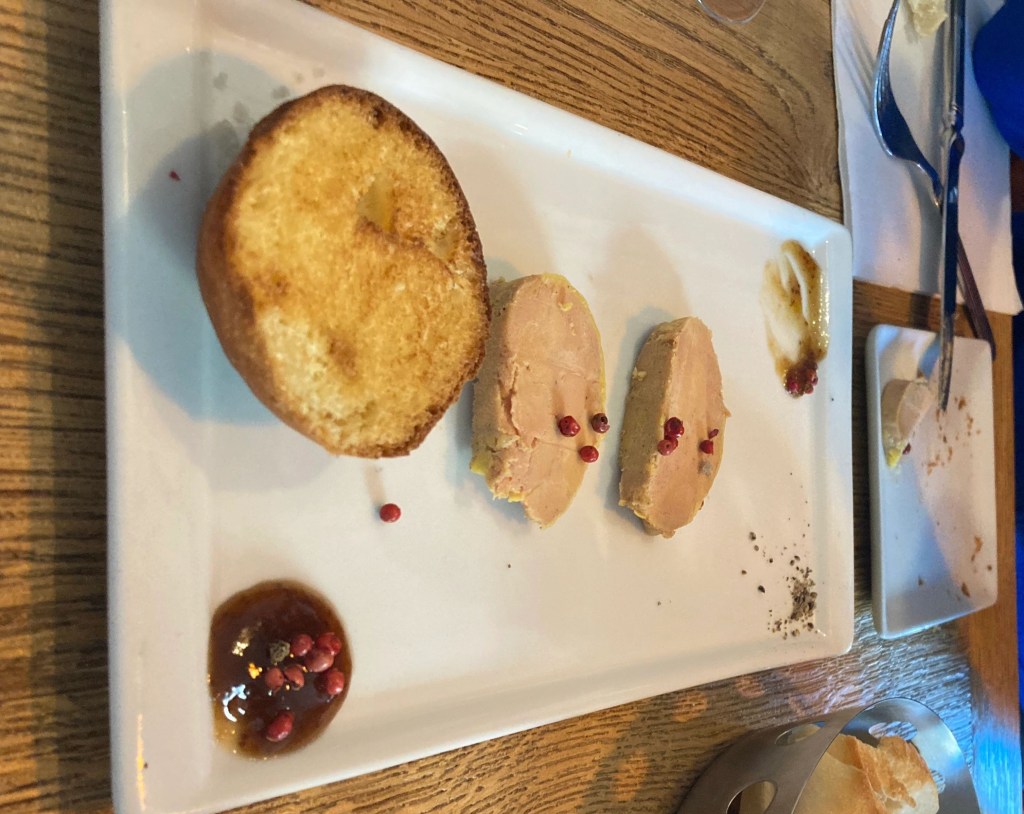
Foie Gras in Laon, WB has already eaten his share!

If you have been to Paris or travelled in the many tourist destinations around France, you probably would not believe that there are culinary deserts in some parts of this country, where you might be grateful at the end of a 20 km hike, for the micro-wave ready curry (which has been slowly defrosting in your ruck-sack all day); because a few nights before, dinner was boiled egg and bread kindly provided by your rural gîte host..

Some of the tiny settlements along the path we have been walking through Hauts-de-France have no shops of any description. Even in middle sized towns, like Tergnier, which you reach across vast railway yards and streets lined with blocks of flats, eateries are an unenticing string of pizzeria and friterie along a busy highway.

Railway tracks around Tergnier

In smaller places you can have the strangest conversations with Google’s translation services. Here I quote the end of an sms exchange between Walking Buddy and very kind Air B&B Host at Bertaucourt (village of maybe two dozen houses, a little off the VF track):

Host: No food here. No shop.

WB: Can you perhaps leave some bread and cheese in the house?

Host: Because I already went to the races yesterday. Cannot go today. (WB can find no adequate way to respond to that)

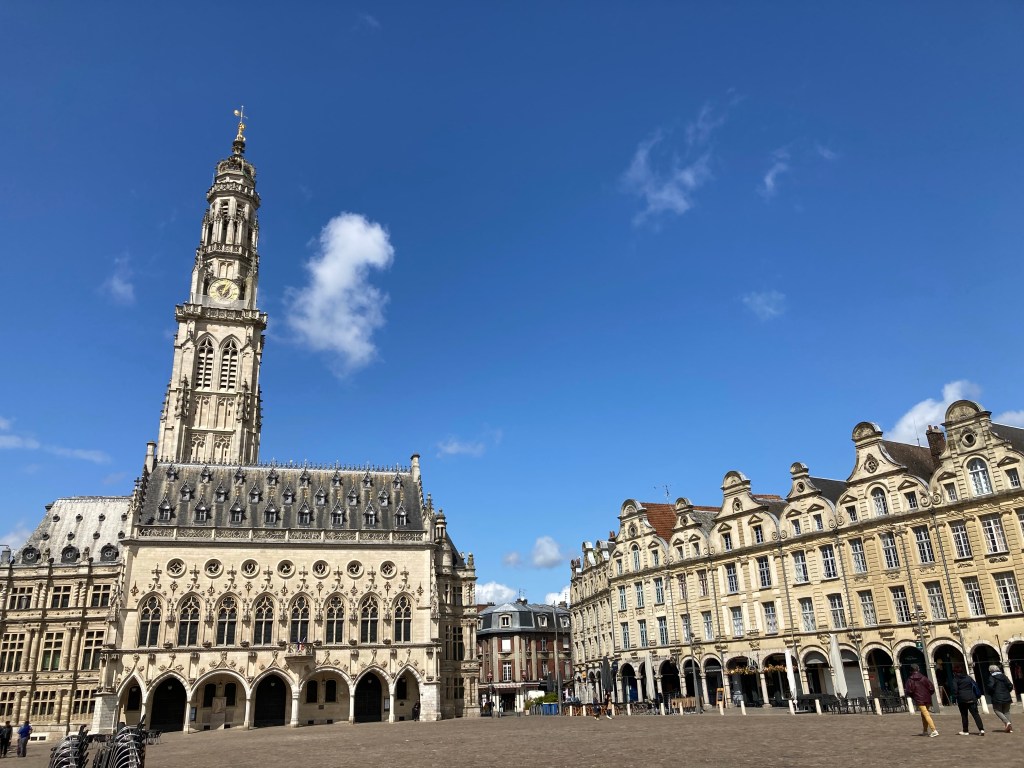
Even in the more touristy places, like Arras, with its historic churches and city squares, the daily rhythm of the walker is often out of kilter with that of cafes and restaurants. Walkers often want their breakfast unseasonably early and dinner unfashionably so. And when they walk into town in mid-afternoon every reasonable cafe owner is having a little break between the lunch and dinner crowds.

Arras town square

That said, it does appear that there is a little bit of a problem with food in Pas-de-Calais, the westernmost province (department) of the Hauts-de-France region, where the first quarter of the French VF lies.

At the tourist office in Arras. I asked the lovely young woman with fluent English, what we should sample as local food. ‘Hmmm’, she said, and ‘aahhh’ after much metaphoric hand-ringing. She comes from an area further to the south and clearly does not want to say anything negative. Eventually she says ‘well, this area has a lot of chips and also some local beers.’

We have been walking between potato and canola farms for two weeks or more and some super-markets in this area stock more varieties of potatoes than pretty much all green vegetables put together. For environmental reasons one should indeed eat locally grown foods, so chips make good sense. And, way back when, this area was ruled by the English for over 200 years. And that is all I am saying about food in Pas-de-Calais Department of Haute de France.

Gateway to Laon, Aisne department in Hauts-de-France

We had walked a little over 300 kms from Canterbury when we panted up the final 100 metre ascent into the medieval walled city of Laon. The Cathedral was built to strike awe and from the top of the town the surrounding plane is astonishingly lovely. It is, however, May Day and 3 p.m – only fools and foreigners would want to eat at this hour. Fortunately, the gourmet eatery, just across the Cathedral square will open at 7 and yes they can fit us in!

Cathedral Notre Dame: with dinner over a long May sunset

Really, one should walk a long way before eating Foie Gras – there are 462 calories in every hundred grams of the stuff and then there is the burden of sin from eating food with a dubious history of animal cruelty which demands additional self-flagellation.

The chicken mousse amuse-bouche goes before I can take my camera out. Followed by Fois Gras which WB has been praying for since we landed in Calais off a stormy sea. Then the ‘local speciality’ ‘rabbit sausage’ for WB and ‘pour Madame?’ They can recommend the dish always popular with English tourists, ‘duke with o-hwr-aange’.

Half-eaten, so you can’t see how pretty it all looked!

As April turns to May, the ground underfoot is firmer. With days so long, it is less daunting to take on longer distances.

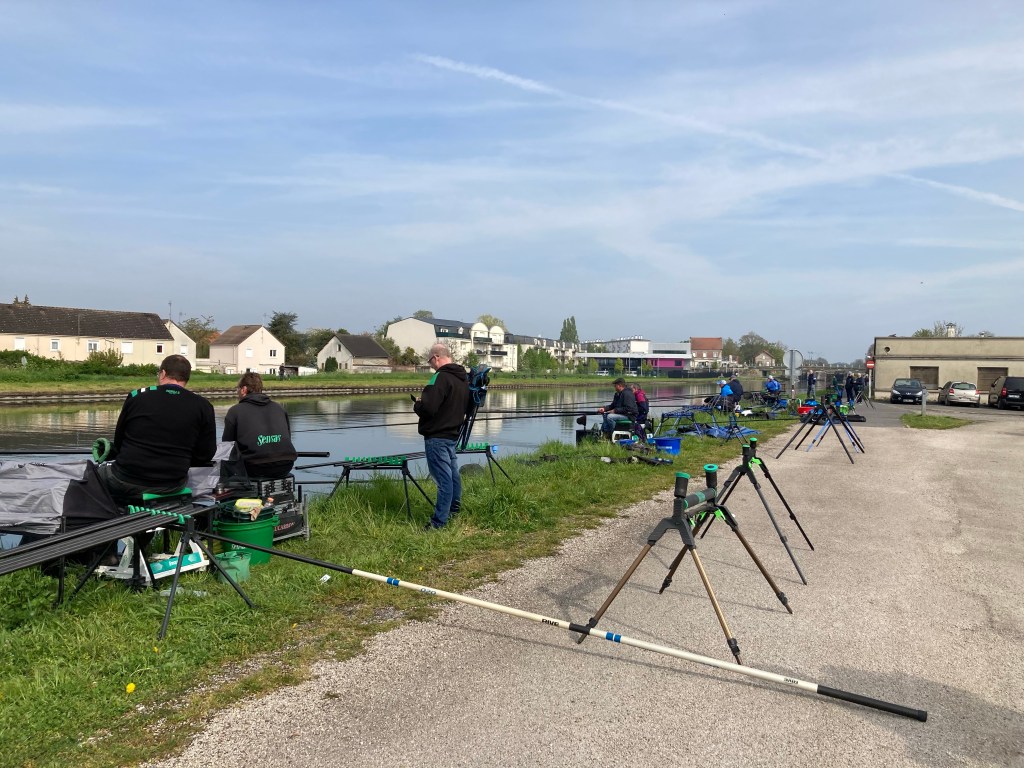
The topography is changing too. Past Peronne on the north-east corner of Department Somme, the surroundings have mellowed, with rivers and canals criss-crossing the way, some of which runs through pretty parklands. Sunday in mid-spring has brought fishermen out in droves, and yes, they are ALL men – with fishing rods longer than I ever imagined!

Walking into Laon was an up and down affair, with hillocks rounding out the harsh flat horizon we have been chasing for the previous 250 kms since Wissant. The foie gras has soothed the hungry spirit, and no doubt given us wings to take on our first 30km day tomorrow.

WB’s French is improving by leaps and bounds: he has stopped introducing me as his Mary or Mairie or Mari in turn. But I still cannot tell the difference between ferme and a ferm, which is a bit problematic when trying to book accommodation, when the only place within a cooee (in Australian parlance) is a farm gite, firmly shut since COVID killed off the trickle of tourists passing through the village…

NB: the title of this blog is inspired by Brian Mooney’s book about the Via Francigena, A long way to walk for a Pizza

Bruay to Bapaume around ANZAC Day

But many men are falling / where you promised to stand guard’ Leonard Cohen.

As someone who came to adulthood in post-colonial India, I have never quite understood what ANZAC Day is all about. Those unfamiliar with things Australian might want to think of it as a national day, its origins embedded in the disastrous defeat of the allied forces, including a large Australian contingent, at the hands of the Ottoman army during the First World War (you can google for more – lots more, including recipes for lamb and biscuits and, no, I am not kidding.)

They say the ‘Camino provides’ – the path you walk gives you what you need, or perhaps what you deserve?

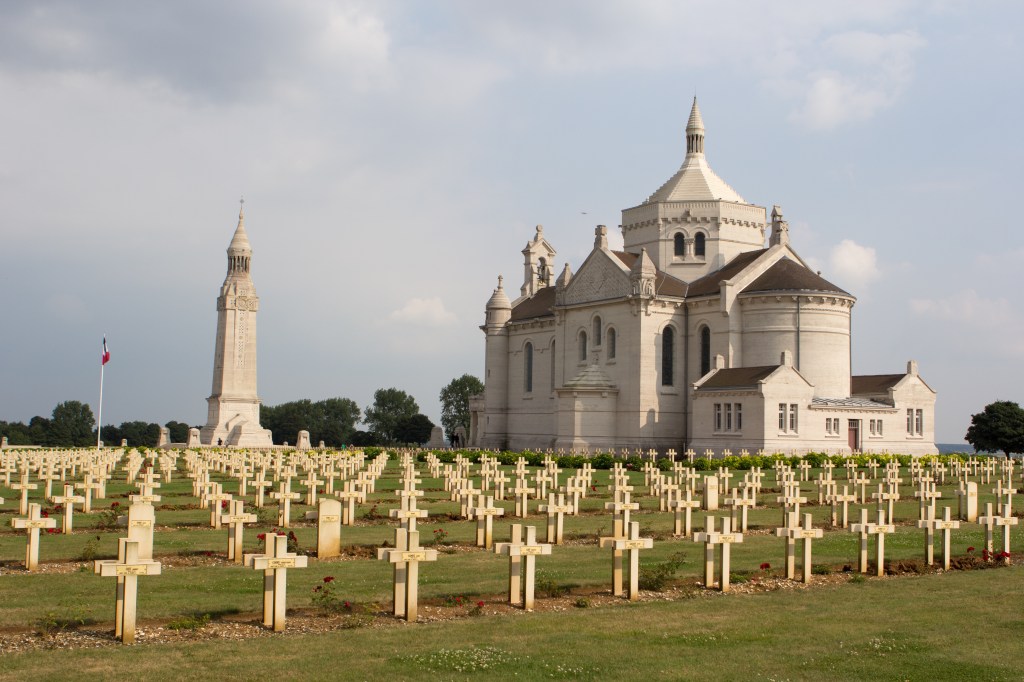
Unlike many Australians visiting France at this time, we did not consider the 25th of April in any special way in our planning. Quite unbidden, however, our path brings us to the edge of the largest French military cemetery, Notre Dame de Lorette, two days before ANZAC Day. This place holds the remains of tens of thousands of French soldiers.

Necropole

From the Necropole Notre Dame de Lorette, a boulevard runs two kilometres, to our night’s destination in Souchez. Its wide footpath is posted with images of devastation wrought in this region by the First World War. On the way in and again on the way out of Souchez heading towards Arras, you can see allied flags fluttering on the horizon, including Australian and New Zealand ones marking the graveyards that dot the area through which we re walking.

Bicycles, in memory of Francois Faber, won Tour de France 1909, ‘died for France’ 1915

On ANZAC eve, about half-way along our way to Arras, at Mont St. Elloi, we ran into Australians for the first time in 200 kms. They are driving around, and on their way to the ANZAC Day celebrations at Villers-Bretonneux – another place where young Australians fought and died a long way from their island home. In Arras, the very next day, we meet our second Aussie, sitting on a bench along the path that leads the walkers out of the city. He tells us he has just been to the ceremony at Villers-Bretonneux.

Far away from the battle fields, way down under in Australia, the war has always felt to me more like a tall tale: at best a myth to manufacture nationalism for a colony of white settlers, on an island, whose security is never seriously threatened by foreign powers scrapping over Europe.

Arras Cathedral after WWI

But all across the north of France, the land is pock-marked with war. Some days we have counted more war memorials than people in the tiny settlements between farms.

Arras Cathedral today

In Arras, a historic town with its roots going back to the Iron Age, every significant building has been re-built after either the first or the second World War or both. Around its over-large cathedral, severely damaged in 1917 there are memorials to the many distant nations who sent men (yes, mostly men) to die for and rebuild France – even the Chinese.

Arras, plaque for Chinese war-dead in France

I don’t know enough history to comprehend this. The Indian soldiers, I guess, were dragooned here by their British colonial masters, but what were the Chinese doing here so far from home? (Though not quite as far as the Australians!)

220 km from ‘Cant orbery’

On our way from Arras to Bapaume, where a tiny shelter measures the distance to ‘Cant orbery’ we met Dominic, the volunteer whose job it is to maintain this part of the track. Through his broken English and my Walking Buddy’s fractured French, Dominic none-the-less worked out that we have come from Australia and insisted on showing us the ‘Australian trench’. To the untrained eye, the trench looks just like a hole in the bush. And in a sense, it really does not matter whether or not it really ever was a trench – it’s a story that connects, allows for a moment’s camaraderie, even where language has mostly failed.

In Bapaume, a minute’s walk from the VF stands a beautifully maintained Australian cemetery.

Bapaume- Australian war cemetery

On ANZAC DAY, a fellow Aussie had left a message for his grandfather who died in the war.

Personal messages across grenerations

India’s English rulers thankfully did not regard Bengalis as a martial race. So I have no direct experience of loosing someone important in a war. The ANZAC mythology continues to be no more meaningful to me than any other story of poor judgement and foreign military adventurism. But the common human condition of futile loss to wars is made concrete here in the acres of graves we have walked past and will continue to walk past in the next week or two.

If the Camino provides – perhaps in this instance, it provides me the opportunity to feel empathy, even if the meaning of it all still eludes my grasp.

For hiker, pilgrim, blogger Joanne who is on a ‘Bloody Long Walk’ through the war graves with her own questions.

Back on Track: Wisques to Bruay

In response to my last post, a wise reader suggested that one ought not to compare lovers. VF is your new companion, she said, ‘give it time, let it grow on you’ – something like that.

Map: way from Wisques

Armed with good advice and back on track in Wisques, we have averaged about 20 kms a day over the last 3 days to Bruay-la-Buissiere. No one claims that these sections of the VF in Northern France are especially handsome. But we met some wonderful fellow-walkers in Wisques and somehow time and season have fallen into place, making the days pleasant.

The path here passes through suburbs, manicured parklands, farms and patches of woodland. Spring has started garlanding the ground with sprays of yellow and white and sprinkles of blue and pink (too tiny for my camera) so that even the grey tarmac roads which are hard on your feet, are gentle on the eye. In the new holiday suburbs, it is the upstart tulips and trees grafted by human hands that demand attention.

Pink and white blossoms on one tree!

My sharp-eyed companion has spied several rabbits, one hare and even I could see the three deers darting along a ridge above our path. A big bird, something like a pheasant, clattered right into us, surprising all involved,

For days now, the clouds have held sway over the sky. The sun is soft when it winks out for brief intervals. The wind is silent one day and playful the next. Dire predictions of rain and storm from my pessimistic weather app have not come to pass.

But it is not always pretty – what relationship is? Northern France was devastated by two world wars. Already I have seen more grave yards and war memorials than I can remember anywhere else.

Terril: remains from coal mines near Bruay-la-Buissiere

In an area where coal was key to post-war recovery, the detritus of mining, closed down late last century, is part of the landscape. The tyre-churned boggy paths in the woodlands are tedious to walk through. And we have days, perhaps two weeks ahead of us, of walking on sealed roads, designed for cars, not foot-fall.

So yes, I am still apprehensive. But in the parks and the less curated woods, spring is in the air and bird-calls compete with, and occasionally drown out the sound of electric saws on one side and cars on the other.

With a little help from good weather, the VF has been a considerate companion, showing us bits of modern rural France, that are rarely captured through car windows, and never found on must-do tourist lists.

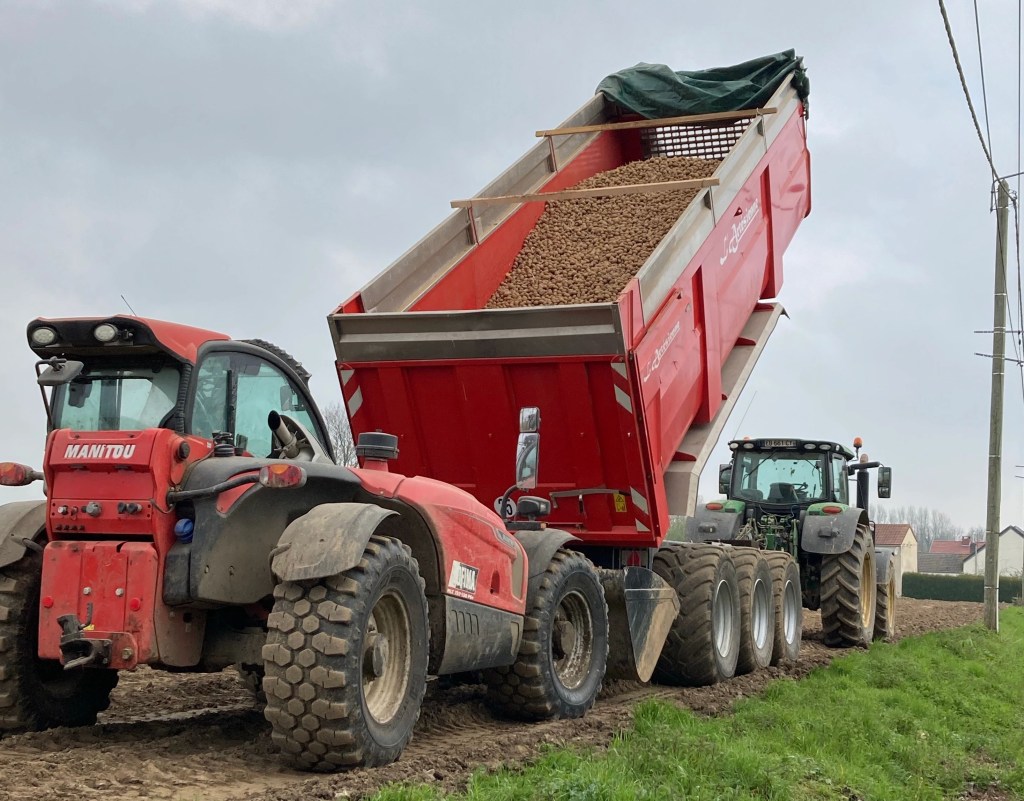
Is this the season for sowing potatoes?

So for the moment we are staying the course with all the hopes and fears of travellers on a road less travelled.

On French Soil Assailed by Doubts

Calais, church fence

If this was an academic essay, I would start thus: there is so much inefficiency in the bipedal mode of transport in the modern era, that the author now believes walking to be a fool’s errand! But doubts are part of the course on any long journey, so let me start at the start.

Notre Dame, Calais

In France the Via Francigena starts at Notre Dame in the centre of the port city of Calais. From here you walk towards the coast, across the canal, then ramble through a bit of suburbia to a concrete promenade which hovers over the beach following the coast line pretty much all the way to Wissant.

The coastal route GR 120, with its startling views of the ‘white cliffs of Dover’ across the channel on a clear day, is as comfortable as hiking gets – flat and with photo opportunities galore.

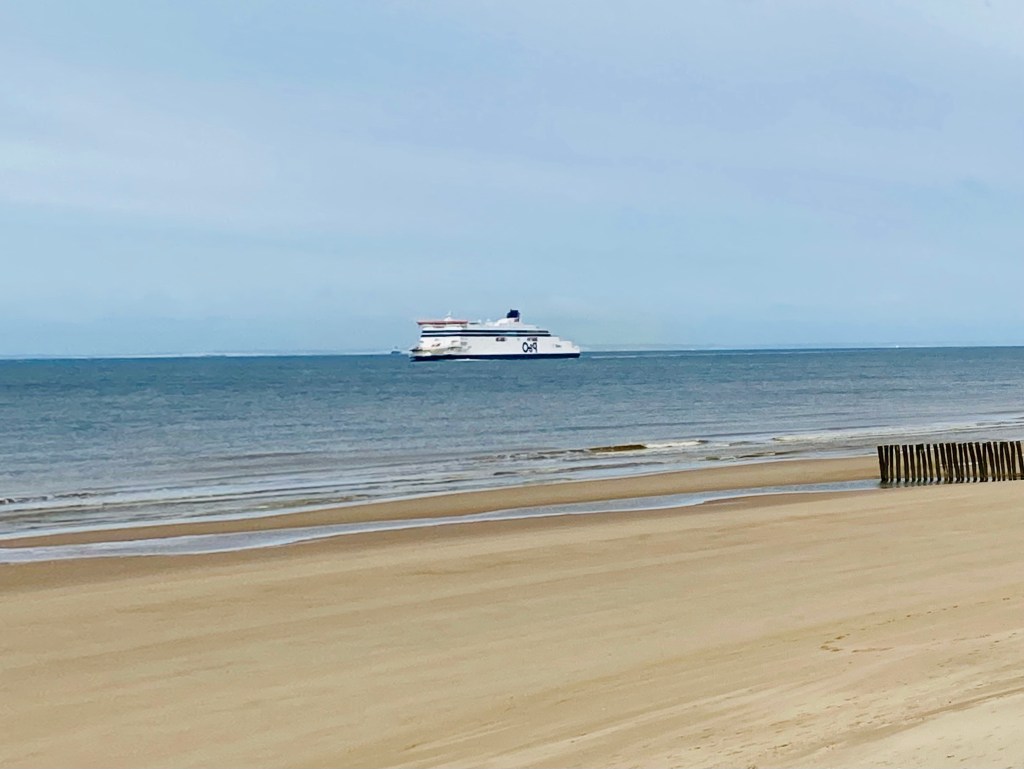
Ferry boat crossing Channel from Dover

GR 145, which cuts back from the coast line, before re-joining it at the Dover Patrol Monument, is slightly longer and a tad uphill. So I grumble when my meticulous Walking Buddy insists on taking the official VF. Doesn’t he know all roads lead to Rome? On the other hand, this venture is all about the road, and not at all about Rome, I am eventually forced to concede.

Despite that small Hill Difficulty (which I mention only to show off my familiarity with the English classic Pilgrim’s Progress and not to impugn my Walking Buddy, who happens to belong to a certain Hill clan), the day is as good as walking gets, easy and beautiful.

Wissant is a lovely little sea-side resort, with a Friday night market in the village square, selling local produce. Someone has decked out the church with the little white blossoms we have been admiring along the way.

Church, Wissant

The walk into Wissant, and even more the way out of it to Guines, is marked with remnants of war, both medieval and modern, some memorialised officially and others turned into sites for protest.

On the beach, along the way into Wissant

Day 2, the walk to Guines, starts with the anticipation of meeting Micheline at Mont du Couple, making real a Facebook virtual friendship. The track is uninspiring, but not unpleasant.

At Landrethun-le-Nord, after farewelling Micheline, we go against her advice and the official VF to follow an alternative map which seems to be more direct, though with some sections on a D road. Our final 4 kms into Guines, turn out to be on the edges of a highway with cars screaming past every minute.

Perhaps there is a benefit in the getting of self-knowledge: I HATE walking where cars abound but I never again wish to pay with my fragile sanity for confirmation of this knowledge😑

Information from other pilgrims that the official VF path into Guines is uninspiring only adds to my anxiety. Just four days into the walk, the VF is wearying, different, alien. It’s not like the South West Coast Path in UK, which I remember as exciting and challenging. Unlike the Camino, the folks in track towns don’t cheer the walkers on. So what will keep me walking this road, I wonder.

We decide to go off the track for a couple of days to Saint-Omer, to see one of Europe’s oldest libraries. A free bus takes us back to Calais in 35 minutes – the distance that we covered on foot in two days, and which cost us two nights of accommodation and food. Then a half hour in the train and we are in Saint-Omer.

Walking seems completely illogical in a place where transport is easy, cheap and even from an environmental point of view, the marginal cost in greenhouse gas-generating fuel per passenger, is negligible.

Saint-Omer is a sweet old town, with gourmet eateries and historic monuments. It would be so easy to stay for a bit, then move to some place where curated tourist fodder is more readily at hand.

But for now, we are committed to getting back on track tomorrow, a very short walk into Wisques will bring us back to the Via Francigena.

When in doubt the Believers turn to God. For Bengalis there is always রবি ঠাকুর (Tagore to the rest of the world, but almost a deity to us).

“ওগো পায়ে চলার পথ, অনেক কালের অনেক কথাকে তোমার ধূলিবন্ধনে বেঁধে নীরব করে রেখো না। আমি তোমার ধুলোয় কান পেতে আছি, আমাকে কানে কানে বলো।” ‘Dear walking path, all the stories you have gathered through the ages, don’t keep them quietly secured in your dust cover. I have my ears pressed to your dust, whisper them to me.’

Days 1 and 2: Canterbury to Dover

Let’s start with weather: in a word… English…

All decked out for a walk in the rain

No. Let us start by counting our blessings. First, conveniently for those hikers who are built for comfort rather than speed, the walk from Canterbury to the coast is easily broken into two bite-sized pieces, about 17 kilometres to Shepherdswell, and a similar distance into Dover. And my prescient Walking Buddy had booked us into the only available accommodation in Shepherdswell.

Secondly, almost miraculously, we had barely taken two hesitant steps into our first day’s walk when we ran into four other walkers, two of them headed, like us, as far as they can get, in the time permitted on their visas!

So, for most of Day 1, we walked as a group of seven, including three doctors – very reassuring in case one slipped in the despondent slough and broke a leg or something! By the end of the first hour we had forgotten the rain and were chatting like old friends, finding common ground and even common friends in unexpected places.

The world is getting smaller, and perhaps the VF is no longer such a lonely walk as most of the books and blogs of yesteryears suggest.

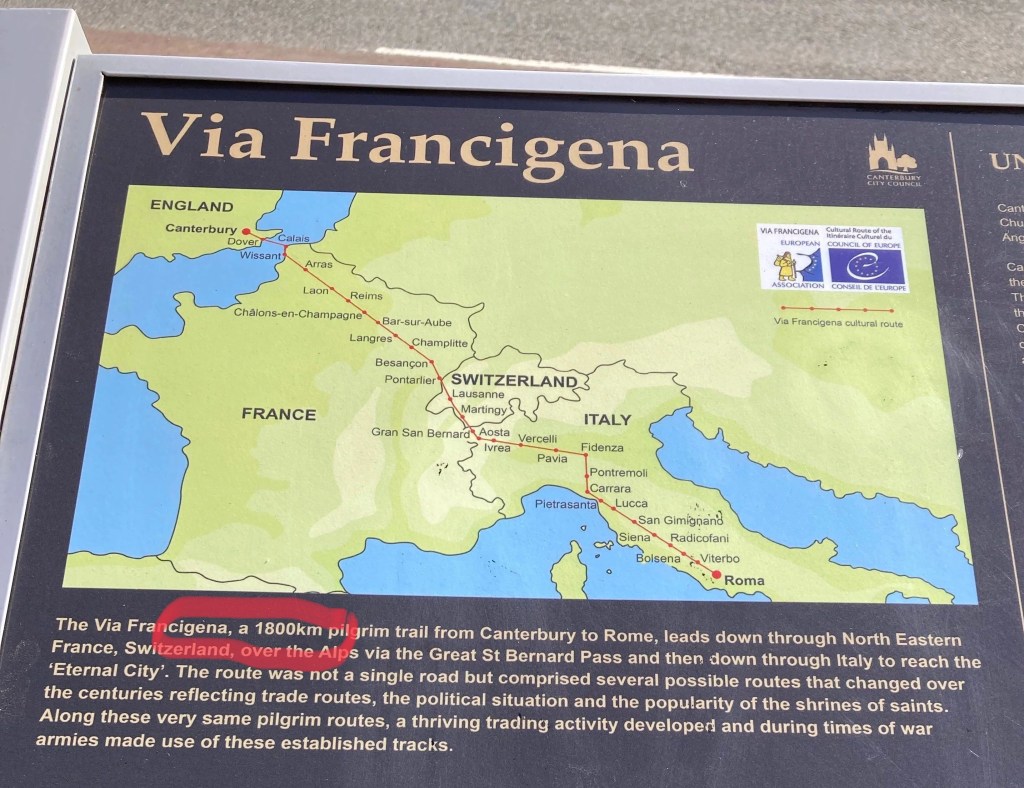
From Canterbury, the VF is well sign-posted, if you can ignore the persistent indeterminacy of the road’s length. St.Augustine’s Abbey, just a few hundred meters from Canterbury Cathedral calculates the distance as 1800 kilometres.

A kilometre or so further along the road at St. Martin’s church, the distance has increased by a whole 100 kilometres!

St Martin’s Church, Canterbury

Mileposts on the walk from Shepherdswell to Dover are also anarchic, showing ‘3 miles to Dover’ at three successive cross-roads a kilometre or two apart. An American day-walker overtaking us at the third 3-mile post, caught the dismay on my face and helpfully suggestd: ‘Three miles thrice? Oh, that just means not-long-to-go-now.’

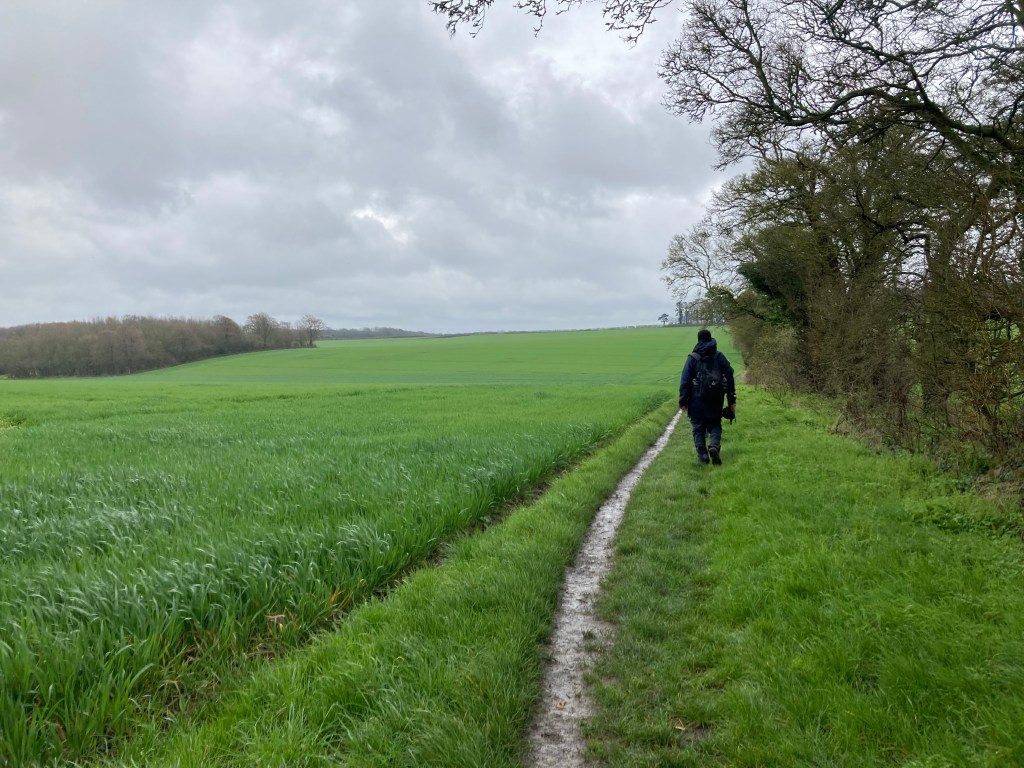
Outside of the towns the path winds through farms and forests, sodden, squelchy and muddy, sometimes completely obscured, except for a distant fence that somehow manages to guide your steps to the next turn.

The track is a sludge

The weather made me think about difference between day walks and long distance hiking. Had I been planning for a little day ramble on Easter Monday, I would have consulted my weather app, stayed home and eaten the remaining Easter eggs.

It rained pretty much non-stop for the first three hours of our first day’s walk while gusty winds played havoc with ponchos and hats. But when you walk day after day, week after week, and indeed on the VF, month after month, you can’t really expect sunshine and clear skies and temperature regulated precisely to your walking preferences, every day. In the time it takes to walk 2000 kms, the seasons turn over, you move from the coast to the snowy mountains. Once the course is set, you walk whatever the season or the terrain. And if you have good company to distract you with lively conversation, that is what you remember rather than the muddy boots and dung-splattered pants.

Just for the record: the sun was shining on Day 2, making for a pleasant, mostly uneventful walk into Dover, made memorable by the company of fellow-travellers.

A pleasant walk through farms and woodlands

The Path You Take: dateline Canterbury

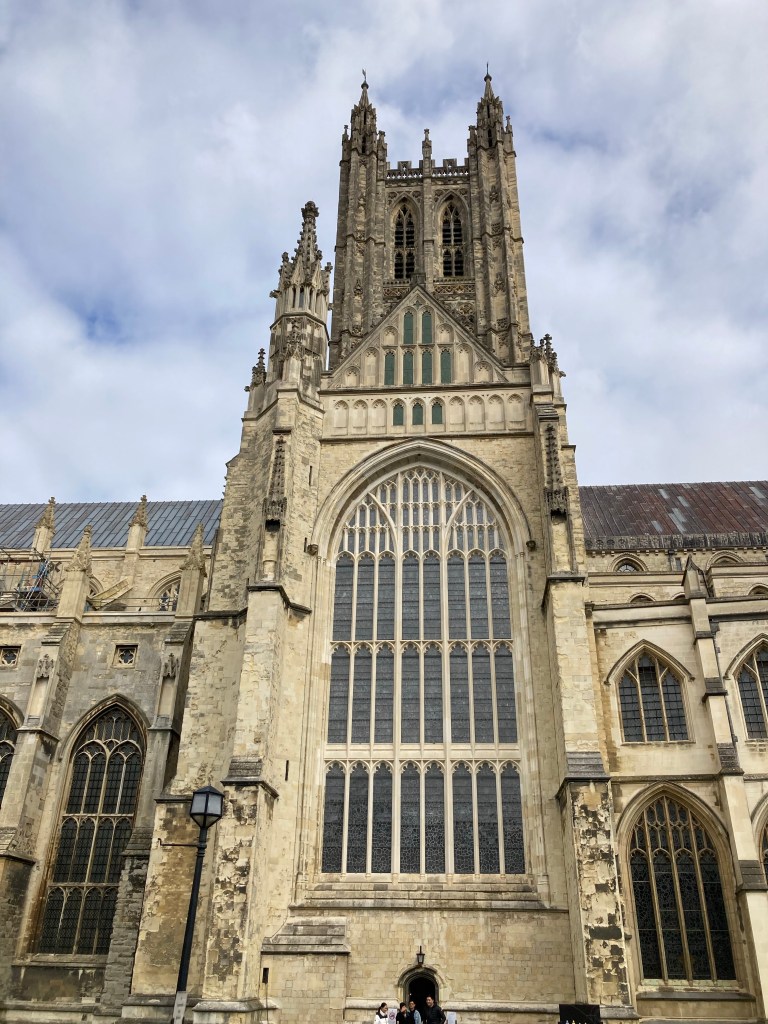
Canterbury Cathedral

Canterbury has been a premier tourist destination since the middle ages: at its heart one of the most ancient and venerated cathedrals bearing witness to 1500 years of history and mythology of spectacular crimes and redemptions, miracles, arsons, blazes and international diplomacy. (But you have read Murder in the Cathedral, and seen Peter O’Toole and Richard Burton play out the drama between King Henry II and Archbishop Thomas Becket on the big screen). The surrounding town still hosts medieval inns where Chaucer’s somewhat unholy pilgrims would have been entirely at home!

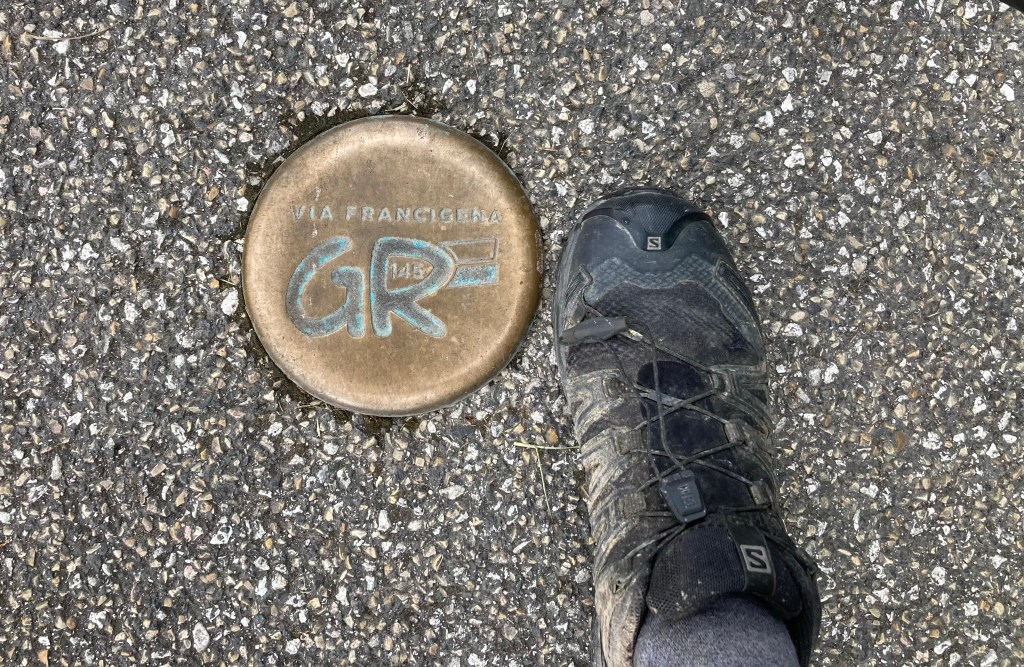
In a place screaming with religious and literary allusions, the official trailhead to Via Francigena (VF) is a modest concrete tablet – located beside the path between the two main entrances to the cathedral.

The ‘official’ start of the pilgrim walk

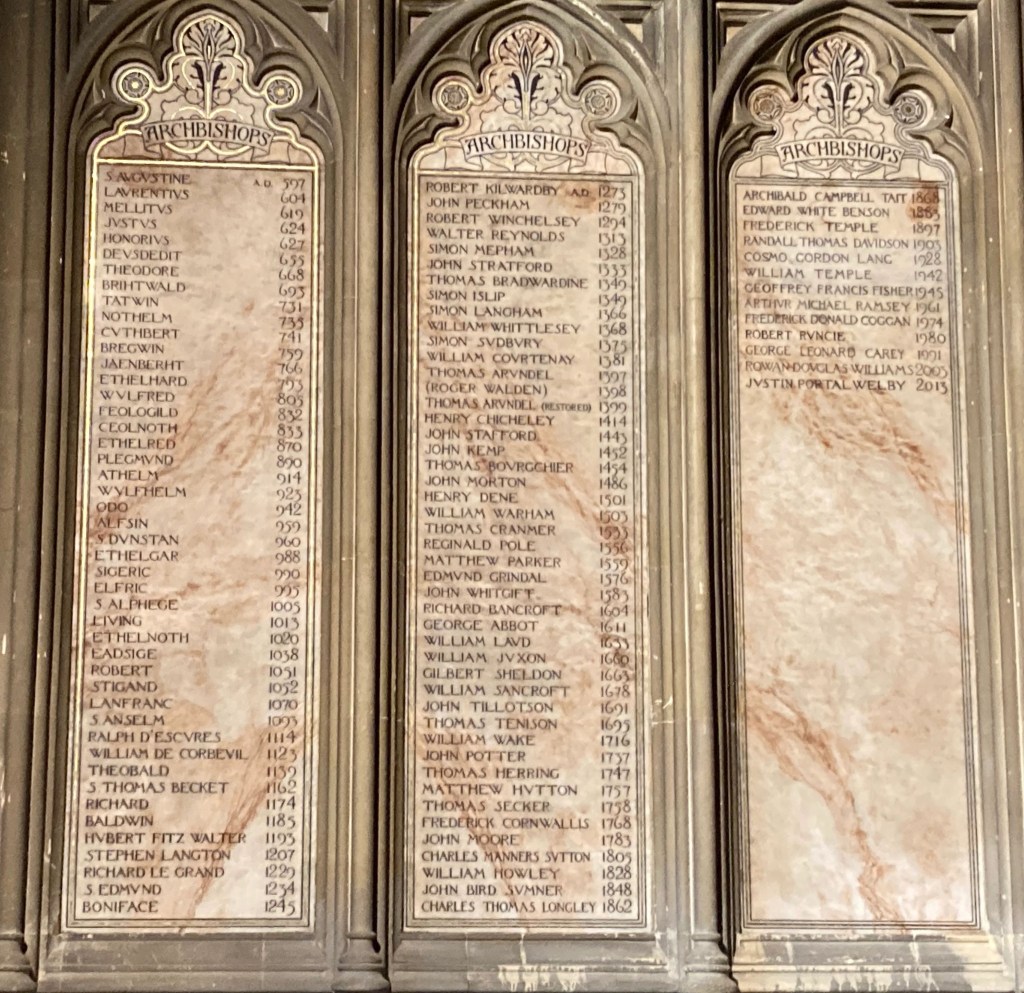
Nor is it easy to find Sigeric the Serious (my first pilgrim vow is to eschew bad jokes about His Seriousness) whose itinerary from Rome back to Canterbury in 990, forms the basis of the contemporary Via Francigena. Eventually my sharp-eyed Walking Buddy finds him on a wall, amongst the complete list of Canterbury Archbishops – along with 104 others, from the year 594 to the current Primate. (It is hard to get attention when you are competing with successors like Becket, who got his head bashed in by knights, and Cranmer who was burnt at the stake.)

Spot Sigeric? Half-way-ish in column I

Apparently, travelling to Rome from England was not unusual in Sigeric’s time. Roads to Rome, it seems, were full of English pilgrims and those who robbed them. Four decades earlier, Archbishop Aelfsige (he is also on the list above) had set off to collect his pallium from the Pope and quite literally came to a dead end in the icy Alps in the winter of the year 959.

A long way to go for a neck-tie?

Sigeric, by contrast, travelled in mid-summer – and with luck and weather on his side, lived to tell the tale. He (or a minion) wrote down his itinerary: a list of the places he passed and possibly stopped for the night. By a further stroke of good luck, the record, which to the untrained eye looks like two pages of scribbles, survived, so that a thousand years later, historians, scientists and tourism promoters were able to re-imagine a 2000 kilometre path, and re-make the Via Francigena, the road through France, into something of an emerging ‘destination’, modelled on Camino Santiago.

But on contemporary maps, at any rate, VF is not so much one road as a general direction heading from Canterbury to Rome, more or less in a straight line. Not only can you connect the sections of Sigeric’s diary via several different paths, there are options to take off on other ancient roads, perhaps not taken by Sigeric, but frequented by other pilgrims, past and present.

Facebook (now the source of all knowledge, of course) tells me that over this Easter weekend, there are pilgrims, tourists and philanthropists starting their VF walk not only from Canterbury, but also from Winchester (further to the north), and Calais (across the water in France). And one could easily set off from some seedy old pub near London Bridge, following in the footsteps of Chaucer’s pilgrims. All of these, and many more villages and towns are equally valid trailheads for this road to Rome.

Despite the straight and narrow Roman roads and Sigeric’s notes and all the hundreds of books and charts and maps that have been laid upon each other over many centuries, there seems still to be a kind of fluidity to this path: there are no precise answers to the question ‘how long is the Via Francigena’ – 1700 kilometres? May be even 2300 kilometres. Somewhere along that long and shifting line you can make your own beginning and end and determine the turns you make.

For those like me, brought up within a Bengali Hindu sensibility, this malleability of the path gives comfort. The most quoted line from our most famous mystic Ramakrishna Paramahamsa is this: যত মত ততো পথ – there are but as many roads as you can see.

We have located our trailhead. And we have set an end point – the Great St. Bernard’s Pass. In between, we have the footfalls of those who have gone before to guide us. As in life, so on this long walk, even with digital maps and GPS guidance and all the other technological determinations, there will be choices to make and mistakes and missed steps, the fear of getting lost and falling and the excitement of finding the road again. All that is still ahead of us!