On French Soil Assailed by Doubts

Calais, church fence

If this was an academic essay, I would start thus: there is so much inefficiency in the bipedal mode of transport in the modern era, that the author now believes walking to be a fool’s errand! But doubts are part of the course on any long journey, so let me start at the start.

Notre Dame, Calais

In France the Via Francigena starts at Notre Dame in the centre of the port city of Calais. From here you walk towards the coast, across the canal, then ramble through a bit of suburbia to a concrete promenade which hovers over the beach following the coast line pretty much all the way to Wissant.

The coastal route GR 120, with its startling views of the ‘white cliffs of Dover’ across the channel on a clear day, is as comfortable as hiking gets – flat and with photo opportunities galore.

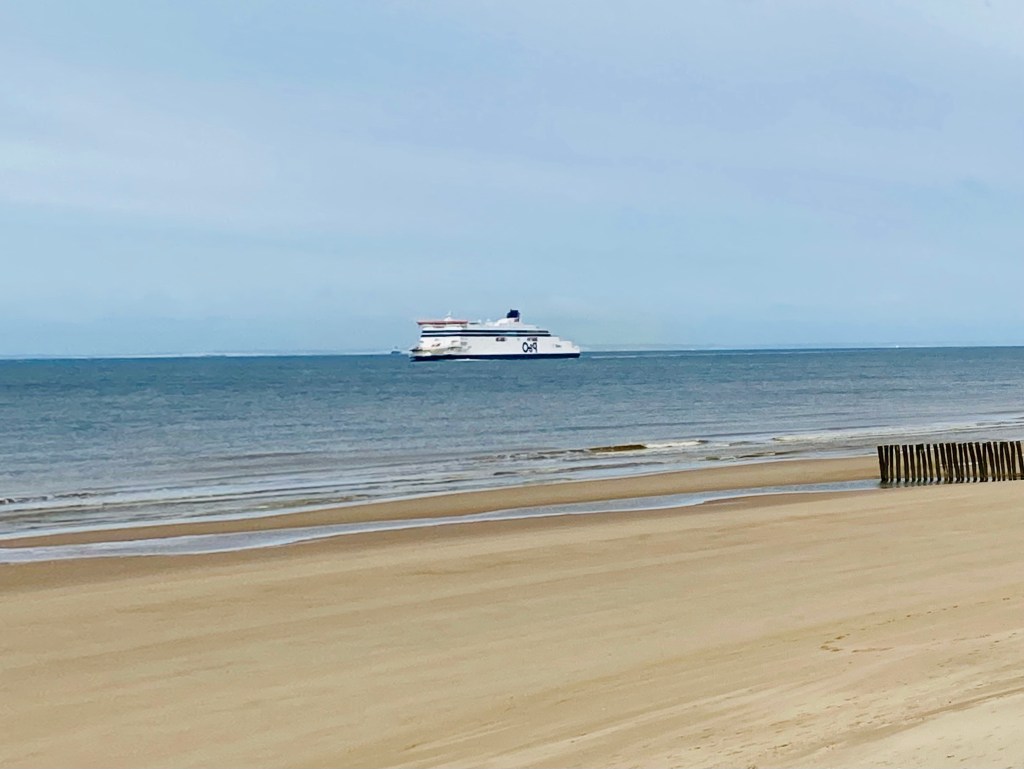
Ferry boat crossing Channel from Dover

GR 145, which cuts back from the coast line, before re-joining it at the Dover Patrol Monument, is slightly longer and a tad uphill. So I grumble when my meticulous Walking Buddy insists on taking the official VF. Doesn’t he know all roads lead to Rome? On the other hand, this venture is all about the road, and not at all about Rome, I am eventually forced to concede.

Despite that small Hill Difficulty (which I mention only to show off my familiarity with the English classic Pilgrim’s Progress and not to impugn my Walking Buddy, who happens to belong to a certain Hill clan), the day is as good as walking gets, easy and beautiful.

Wissant is a lovely little sea-side resort, with a Friday night market in the village square, selling local produce. Someone has decked out the church with the little white blossoms we have been admiring along the way.

Church, Wissant

The walk into Wissant, and even more the way out of it to Guines, is marked with remnants of war, both medieval and modern, some memorialised officially and others turned into sites for protest.

On the beach, along the way into Wissant

Day 2, the walk to Guines, starts with the anticipation of meeting Micheline at Mont du Couple, making real a Facebook virtual friendship. The track is uninspiring, but not unpleasant.

At Landrethun-le-Nord, after farewelling Micheline, we go against her advice and the official VF to follow an alternative map which seems to be more direct, though with some sections on a D road. Our final 4 kms into Guines, turn out to be on the edges of a highway with cars screaming past every minute.

Perhaps there is a benefit in the getting of self-knowledge: I HATE walking where cars abound but I never again wish to pay with my fragile sanity for confirmation of this knowledge😑

Information from other pilgrims that the official VF path into Guines is uninspiring only adds to my anxiety. Just four days into the walk, the VF is wearying, different, alien. It’s not like the South West Coast Path in UK, which I remember as exciting and challenging. Unlike the Camino, the folks in track towns don’t cheer the walkers on. So what will keep me walking this road, I wonder.

We decide to go off the track for a couple of days to Saint-Omer, to see one of Europe’s oldest libraries. A free bus takes us back to Calais in 35 minutes – the distance that we covered on foot in two days, and which cost us two nights of accommodation and food. Then a half hour in the train and we are in Saint-Omer.

Walking seems completely illogical in a place where transport is easy, cheap and even from an environmental point of view, the marginal cost in greenhouse gas-generating fuel per passenger, is negligible.

Saint-Omer is a sweet old town, with gourmet eateries and historic monuments. It would be so easy to stay for a bit, then move to some place where curated tourist fodder is more readily at hand.

But for now, we are committed to getting back on track tomorrow, a very short walk into Wisques will bring us back to the Via Francigena.

When in doubt the Believers turn to God. For Bengalis there is always রবি ঠাকুর (Tagore to the rest of the world, but almost a deity to us).

“ওগো পায়ে চলার পথ, অনেক কালের অনেক কথাকে তোমার ধূলিবন্ধনে বেঁধে নীরব করে রেখো না। আমি তোমার ধুলোয় কান পেতে আছি, আমাকে কানে কানে বলো।” ‘Dear walking path, all the stories you have gathered through the ages, don’t keep them quietly secured in your dust cover. I have my ears pressed to your dust, whisper them to me.’

Days 1 and 2: Canterbury to Dover

Let’s start with weather: in a word… English…

All decked out for a walk in the rain

No. Let us start by counting our blessings. First, conveniently for those hikers who are built for comfort rather than speed, the walk from Canterbury to the coast is easily broken into two bite-sized pieces, about 17 kilometres to Shepherdswell, and a similar distance into Dover. And my prescient Walking Buddy had booked us into the only available accommodation in Shepherdswell.

Secondly, almost miraculously, we had barely taken two hesitant steps into our first day’s walk when we ran into four other walkers, two of them headed, like us, as far as they can get, in the time permitted on their visas!

So, for most of Day 1, we walked as a group of seven, including three doctors – very reassuring in case one slipped in the despondent slough and broke a leg or something! By the end of the first hour we had forgotten the rain and were chatting like old friends, finding common ground and even common friends in unexpected places.

The world is getting smaller, and perhaps the VF is no longer such a lonely walk as most of the books and blogs of yesteryears suggest.

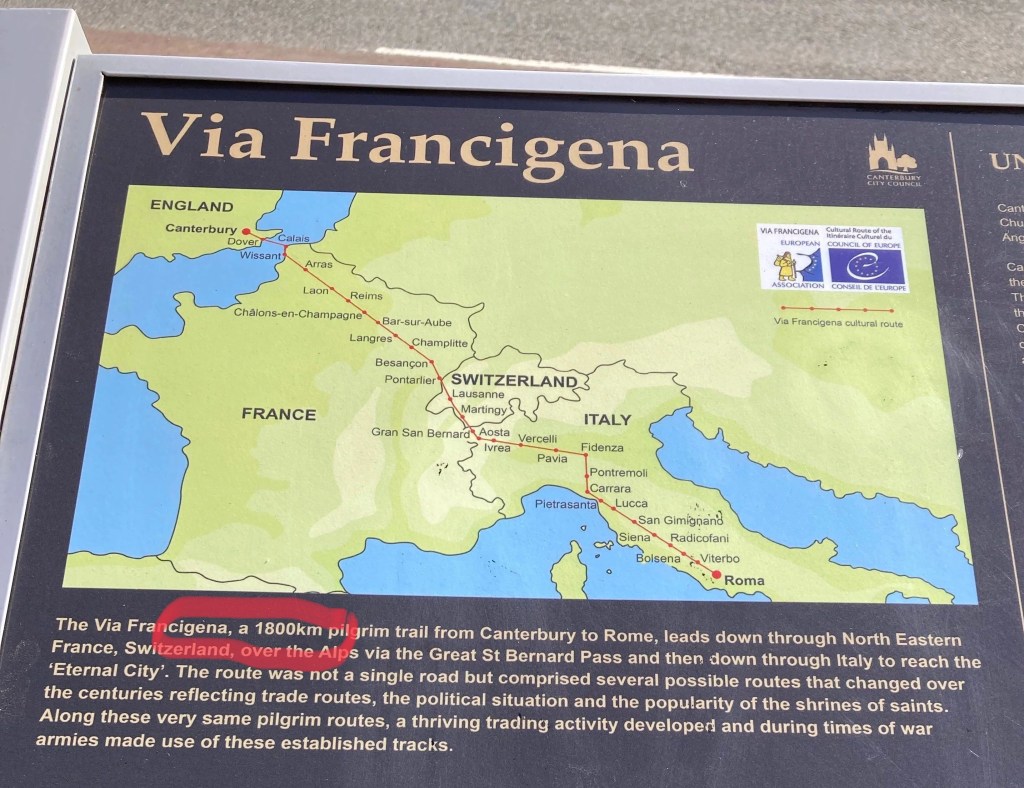
From Canterbury, the VF is well sign-posted, if you can ignore the persistent indeterminacy of the road’s length. St.Augustine’s Abbey, just a few hundred meters from Canterbury Cathedral calculates the distance as 1800 kilometres.

A kilometre or so further along the road at St. Martin’s church, the distance has increased by a whole 100 kilometres!

St Martin’s Church, Canterbury

Mileposts on the walk from Shepherdswell to Dover are also anarchic, showing ‘3 miles to Dover’ at three successive cross-roads a kilometre or two apart. An American day-walker overtaking us at the third 3-mile post, caught the dismay on my face and helpfully suggestd: ‘Three miles thrice? Oh, that just means not-long-to-go-now.’

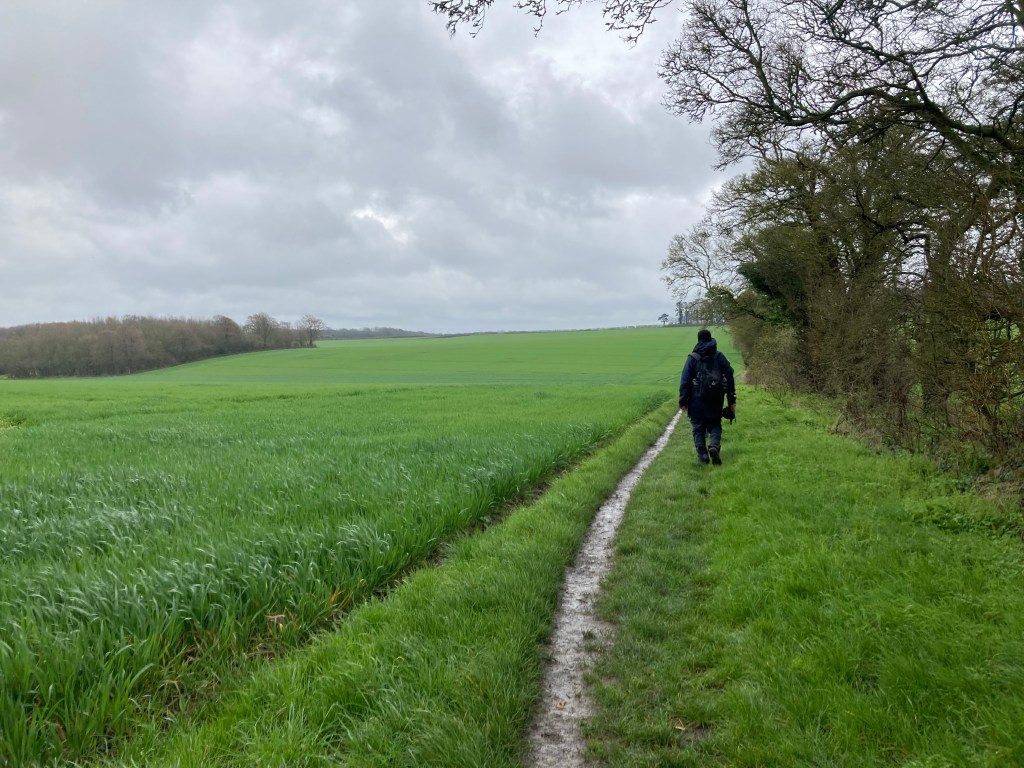
Outside of the towns the path winds through farms and forests, sodden, squelchy and muddy, sometimes completely obscured, except for a distant fence that somehow manages to guide your steps to the next turn.

The track is a sludge

The weather made me think about difference between day walks and long distance hiking. Had I been planning for a little day ramble on Easter Monday, I would have consulted my weather app, stayed home and eaten the remaining Easter eggs.

It rained pretty much non-stop for the first three hours of our first day’s walk while gusty winds played havoc with ponchos and hats. But when you walk day after day, week after week, and indeed on the VF, month after month, you can’t really expect sunshine and clear skies and temperature regulated precisely to your walking preferences, every day. In the time it takes to walk 2000 kms, the seasons turn over, you move from the coast to the snowy mountains. Once the course is set, you walk whatever the season or the terrain. And if you have good company to distract you with lively conversation, that is what you remember rather than the muddy boots and dung-splattered pants.

Just for the record: the sun was shining on Day 2, making for a pleasant, mostly uneventful walk into Dover, made memorable by the company of fellow-travellers.

A pleasant walk through farms and woodlands

The Path You Take: dateline Canterbury

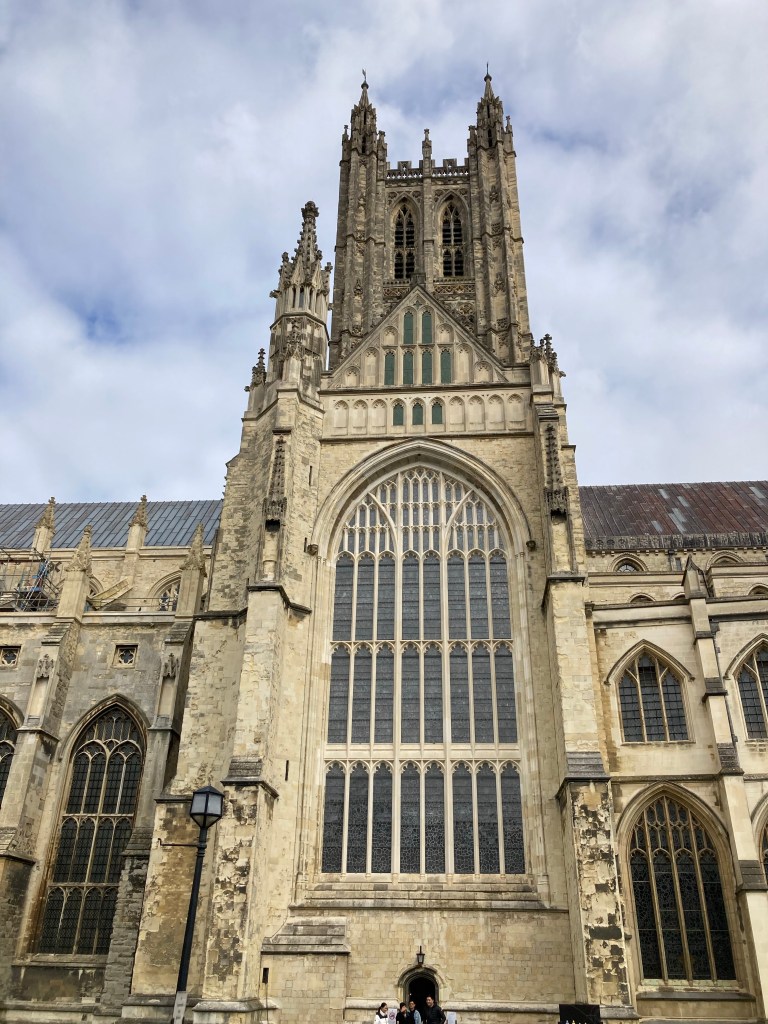
Canterbury Cathedral

Canterbury has been a premier tourist destination since the middle ages: at its heart one of the most ancient and venerated cathedrals bearing witness to 1500 years of history and mythology of spectacular crimes and redemptions, miracles, arsons, blazes and international diplomacy. (But you have read Murder in the Cathedral, and seen Peter O’Toole and Richard Burton play out the drama between King Henry II and Archbishop Thomas Becket on the big screen). The surrounding town still hosts medieval inns where Chaucer’s somewhat unholy pilgrims would have been entirely at home!

In a place screaming with religious and literary allusions, the official trailhead to Via Francigena (VF) is a modest concrete tablet – located beside the path between the two main entrances to the cathedral.

The ‘official’ start of the pilgrim walk

Nor is it easy to find Sigeric the Serious (my first pilgrim vow is to eschew bad jokes about His Seriousness) whose itinerary from Rome back to Canterbury in 990, forms the basis of the contemporary Via Francigena. Eventually my sharp-eyed Walking Buddy finds him on a wall, amongst the complete list of Canterbury Archbishops – along with 104 others, from the year 594 to the current Primate. (It is hard to get attention when you are competing with successors like Becket, who got his head bashed in by knights, and Cranmer who was burnt at the stake.)

Spot Sigeric? Half-way-ish in column I

Apparently, travelling to Rome from England was not unusual in Sigeric’s time. Roads to Rome, it seems, were full of English pilgrims and those who robbed them. Four decades earlier, Archbishop Aelfsige (he is also on the list above) had set off to collect his pallium from the Pope and quite literally came to a dead end in the icy Alps in the winter of the year 959.

A long way to go for a neck-tie?

Sigeric, by contrast, travelled in mid-summer – and with luck and weather on his side, lived to tell the tale. He (or a minion) wrote down his itinerary: a list of the places he passed and possibly stopped for the night. By a further stroke of good luck, the record, which to the untrained eye looks like two pages of scribbles, survived, so that a thousand years later, historians, scientists and tourism promoters were able to re-imagine a 2000 kilometre path, and re-make the Via Francigena, the road through France, into something of an emerging ‘destination’, modelled on Camino Santiago.

But on contemporary maps, at any rate, VF is not so much one road as a general direction heading from Canterbury to Rome, more or less in a straight line. Not only can you connect the sections of Sigeric’s diary via several different paths, there are options to take off on other ancient roads, perhaps not taken by Sigeric, but frequented by other pilgrims, past and present.

Facebook (now the source of all knowledge, of course) tells me that over this Easter weekend, there are pilgrims, tourists and philanthropists starting their VF walk not only from Canterbury, but also from Winchester (further to the north), and Calais (across the water in France). And one could easily set off from some seedy old pub near London Bridge, following in the footsteps of Chaucer’s pilgrims. All of these, and many more villages and towns are equally valid trailheads for this road to Rome.

Despite the straight and narrow Roman roads and Sigeric’s notes and all the hundreds of books and charts and maps that have been laid upon each other over many centuries, there seems still to be a kind of fluidity to this path: there are no precise answers to the question ‘how long is the Via Francigena’ – 1700 kilometres? May be even 2300 kilometres. Somewhere along that long and shifting line you can make your own beginning and end and determine the turns you make.

For those like me, brought up within a Bengali Hindu sensibility, this malleability of the path gives comfort. The most quoted line from our most famous mystic Ramakrishna Paramahamsa is this: যত মত ততো পথ – there are but as many roads as you can see.

We have located our trailhead. And we have set an end point – the Great St. Bernard’s Pass. In between, we have the footfalls of those who have gone before to guide us. As in life, so on this long walk, even with digital maps and GPS guidance and all the other technological determinations, there will be choices to make and mistakes and missed steps, the fear of getting lost and falling and the excitement of finding the road again. All that is still ahead of us!

‘Pilgrim How You Journey’

The Road

An ill wind, not just metaphorically but literally, has been blowing these last few years – a wind that has disrupted travel, and turned the clinical acronym, COVID, into a household word. In addition, the minuscule particle of the world, that takes up most of Yours Truly’s attention, has been focussed on another C word.

Now that all that’s been sorted with a few rounds of chemo and antidotes and potions, for the convalescent, the doctor and the Romantic poet alike have prescribed daily walks and fresh air.

‘Afoot and light-hearted, I take to the open road,
Healthy, free, the world before me,
The long brown path before me, leading wherever I choose.’

So writes Walter Whitman, the great grand-daddy of American poetry.

However, as far as we know, Walt never did walk the thousand kilometres of GR 145, across the north-east border of France to the Great St Bernard’s pass in Switzerland. Nor did he have to deal with my meticulous Walking Buddy (WB aka ‘Co-Pilot’), who is prone to brandishing his 29 column spreadsheet detailing weights, dimensions, pros and cons of every piece of hiking equipment ever invented.

So, as I struggle to decide which backpack is best for this precise trip and which sleeping bag has the ideal weight to warmth ratio, (for the record, I have landed on Osprey Lumina pack and a Spark-I sleeping bag), most of that light-hearted free-footing open road still sounds like a distant fantasy.

Pack weighs 6 kilos after I took the kitchen sink out🙄

But by all accounts a ‘long brown path’ does indeed loom ahead of us, which my mobile weather app says is likely to be woefully wet and monstrously muddy when we take off on foot from Canterbury on Easter Monday.

Given the coincidence of Christianity’s holy place and holy day at the start of our hike, you would think that we are on a pilgrimage. And given that there is not a single religious bone in my body, I too have been wondering about my fascination with the pilgrim walks of Europe.

Part of the answer lies in the relative ease of these walks. Unlike what the Americans call ‘through hikes’ in the vast wilderness of the American or Australian continents, Europe’s pilgrim walks have been curated over a thousand or more years for travellers, traders and armies and are being refurbished now for the walking-tourists. On the Via Francigena (see map above), as far as we can tell from books, maps and apps, you can more or less plan to reach some source of food and shelter at the end of each day’s walk.

Of course you need more than the convenience of lousy hotels and average food to keep you on track day after day! And, somehow, at least for me, the idea of a pilgrimage, that is, the certain knowledge that many, many people, over more than a thousand years of recorded history, have found joy and imagined salvation on these very roads, helps to keep a certain focus, to keep one going.

But this isn’t really a good time to get all spiritual when the prospect of hot-footing 1300 kms (give or take – wait for a later blog about the malleability of this road) seems a little daunting and even unreal while I weigh and spray my ultralight gear and deal with practicalities of contemporary travel: the COVID certs and credit cards and so on.

I know, too, from reading the works of those who have gone before me on this road, especially the classic 1903 travelogue by Hilaire Belloc , how easy it is to lose your way and break your vows on this particular pilgrimage. Belloc broke most of the promises he had made within the first week of his walk. Admittedly, he was carrying half a bottle of alcohol which I am not, and his sack would have weighed a ton compared to my feather weight uber-modern gear.

Belloc did however reach his end goal – he got to Rome, having walked 750 miles. Along the way, he kind of worked out the importance of letting go of the small promises in order to walk on.

So, perhaps we define the pilgrim by the how rather than the where and why of the walk. On foot and carrying all you need for the day; with a determination to reach a destination but knowing also that plans and promises are necessarily provisional.

‘Pilgrim, how you journey
On the road you chose
To find out why the winds die
And where the stories go’

For now this song by the Irish singer , Enya, resonates.

I hope some of you will come along for the read (not really a ride, is it?) while I try to walk and inscribe the Grande Randonnée (GR) 145, or Via Francigena, a long road by any name.

Eat, Preach, Drive

EV drivers get spoilt on the Nullarbor. Pretty much every roadhouse owner (not that there are many) with a plug point will let you charge overnight. Grey nomads (not that many of them here either) tumbling out of their enormous 4WDs will be solicitous ‘are you crazy or are you writing a book? (No!) Where do you charge (‘pretty much the same places as you – only slower…’) 

The attention goes to your head: your ‘virtue signalling’ is rampant, opportunities for proselytising irresistible. ‘Price? this car? About half-way between a petrol SUV and your 4WD…and we are charging for free or next to nothing’ you say, knowing that they have just parted with about $200 to fill their car. 

There are opportunities too, to promote the value of installing EV chargers to the receptive business owners, while sampling Buffalo salami and Camel milk ice-cream at Harry’s Home Made Fine Foods in Baroota, S.A.

In Port Augusta, we came across our first competing EV. The charger is booked for us only until 7 pm, we are told at the motel. Fine, we said, but can we please book it again for 7 a.m for a final top-up before we leave?

7 p.m change-over works fine. Not so much the early morning swap. The Tesla has completed charging but is still plugged in and, understandably, the reception staff are not willing to call a customer at the crack of dawn. Unhappy, we adjust our route a little to drive via Tanuda, Barossa Valley, which looks perfect for a lunch and a fast-charge. 

Tanuda is, indeed, quite lovely, but its one charger is serving another client, a beautiful electric Volvo. Soon another Tesla is lining up beside us. Thankfully, the Volvo owner turns up in half hour or so. He has the patience of a saint, I realise after I have read him my ‘Complete Discourse on the Necessary Etiquette of EV Charging.’ 

Good practice

On the main arteries between Adelaide and Sydney, fast charging stations are plentiful. More are coming on line every month, many are conveniently located in petrol stations and shopping centres. But given the variable charging times of EVs even on the ultra-fast chargers, there are bound to be instances where demand exceeds supply.

Conventions for sharing assets take time to develop. In the meanwhile it might make sense to work out some good practice, for example

  1. Limit charging periods, especially when there are others in the queue. 
  2. Register on Plug Share if you are charging or waiting.
  3. Set up your car so it can be disconnected when it’s finished charging by waiting drivers (so you won’t have to rush your drink at the pub).

Just commonsense, the sort of stuff we mostly do but can easily forget in a rush. 

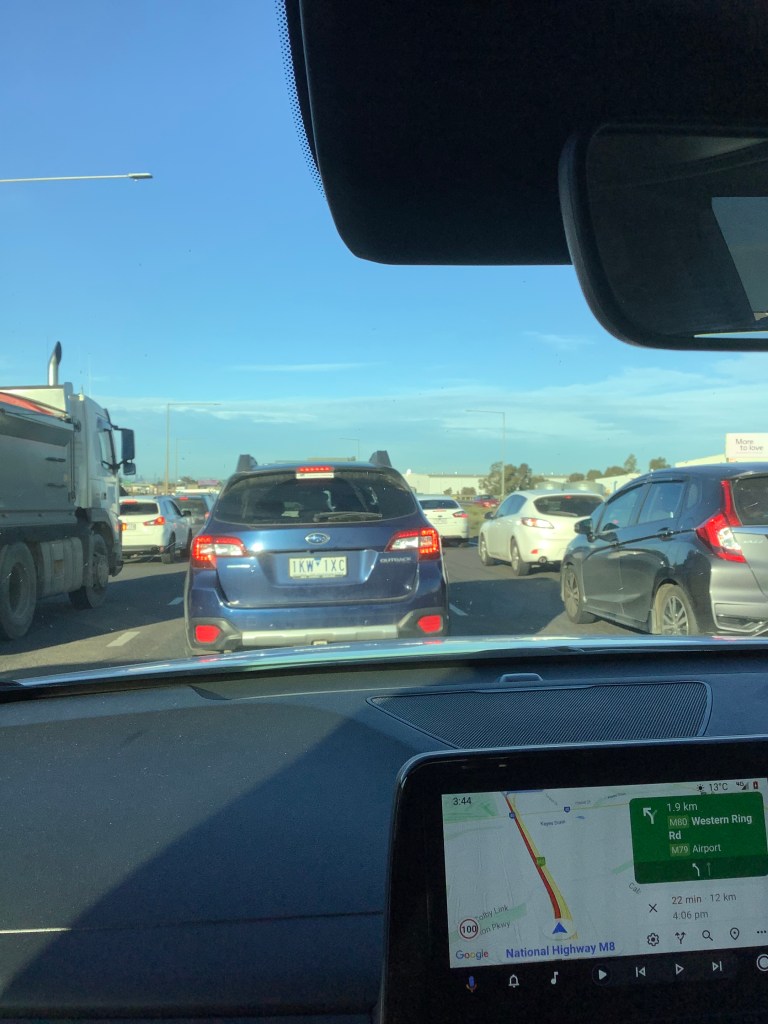
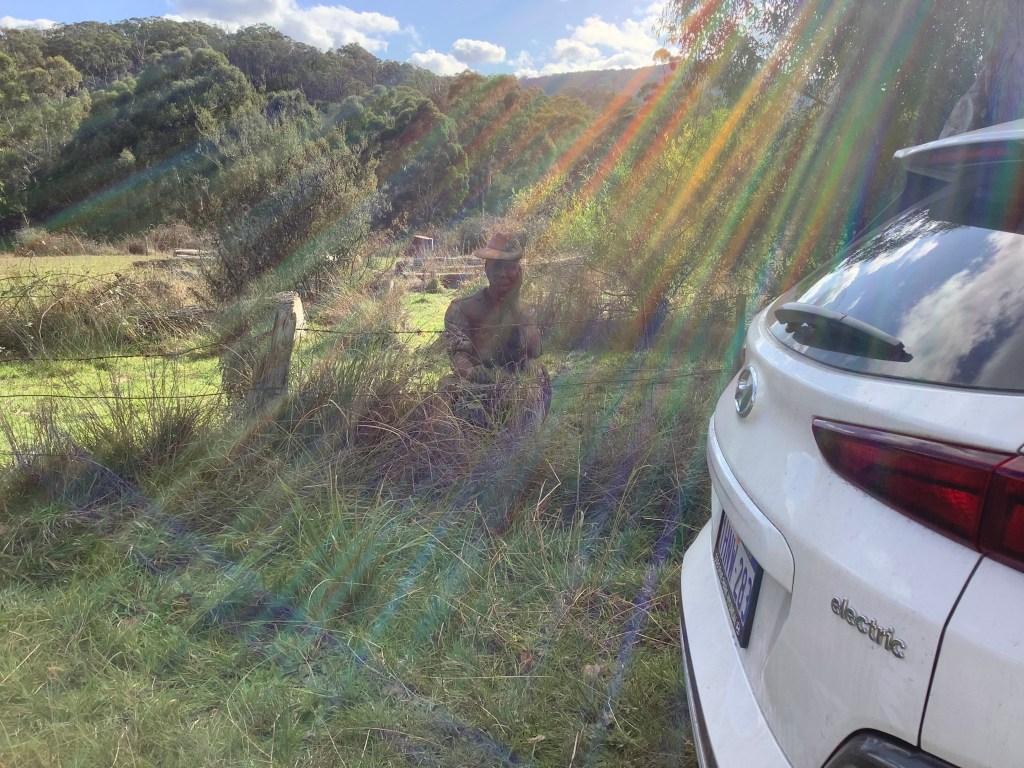
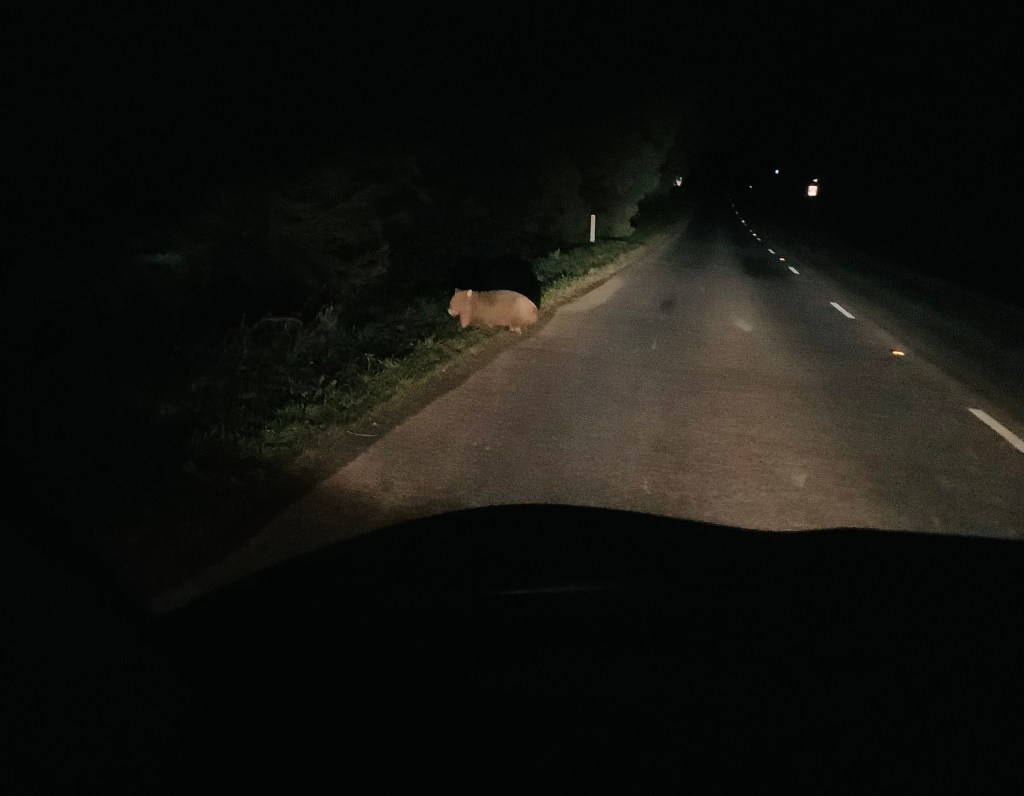
We skirted north of Adelaide, and 2 days after leaving Port Augusta crawled into Melbourne in bumper to bumper traffic. Our first big city in 10 days dazzled us with the best chai and dosa since my teenage years in Kolkata. Then a couple of days meandering in the narrow hilly lanes of the Yarra Valley, slow enough to notice mystifying unmarked sculptures and not run-over a wombat in the dark.

On our first day out of Melbourne on the M31 towards Sydney, I finally came to grips with the question of speed:range ratio of an EV. Where charging stations abound, and provide insurance against range anxiety, why not join the average Motorway user at 110 kmph?

The only problem is that everyone else is driving just a little faster, overtaking and slowing you down just that little bit.

When the 13th car overtakes you – incidentally it’s a ute – you give into a less virtuous self who sits just beneath your environmentally-friendly-echo-plus type driving persona. Johnny in the ute sees just a silver flash, then 12 other small and large vehicles vanish into a blur in your rear vision mirror. By the time you notice you have been, ahem, going a little over the speed limit, the car range has dropped dramatically and you are not going to make Gundagai without another charge! 

We have to stop for a charge at Tarcutta. Co-pilot sets the car to charge up to 85%. It will take nearly 2 hours. By the time we make Gundagai, the sun will have set and I won’t be able to take a photo of the great Aussie icon, the ‘dog on the tucker box’.  But co-pilot and I are no longer on speaking terms, so negotiation is impossible. Never mind. Missing a photo op is a small price to pay for guilty pleasures. And there’s just enough light to catch the Giant Koala.

The Giant Koala, Gundagai

For the record: 4700 kms Fremantle to Sydney in Kona EV 2022 – done. Easy, safe, with just a light sprinkle of excitement.

A 21st Century Pilgrimage

What is this that roareth thus?
Can it be a Motor Bus?
Yes, the smell and hideous hum
Denotes a motor bus!

Alfred Denis Godley, 1914

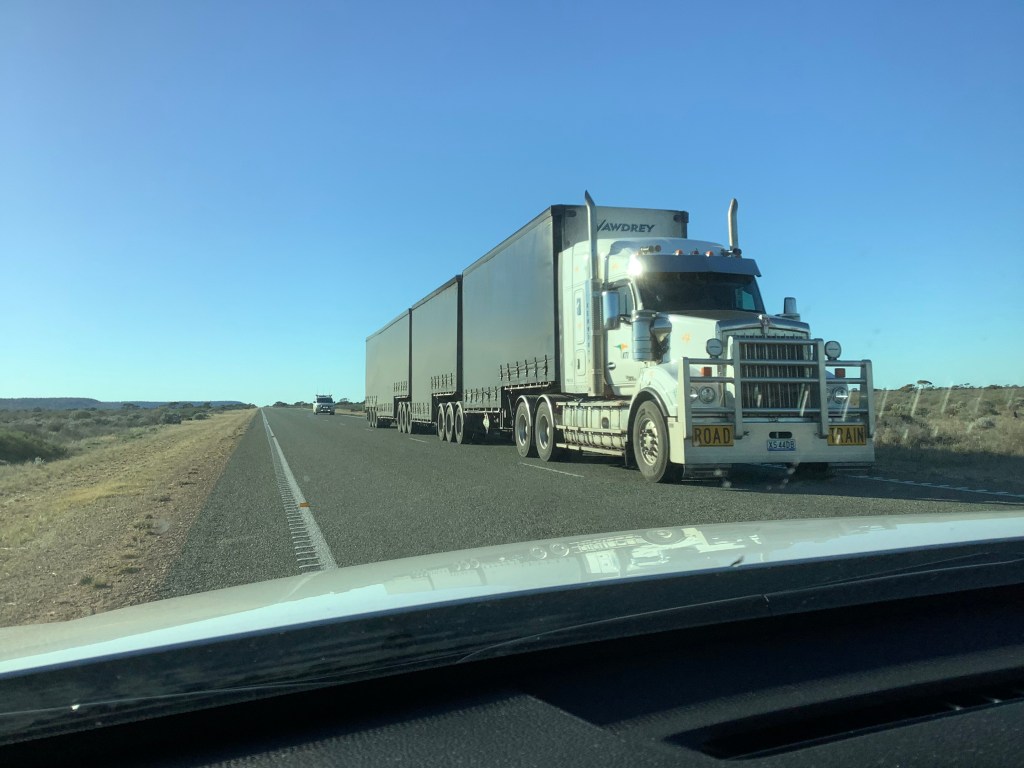
There is no odious fume, nor the visceral grumble of the engine as your electric car glides over the well-maintained surface of the thousand miles of Eyre Highway (https://en.wikipedia.org/wiki/Eyre_Highway) from the empty eastern end of Western Australia to Port Augusta in South Australia. Your car is perfectly silent or filled with your favourite music. The white noise hum from the rubber on the road might put you to sleep but for the bone-rattling thunder of monstrous road trains every so often.

Having struggled with range-excitement on Day One (https://readingontheroad54893552.wordpress.com/2022/06/23/range-anxiety/) we settle into driving around 400 km a day, at about 10 km  under the 110 km/ph speed limit on the wide open roads. The car is set to move at the most ecologically friendly mode that our KonaEV has to offer. Though the cold desert mornings dampen the range projection a little, on crisp sunny days we can do without any climate aides. So, most days, we seem to be getting around 430 kms on a 90%-ish battery.

Longest straight road in Australia

This road-trip has all the hall-marks of a pilgrimage. We are following in the foot-steps (perhaps I should say the wheel tracks?) of many who have gone before – doesn’t everyone of a certain age have a story of crossing the Nullarbor in a petrol-guzzling bomb some time in the late 20th century?

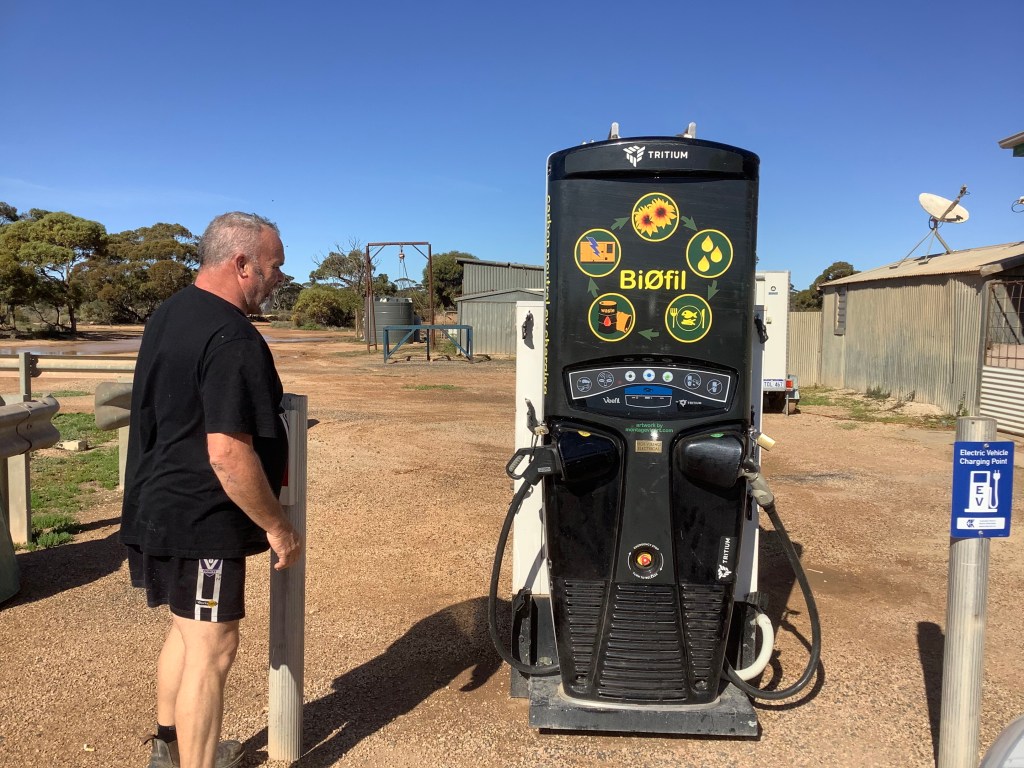
Like any great pilgrimage, this flat and featureless road has its own essential icons. The iconic ‘90 mile straight’, Australia’s longest straight road (though it’s apparently only the 11th longest-straight in the world – but hey, this is not a competition) brings us from Balladonia to Caiguna, which hosts by far the most important attraction for the EV-community: a 50 kw DC charger, fastest charger by far on the entire 1000 kms of the Eyre highway! 

Fastest and most eco-friendly EV charger on Eyre Highway

The eco-aware EV drivers will be happier still to learn that this charger is carbon neutral, running as it does on the waste oil from all the fish and chips fried at the Roadhouse. (https://www.abc.net.au/news/2022-01-17/first-fast-charger-for-electric-vehicles-installed-on-nullarbor/100762138) For a flat fee of $50 you can fill up your car in an hour or two. More importantly, this might be the only place in the world, where you can feel virtuous while stuffing your face with battered fish, as you bask in the glow of saving the earth one french fry at a time. Not all chargers are quite so spectacular.

Two other relatively fast chargers at the Balladonia Hotel and at the Madura Pass Oasis Motel are connected to a research project (https://robotics.ee.uwa.edu.au/rev/) led by engineers at the University of Western Australia (in case of any perception of conflict I should declare that I spent many happy working years at that university). Other charging options are mostly slower, generally three-phase plugs hidden out of sight behind a toolshed or in far corners of roadhouses, whose principle customers are, of course, still, the massive transport vehicles that enter these premises to engorge on fossil fuels.

Nonetheless, there are on the Eyre Highway, at least 10 points where we could charge our car –  most are slow, so it is most  practical to charge overnight, replenishing yourself and your car at the same time and in the same motel. And, best of all, given the very low numbers of EVs here, you are unlikely ever to have to wait in line.

One of the many hidden nooks where we charged our car

We left Fremantle on the West Coast of WA on a Sunday. The following Sunday, having broken no speed records, we were in Port Augusta on the eastern bank of Spencer Gulf, South Australia.

We had driven just over 2,500 kilometres: some of it through the ancient fragile land of the Yalata people; much of it though vast central Australian Desert, the Nullarbor, named thus because the Europeans saw no trees, but which is in fact covered in low shrub.

We cross the Great Australian Bight, where the world’s ‘largest exposure of lime stone bedrock’ (https://en.wikipedia.org/wiki/Nullarbor_Plain) plunges abruptly into the ocean. The road is a silver thread stitching together a haunting, implausible landscape of a greying desert and a green ocean. You can love this path in any car but you will do less harm in an electric one.

Where the desert meets the ocean

So… what are you waiting for?

Range Anxiety

Range Anxiety is the EV’s contribution to the English language. The term entered the Oxford English Dictionary in 2013: ‘worry on the part of a person driving an electric car that the battery will run out of power before the destination or a suitable charging point is reached.’

In some parts of the world, such anxiety is, arguably, a matter of the individual psyche (https://www.pitchcare.com/news-media/range-anxiety-fact-or-fiction.html). But in much of this vast land, basic infrastructure for these cars (ie. charging stations) is in its infancy, so unregulated that you need a half a dozen different apps and attachments to be able to access a sufficient number of chargers on any long trip. Add to that the sparseness of most things in outback WA, and you have a perfect habitat for the dreaded Range Anxiety in the novice EV driver’s head!

Just 45 minutes and 50 km out of Fremantle, the speedometer indicates we have used 11% battery and one of my apps is showing ‘McDonalds, Mundaring’ charger nearby – motor car owners staggering under petrol price rises, please take note: it is free. But it will take an hour and 45 minutes to fill up the car!!! So begins a long debate between me and my Range Anxiety (henceforth RA).

Me: we don’t need to top up the battery

RA: more experienced drivers say you should top up when you can when you are on unfamiliar roads.

Me: Not unfamiliar!! We drove to Adelaide in a clapped out Honda Civic…

RA: Yes, in 1988… 

I take the point but persist, pointing at a popular app: look, we get to the next charger at Merredin in 250 kms – we have plenty of battery to do that.

RA: but what if the Merredin one is not working? Or if your car will not charge as fast as the app says?

‘What if’ is always Anxiety’s killer punch! New car, we don’t know its quirks. And we know the uncertainties around charging points. They can work differently for different cars. For instance, our Hyundai Kona Extended Range goes a longer distance per charge, but depending on the charging technology, it can be much slower to charge up than its cousin, the Hyundai Ionic 5. And some chargers indeed are damaged, vandalised or simply may not charge at the anticipated rate. And everything from temperature to rain to road surface can affect the range of an electric car. Anxiety wins. We stop for nearly 2 hours to add just 50 kms of additional range. 

It would be 2 days before we worked out that the last 10% of battery is always the slowest to charge up – not worth the time unless you really need the full range. On Day 1, we are at the bottom of a steep learning curve.

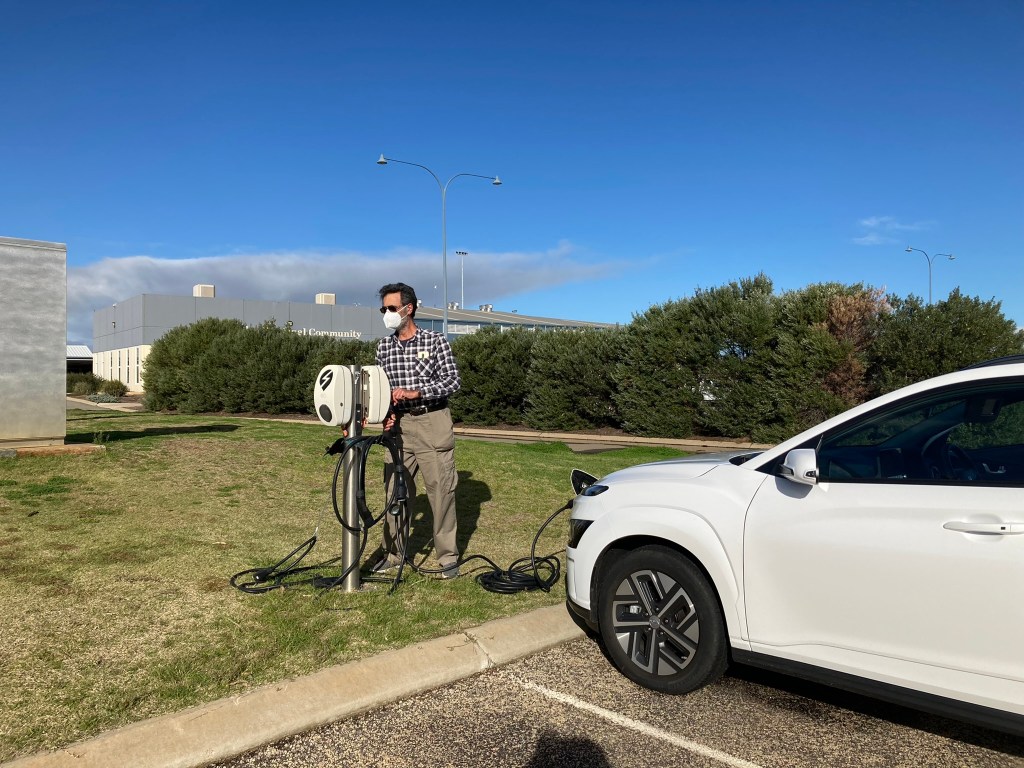
At the Merredin Community and Leisure Centre charging is happily, yet again, free and the rate of charging substantially faster than at Mundaring. Even so, it will be 6 hours before the car is fully charged. This time we bargain Anxiety down – 80% charge will get us comfortably to our destination for the night. And that will be done by about 4 in the afternoon. We tether the car to the charger and walk to Merredin’s only eatery operating this Sunday afternoon!

The clingy charger

And this is when the real problems start. My co-pilot finds a Tesla charger which promises a faster charge. So we run back and carefully follow the instructions to un-tether our car from the charger: but the plug won’t release! First gentle persuasion, then increasingly forceful coaxing – the thing won’t budge! We try randomly turning things off and on several times – same result each time – the car remains fixed to the charger. Co-pilot searches the web – but this is not a common problem and consequently the web offers no solution!!

Following my damsel-in-distress instinct, I hail a group of men playing bowls. The lovely gentlemen, between them, have a thousand years of driving experience but are seriously befuddled by a car without a motor! 

Meanwhile co-pilot has EV expert, J, on the phone and he too has never encountered a clingy charger until now. Yet, somehow, J talks co-pilot through the options and (phew!) at some point, after repeatedly hitting an ‘unlock everything’ button on the driver’s door (which we did not know existed until this point), the charger releases it’s grip on the car!! This process has taken an hour and we still have quite some charging to do before we can be confident about reaching our accommodation for the night.

Finding the Magic Button

So, to the TESLA charger we go and it works and the car screen shows that we will get the charge we need (without too much concession to Range Anxiety) by about 5 pm. And this charger too, is free!!

Meanwhile, our accommodation arrangements have gone awry, for reasons too tedious to explain. Eventually, we drive 3 hours in the dark and rain, the ‘range’ gauge dropping rapidly as headlights, wipers, de-misters, all draw on battery power. For our first night, we have no options but the caravanpark at Coolgardie, where you would not want to stay except in an emergency! But on the positive side, there is a caravan park plug point at which the car charges very slowly for the next 12 hours – and that is just enough to get us to the next charger in the morning.

Not many come to Coolgardie

Best thing ever: total ‘fuel’ cost for 600 km of driving? $0

First test for the long-distance EV driver: meet and beat Range Anxiety. 

That done, with a little planning and some intriguing chargers (wait for the next post), the trip is turning out to be both entertaining and educational!

Crossing the Nullarbor! Or not?

You to the Universe, aka, Face Book: ’We are planning to drive Perth to Sydney, and hopefully back again, in our new Electric Vehicle (henceforth, Evie). Any advice?’

First responder : No! Mate!! Seriously, Don’t do it.

Like Donald Trump we ignore reasonable counsel against self-destructive stupidity. Eventually more supportive advice flows in and we find at least three real people who have really done the distance.

So begins the planning for the  5000 km drive across the flattest, longest, straightest road in the world with less trees, people and EV charging stations per thousand kilometres than most places you care to name. (https://en.wikipedia.org/wiki/Nullarbor_Plain)

Unlike this blogger’s usual sojourns on foot, this trip is not going to be 100% guilt-free as many of the charging stations, where we will figuratively ’fill up’ the car, have fossil fuel generated electricity. (See https://www.mynrma.com.au/cars-and-driving/electric-vehicles/our-mission/are-evs-better-for-the-environment). Still, by most calculations, our environmental impact for this trip will be less than half of a petrol-guzzling, ozone ripping, air-polluting jalopy (I learnt that word from doing the Guardian crosswords and just had to use it).

Some say a previous Hyundai electric car was known to burst into flames for no apparent reason – but that was several generations (of cars) ago and we are assured by the dealer that that model is in no way related to our own Evie, who is a slick, white, 2022 Kona, with an enviable reputation for doing 480k on a full tank (i.e. 100% charge), on a good day. The equivalent more posh brand car costs 25% more.

She is cheap to fill up. For our test run, about 650 km Fremantle to Augusta round trip, we spent less than $15 on charging.

But there is a whole other language to EV ’filling up’ that ICE owners know nothing about. (If you don’t know what ICE is, I’m pretty sure you drive one! ICE = Internal Combustion Engine, in other words, most of the cars on the road.)

The most important question for an EV owner is ‘how long does it take to fill my car?’ The answer: how long is a piece of string? You will get a different answer depending on the type/model/year of car owed by the inquirer + the type/model/year of car owned by the responder + the charging station where this conversation takes place + the various cables that you should have bought but did not, plus 21 other variables I cannot remember.

Walking Buddy, WB, now re-classified as FM (Fast Mover) has read thousands of documents and composed a 400 page manuscript titled ‘Number, Length, Strength, Shape and other Variables of EV Charging Plugs and Cables: Essential Considerations Prior to your Long-Distance Motoring Adventures.’ As this is an open-ended discursive thesis, the work ends with no recommendations on what one can actually do to ensure availability of power to your car on the Nullarbor!

In any case, I really wanted the plug called Pig-tail because it has a cute name, but FM insists that name nothing to do with efficacy. In the end, the nice people from Hyundai HQ in Sydney stepped in to save the day (and a beautiful friendship) by offering us a full set of charging cables. HOWEVER, there’s a catch. These will be available at Port Augusta, which is after we have crossed the most remote stretch of the road.

Meanwhile we are setting off with a ’granny charger’ (which sounds slightly obscene and takes more than 30 hours to charge the car from 0-100), a type 2 (not to be confused with diabetes) and something called ’3-phase-5-pin’ (I-give-up) that FM has borrowed from more knowledgeable EV owners, which, used wisely, hold the promise of charging for just four or five hours most days. But hey, it’s not a race (as our coal-fired ex-PM once said).

Still, I wonder what will happen if Evie runs out of puff in the middle of nowhere (which is what the 2000 km between Perth and Port Augusta is)? FM has armed himself with an extra-long cable, which weights so much, I think it could be 100 kilometres long. But even so, the prospect of walking into a town with one end of an extension cable in your hand is hardly appealing!

Experienced EV drivers say, if running low on battery you should drop the speed to 40 kmh. That will extend the distance you can go before your next charge. At that speed, we should be in Sydney in 3 or 4 months. 

Bryce Gaton, a respected expert on all things EV and Kona-owner, is crossing the Nullarbor east to west. He recommends patience!

So, we’ll go Leonard Cohen slow:

I’m lacing up my shoes
But I don’t want to run
I’ll get there when I do
Don’t need no starting gun

Please stay tuned for more slow-mo blogs, so you’ll be the first to know when we are stuck somewhere without a plug point within a 100 km radius!!!

#electriccar, #hyundai,