‘But many men are falling / where you promised to stand guard’ Leonard Cohen.
As someone who came to adulthood in post-colonial India, I have never quite understood what ANZAC Day is all about. Those unfamiliar with things Australian might want to think of it as a national day, its origins embedded in the disastrous defeat of the allied forces, including a large Australian contingent, at the hands of the Ottoman army during the First World War (you can google for more – lots more, including recipes for lamb and biscuits and, no, I am not kidding.)
They say the ‘Camino provides’ – the path you walk gives you what you need, or perhaps what you deserve?
Unlike many Australians visiting France at this time, we did not consider the 25th of April in any special way in our planning. Quite unbidden, however, our path brings us to the edge of the largest French military cemetery, Notre Dame de Lorette, two days before ANZAC Day. This place holds the remains of tens of thousands of French soldiers.
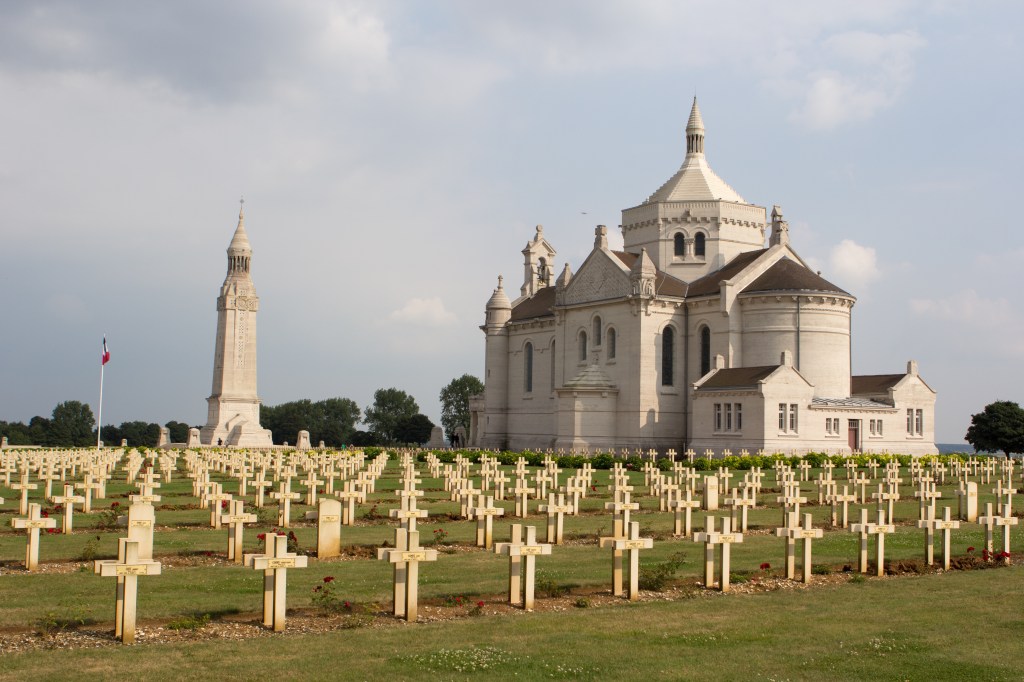
From the Necropole Notre Dame de Lorette, a boulevard runs two kilometres, to our night’s destination in Souchez. Its wide footpath is posted with images of devastation wrought in this region by the First World War. On the way in and again on the way out of Souchez heading towards Arras, you can see allied flags fluttering on the horizon, including Australian and New Zealand ones marking the graveyards that dot the area through which we re walking.

On ANZAC eve, about half-way along our way to Arras, at Mont St. Elloi, we ran into Australians for the first time in 200 kms. They are driving around, and on their way to the ANZAC Day celebrations at Villers-Bretonneux – another place where young Australians fought and died a long way from their island home. In Arras, the very next day, we meet our second Aussie, sitting on a bench along the path that leads the walkers out of the city. He tells us he has just been to the ceremony at Villers-Bretonneux.
Far away from the battle fields, way down under in Australia, the war has always felt to me more like a tall tale: at best a myth to manufacture nationalism for a colony of white settlers, on an island, whose security is never seriously threatened by foreign powers scrapping over Europe.

But all across the north of France, the land is pock-marked with war. Some days we have counted more war memorials than people in the tiny settlements between farms.

In Arras, a historic town with its roots going back to the Iron Age, every significant building has been re-built after either the first or the second World War or both. Around its over-large cathedral, severely damaged in 1917 there are memorials to the many distant nations who sent men (yes, mostly men) to die for and rebuild France – even the Chinese.

I don’t know enough history to comprehend this. The Indian soldiers, I guess, were dragooned here by their British colonial masters, but what were the Chinese doing here so far from home? (Though not quite as far as the Australians!)

On our way from Arras to Bapaume, where a tiny shelter measures the distance to ‘Cant orbery’ we met Dominic, the volunteer whose job it is to maintain this part of the track. Through his broken English and my Walking Buddy’s fractured French, Dominic none-the-less worked out that we have come from Australia and insisted on showing us the ‘Australian trench’. To the untrained eye, the trench looks just like a hole in the bush. And in a sense, it really does not matter whether or not it really ever was a trench – it’s a story that connects, allows for a moment’s camaraderie, even where language has mostly failed.
In Bapaume, a minute’s walk from the VF stands a beautifully maintained Australian cemetery.

On ANZAC DAY, a fellow Aussie had left a message for his grandfather who died in the war.

India’s English rulers thankfully did not regard Bengalis as a martial race. So I have no direct experience of loosing someone important in a war. The ANZAC mythology continues to be no more meaningful to me than any other story of poor judgement and foreign military adventurism. But the common human condition of futile loss to wars is made concrete here in the acres of graves we have walked past and will continue to walk past in the next week or two.
If the Camino provides – perhaps in this instance, it provides me the opportunity to feel empathy, even if the meaning of it all still eludes my grasp.
For hiker, pilgrim, blogger Joanne who is on a ‘Bloody Long Walk’ through the war graves with her own questions.

 Reading the Road
Hi Krishna
Itâs so interesting to follow your walk â you âll get to know different parts of France so well and this war-worn area of Northern France is pretty sobering. People living there will be permanently reminded by the bloodshed that occurred on their lands, what with the many memorials dotting the landscape. Soon you will enter some more uplifting terrain perhaps, for example the champagne vineyards around Reims! And the weather will gradually get warmer â not sure whether that is a good thing or a bad thing? Enjoy your continuing track and hopefully weâll see you both late June or thereabouts!
X Ien
LikeLike
Sobering is exactly the word. Thanks for staying on the journey😊
LikeLike
I wrote a lengthy response here – seems to have totally disappeared now that I check back! Hmm!
LikeLike
Jim, my connections were acting up and today it took me ages to post. Please send again if you can. Thanks so much.
LikeLike
I’ll try to re-do to-morrow…it’s gone 2.30 am here – I’ve just finished a major piece of writing (66,000 words) time to sleep!
LikeLike
Good night Jim. Didn’t realise you were working on something big. Hope it’s going well.
LikeLike
I am going to reply here – RTR – taking your hint that my post might be too long – and already twice posted, twice not appearing – I have copied it – now here:
RTR: No longer the same as the post I lost – but here goes again – sort of. Yes, recently – ANZAC (Australian & New Zealand [Aotearoa)] Army Corps) Day – a day on which the people of these two neighbouring countries in the South Pacific zone “celebrate” all those who have served, died or survived wars going back into the late colonial 19th-century (Sudan and the Boer War – that war straddling the entry of the nation into Federation (January 1, 1901 – said to be the last official act of Victoria). Then The Great War, the Allied Intervention in Russia (Murmansk/Archangel 1918/1919) – WWII, Korea, the US War Viet-Nam – Iraq, Afghanistan, Syria…there seems not to be a war that the Australian government of either major colour can avoid. And given all those wars and memorials and monuments and plaques scattered across every small and large town – almost nothing about the wars of conquest by the British invaders against the First Australians from 1788 onwards – their courage only recently being made plain in books and in documentaries – but still no part of the national War War Museum in Canberra. I have visited war cemeteries at Anzak Koyu and along the peninsula – and seen the grave markers of Australians – and those from India of that period – in Nouvelle Calédonie, in PNG, in Japan, too – sites of PoWs and BCOF cemeteries in Hodogaya-ku at Gontazaka in Yokohama – including British, Australian, Canadian, NZ and Australia sections – planted with the trees of the appropriate nations. I have not visited the war cemeteries through which you have been walking but both my Kent-born and my Parkes NSW-born grand-fathers served on the Western Front and suffered G.S.W. (gun shot wounds) – narrowly escaping death, my maternal g’father, when he was relieved from trench duty returning to sleep – his usual hammock was occupied – he moved further along – and so escaped the shell which killed the poor chap in that hammock. My paternal g’father – his wounds were still being attended to after his return in early 1919 – clearly suffered shell-shock (PTSD and moral injury, too – he had admitted to killing a young German lad, pleading for his life – it was reported to me – my grand-father himself a mere five-foot tall!) Thinking of the path through which you were walking last week I was also thinking of the great anti-war novel by Erich Maria REMARQUE of course – Im Westen nichts Neues translated by the Australian (and Great War veteran) Arthur Francis WHEEN (great uncle of a friend in Sydney) as All Quiet on the Western Front. In 1929. And translator of others of REMARQUE’s books, too. Which takes me in thought to that other great anti-war novel of WWII by the US writer Kurt VONNEGUT “Slaughterhouse-Five” a somewhat magical re-telling of his war service and survival of the napalm conflagration destruction of Dresden in early 1945 – being with other POWs in the underground abattoirs. ANZAC Day is – for me at least – a kind of circus nowadays. It’s not only a reunion for old services people – some marching with old units – others now very elderly and infirm – in cars as part of the parade – people fluttering flags – but of children – even in prams pushed by parents. It’s a mix of true grief at the loss of so many young people and of the maudlin and political photo opportunities. And nowhere do I find strong voices speaking out against war and war-mongering. We are now in this nation at least all gun(g) ho for fighting or contributing to the mess that is Ukraine or being stoked up by our US masters for a war against China. I am not joking about the US masters – there are dozens of them here in Australia running our military reviews, weapons preparedness (to be bought from the US, of course!!!) and infiltrated and funded by the US government in our so-called Policy think tanks… Of course I am a teacher – and a teacher of literature and history – a double danger to those who like their propaganda very much soft and in the background. I really enjoyed your quiet reflectiveness as you walked through these cemeteries and met folk there for services of remembrance. Thank-you!
LikeLike