To the top of the World…

Bourg-Saint-Pierre

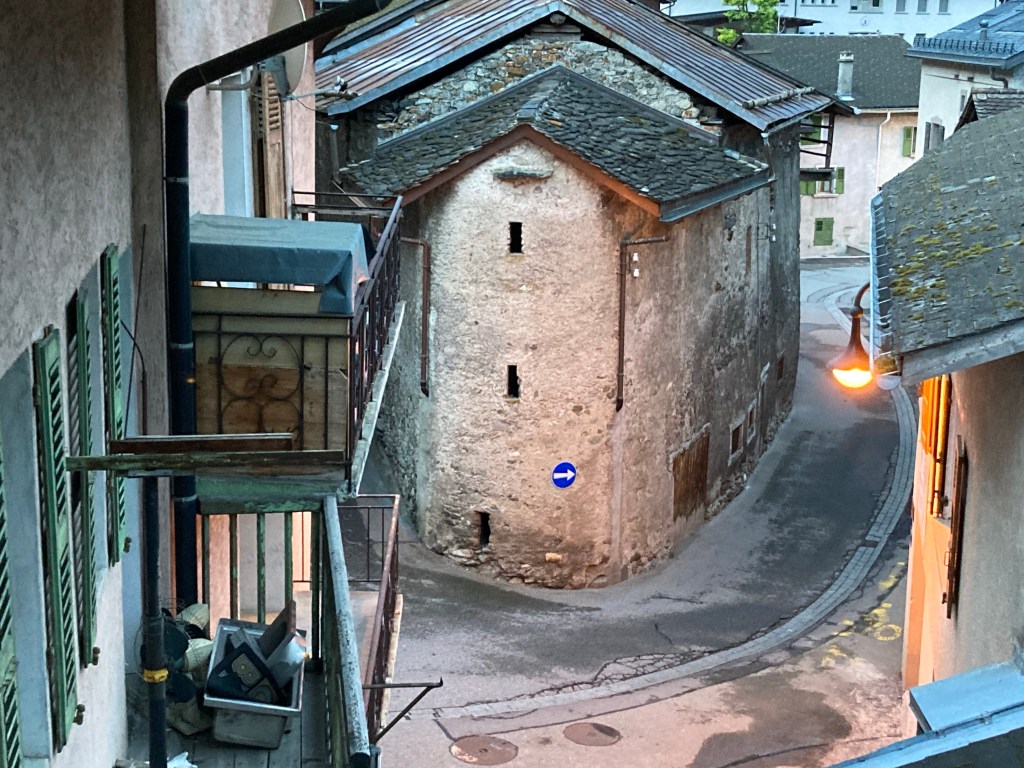
The pretty little mountain village, Bourg-St-Pierre is perfect spot for a night’s rest. From here it is just 11.5 kms to the Col du St Bernard, the pass between the two highest mountains of the Alps, Mont Blanc and Monte Rosa. St. Bernard is our final destination on the Via Francigena.

The Alps as you walk towards the Pass

St. Bernard’s Pass is steeped in history and symbolism. All roads might lead to and from Rome. But across the mountain range, paths are few and far between. Some experts say that this pass has been used by people since the Bronze Age, well before the city of Rome was founded, and several millenia before the birth of Christianity.

If, like me, you had been wondering all along the VF whether you were really following Sigeric’s path to Rome, here at a narrow pass at nearly 2,500 metres above sea level, you can be pretty sure that your footfall couldn’t be too far from where Sigeric walked (or perhaps rode a donkey?) 11 centuries ago.

21 June 2023 – dawn had barely broken when we set off for our final day on the Via Francigena. Other than a brief descent to cross the River Dranse, the road sweeps inexorably upwards. I feel as if the thousand kilometres walked in the last two months were just the preparation for this climb, to that mountain pass just ahead: there to marvel at the grandeur of the snow-capped hills, to reach the sanctuary that Bernard of Menthon built circa 1049 as a respite for tired and hungry walkers.

Climbing past pine trees

On paper, the walk to the Pass is not much steeper than the 1000 metres we climbed the previous day to get to Bourg-Saint-Pierre, though our VF app rates today’s walk as ‘challenging’ while yesterday’s was merely ‘moderately’ difficult. And just 5 days ago, a walker reported icy slopes in the final stretch to the top.

But I am bursting with so much anticipation that I hardly feel the ascent as we climb past the pine trees, and beyond the Alpine timberline.

Frolicking Bulls

Then: Difficulty strikes… in the shape of three young bulls. Yes, no bull! I mean yes, definitely bulls. They are standing right on the path, indeed right in front of the stone marked with the Swiss yellow track sign. And there are hundreds of other similar looking creatures as far as the eye can see!

As I am trying to recall what the brave Pandava heroes of the Indian epic did while facing various impediments on their post-retirement final walk up into the heavenly mountains (too long a story to tell, but you can read it here if you are really keen), I notice my courageous companion is silently slinking away.
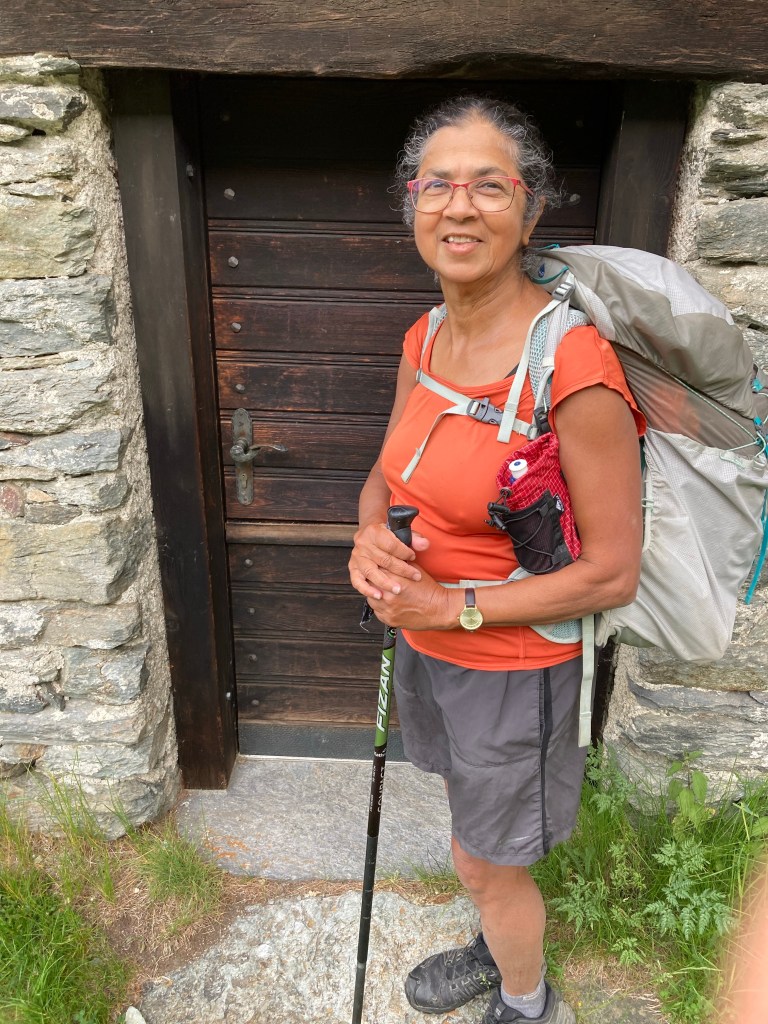
Hobbit house

To cut a long story short, after discounting many absurd options proposed by you-know-who, I walk back to the tiny cottage we had passed just a few minutes back and knock.

Not Frodo the Hobbit, but Michael the Angel answers the door in the guise of a Swiss German having his morning cuppa. Patiently, he explains that those creatures in the paddock are completely harmless to humans as they are either cows or ‘young bulls, just playing.’

Half hour later, having repeated his assurances in many languages and tones and realising that we are settling in for the night unless he walks us off his property, he sighs, pulls on his boots and proceeds to escort us through the slough of the bovine mire. For the record, even Michael has to pick up a log at one point to discourage the young bulls from getting too playful.
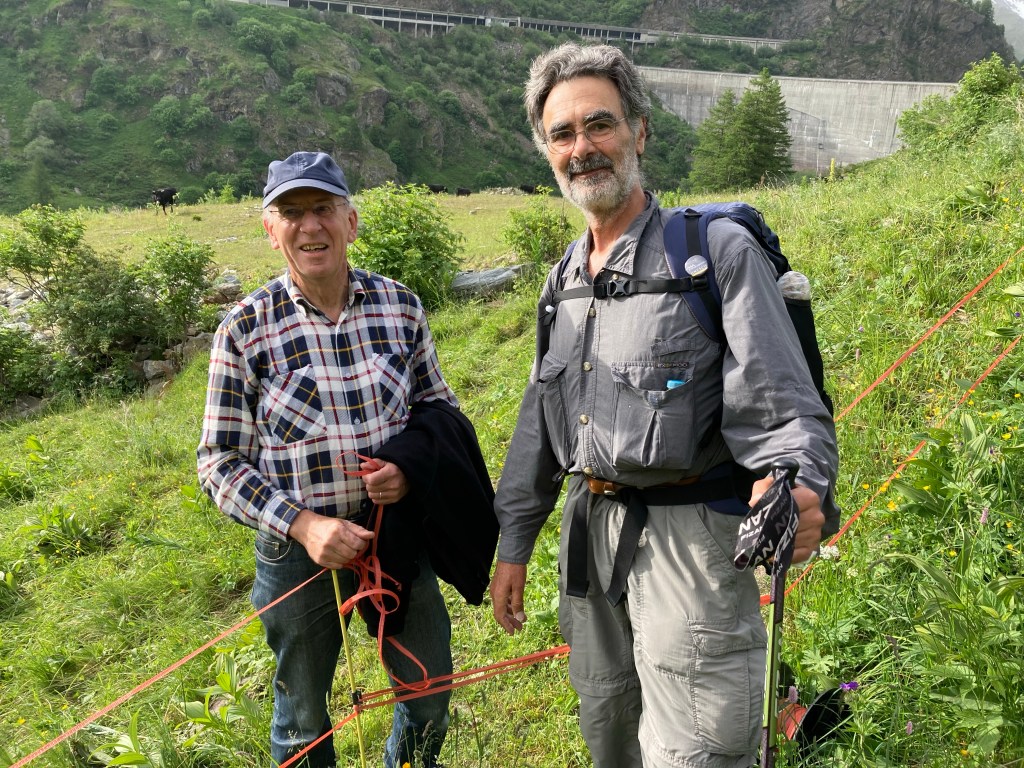
Archangel Michael saves the day – so what’s new?

Apparently the herds of cattle spend a week each year on these lower hills, before setting off for higher pastures. Michael is a font of local knowledge but has a devilish gleam as he bids us ‘bon courage’ (because we clearly need some) adding ‘I have never seen pilgrims frightened by cows.’

Lac des Toules

Past the cow crisis, the intrepid walkers are immediately rewarded with stunning views of Lac des Toules, the mountain lake fed by River Dranse. It gets even more exiting when a pair of Alpine Marmots put in an apperance!

Marmot show

You’d think at this point a walk could not get better. But somehow it does.

Snow-melt streams

In the final three or four kilometres the path leaps over the national highway and tunnel which are now the main thoroughfare from Switzerland to Italy. Heart pounding from the climb, adrenalin coursing through the veins, it is all too breathtaking for words (yes, puns intended).

See the Hospice? We are almost there

We walk skipping through melting snow and then a final tumble across ice and we are at the St. Bernard’s Pass Hospice.

Final stumble

The weather at the Pass turns moody. We had been walking for weeks with spring on our back, facing into summer. But suddenly in the last hour the sky turns grey. The mountain lake, crystal clear when we arrived at two in the afternoon, is blanketed in a milky mist the next morning.

Lake St Bernard

There is something dramatic too about a mountain shelter that has stood open for a thousand years, every day of every year. Though much has changed. The mortuary which once housed the remains of medieval travellers who perished on the icy slopes, has long been closed. The monastery, which Bernard of Menthon established, persists but with only a handful of monks.

Retired

Even the famous St Bernard dogs are now just tourist attractions, as sophisticated search and rescue technology has made them redundant.

Car access to St Bernard’s Pass Auberge

St Bernard’s Hospice is now a hostel and a more up-market Auberge, which continues to house travellers, though these days, unlike Bernard’s times, few are starving and many roll up on wheels, via the sealed road.

Still, compared to most pilgrim destinations, Varanasi, Mecca, Rome, the cool emptiness of the refuge that Bernard created seems an awful lot closer to a haven. But then again, Indians have always imagined that their gods live up on the top of the icy mountains (Himalaya means the land of ice). The kings and queens of the epics always head for the hills at the end of the story. So, perhaps, it is just the stories in my head that make St Bernard’s Pass such a perfect place to end a long journey.

A misty end

300 kms: Long Way to Walk for Foie Gras?

Foie Gras in Laon, WB has already eaten his share!

If you have been to Paris or travelled in the many tourist destinations around France, you probably would not believe that there are culinary deserts in some parts of this country, where you might be grateful at the end of a 20 km hike, for the micro-wave ready curry (which has been slowly defrosting in your ruck-sack all day); because a few nights before, dinner was boiled egg and bread kindly provided by your rural gîte host..

Some of the tiny settlements along the path we have been walking through Hauts-de-France have no shops of any description. Even in middle sized towns, like Tergnier, which you reach across vast railway yards and streets lined with blocks of flats, eateries are an unenticing string of pizzeria and friterie along a busy highway.

Railway tracks around Tergnier

In smaller places you can have the strangest conversations with Google’s translation services. Here I quote the end of an sms exchange between Walking Buddy and very kind Air B&B Host at Bertaucourt (village of maybe two dozen houses, a little off the VF track):

Host: No food here. No shop.

WB: Can you perhaps leave some bread and cheese in the house?

Host: Because I already went to the races yesterday. Cannot go today. (WB can find no adequate way to respond to that)

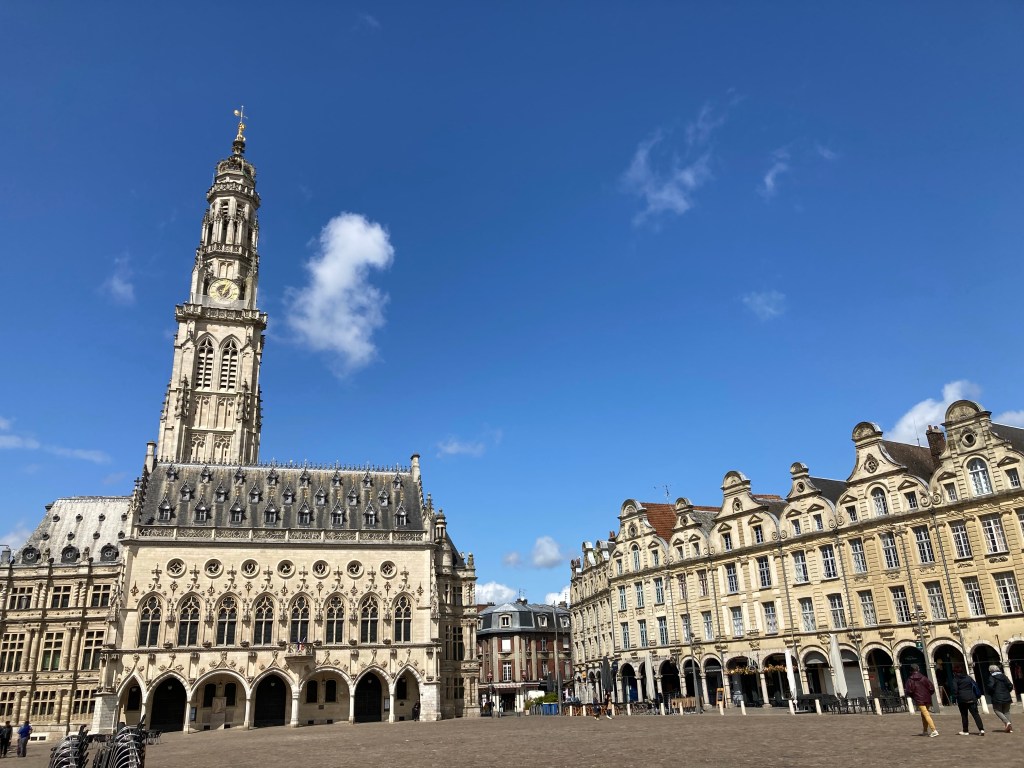
Even in the more touristy places, like Arras, with its historic churches and city squares, the daily rhythm of the walker is often out of kilter with that of cafes and restaurants. Walkers often want their breakfast unseasonably early and dinner unfashionably so. And when they walk into town in mid-afternoon every reasonable cafe owner is having a little break between the lunch and dinner crowds.

Arras town square

That said, it does appear that there is a little bit of a problem with food in Pas-de-Calais, the westernmost province (department) of the Hauts-de-France region, where the first quarter of the French VF lies.

At the tourist office in Arras. I asked the lovely young woman with fluent English, what we should sample as local food. ‘Hmmm’, she said, and ‘aahhh’ after much metaphoric hand-ringing. She comes from an area further to the south and clearly does not want to say anything negative. Eventually she says ‘well, this area has a lot of chips and also some local beers.’

We have been walking between potato and canola farms for two weeks or more and some super-markets in this area stock more varieties of potatoes than pretty much all green vegetables put together. For environmental reasons one should indeed eat locally grown foods, so chips make good sense. And, way back when, this area was ruled by the English for over 200 years. And that is all I am saying about food in Pas-de-Calais Department of Haute de France.

Gateway to Laon, Aisne department in Hauts-de-France

We had walked a little over 300 kms from Canterbury when we panted up the final 100 metre ascent into the medieval walled city of Laon. The Cathedral was built to strike awe and from the top of the town the surrounding plane is astonishingly lovely. It is, however, May Day and 3 p.m – only fools and foreigners would want to eat at this hour. Fortunately, the gourmet eatery, just across the Cathedral square will open at 7 and yes they can fit us in!

Cathedral Notre Dame: with dinner over a long May sunset

Really, one should walk a long way before eating Foie Gras – there are 462 calories in every hundred grams of the stuff and then there is the burden of sin from eating food with a dubious history of animal cruelty which demands additional self-flagellation.

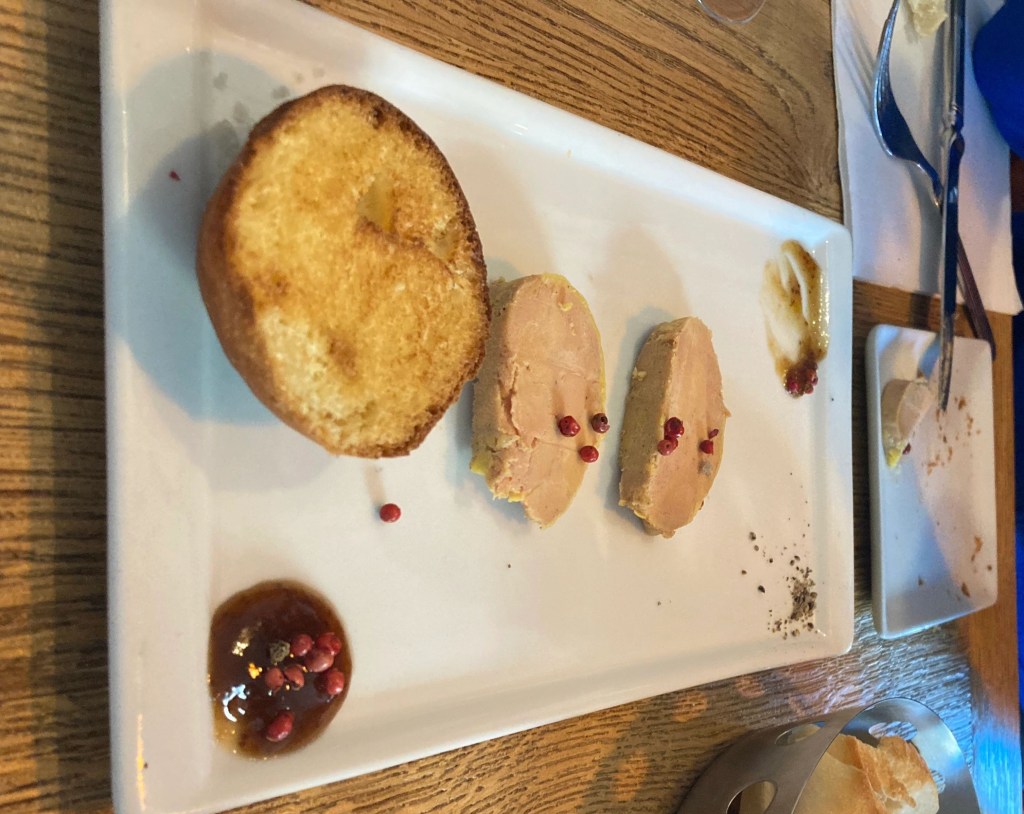
The chicken mousse amuse-bouche goes before I can take my camera out. Followed by Fois Gras which WB has been praying for since we landed in Calais off a stormy sea. Then the ‘local speciality’ ‘rabbit sausage’ for WB and ‘pour Madame?’ They can recommend the dish always popular with English tourists, ‘duke with o-hwr-aange’.

Half-eaten, so you can’t see how pretty it all looked!

As April turns to May, the ground underfoot is firmer. With days so long, it is less daunting to take on longer distances.

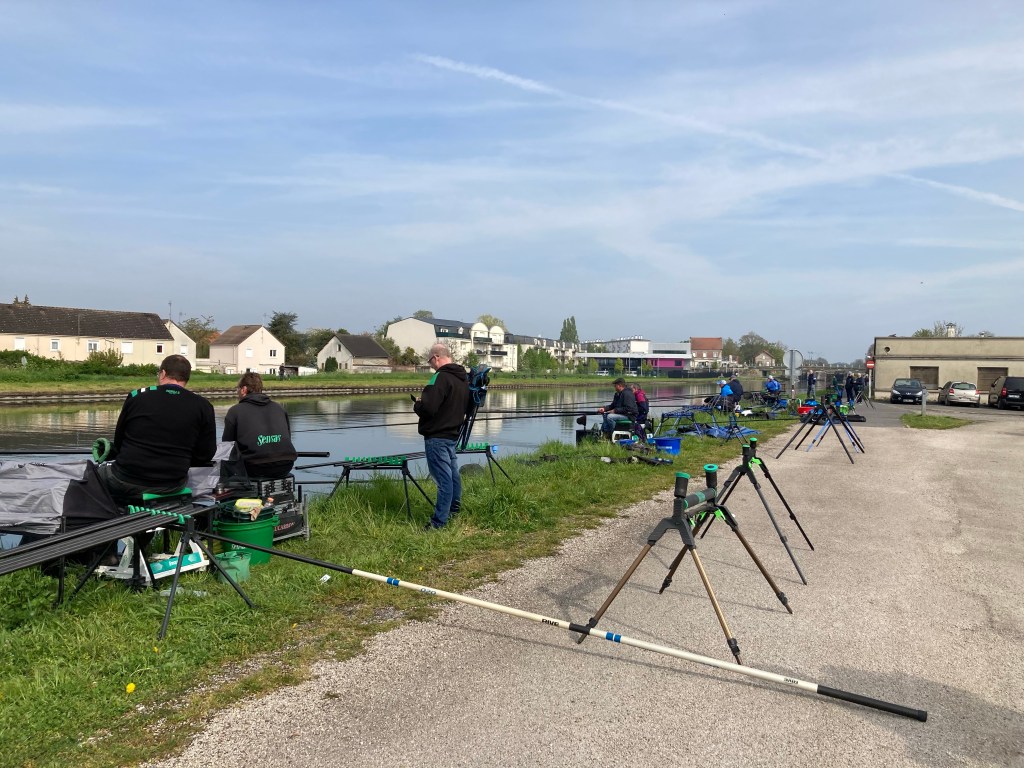
The topography is changing too. Past Peronne on the north-east corner of Department Somme, the surroundings have mellowed, with rivers and canals criss-crossing the way, some of which runs through pretty parklands. Sunday in mid-spring has brought fishermen out in droves, and yes, they are ALL men – with fishing rods longer than I ever imagined!

Walking into Laon was an up and down affair, with hillocks rounding out the harsh flat horizon we have been chasing for the previous 250 kms since Wissant. The foie gras has soothed the hungry spirit, and no doubt given us wings to take on our first 30km day tomorrow.

WB’s French is improving by leaps and bounds: he has stopped introducing me as his Mary or Mairie or Mari in turn. But I still cannot tell the difference between ferme and a ferm, which is a bit problematic when trying to book accommodation, when the only place within a cooee (in Australian parlance) is a farm gite, firmly shut since COVID killed off the trickle of tourists passing through the village…

NB: the title of this blog is inspired by Brian Mooney’s book about the Via Francigena, A long way to walk for a Pizza

‘Pilgrim How You Journey’

The Road

An ill wind, not just metaphorically but literally, has been blowing these last few years – a wind that has disrupted travel, and turned the clinical acronym, COVID, into a household word. In addition, the minuscule particle of the world, that takes up most of Yours Truly’s attention, has been focussed on another C word.

Now that all that’s been sorted with a few rounds of chemo and antidotes and potions, for the convalescent, the doctor and the Romantic poet alike have prescribed daily walks and fresh air.

‘Afoot and light-hearted, I take to the open road,
Healthy, free, the world before me,
The long brown path before me, leading wherever I choose.’

So writes Walter Whitman, the great grand-daddy of American poetry.

However, as far as we know, Walt never did walk the thousand kilometres of GR 145, across the north-east border of France to the Great St Bernard’s pass in Switzerland. Nor did he have to deal with my meticulous Walking Buddy (WB aka ‘Co-Pilot’), who is prone to brandishing his 29 column spreadsheet detailing weights, dimensions, pros and cons of every piece of hiking equipment ever invented.

So, as I struggle to decide which backpack is best for this precise trip and which sleeping bag has the ideal weight to warmth ratio, (for the record, I have landed on Osprey Lumina pack and a Spark-I sleeping bag), most of that light-hearted free-footing open road still sounds like a distant fantasy.

Pack weighs 6 kilos after I took the kitchen sink out🙄

But by all accounts a ‘long brown path’ does indeed loom ahead of us, which my mobile weather app says is likely to be woefully wet and monstrously muddy when we take off on foot from Canterbury on Easter Monday.

Given the coincidence of Christianity’s holy place and holy day at the start of our hike, you would think that we are on a pilgrimage. And given that there is not a single religious bone in my body, I too have been wondering about my fascination with the pilgrim walks of Europe.

Part of the answer lies in the relative ease of these walks. Unlike what the Americans call ‘through hikes’ in the vast wilderness of the American or Australian continents, Europe’s pilgrim walks have been curated over a thousand or more years for travellers, traders and armies and are being refurbished now for the walking-tourists. On the Via Francigena (see map above), as far as we can tell from books, maps and apps, you can more or less plan to reach some source of food and shelter at the end of each day’s walk.

Of course you need more than the convenience of lousy hotels and average food to keep you on track day after day! And, somehow, at least for me, the idea of a pilgrimage, that is, the certain knowledge that many, many people, over more than a thousand years of recorded history, have found joy and imagined salvation on these very roads, helps to keep a certain focus, to keep one going.

But this isn’t really a good time to get all spiritual when the prospect of hot-footing 1300 kms (give or take – wait for a later blog about the malleability of this road) seems a little daunting and even unreal while I weigh and spray my ultralight gear and deal with practicalities of contemporary travel: the COVID certs and credit cards and so on.

I know, too, from reading the works of those who have gone before me on this road, especially the classic 1903 travelogue by Hilaire Belloc , how easy it is to lose your way and break your vows on this particular pilgrimage. Belloc broke most of the promises he had made within the first week of his walk. Admittedly, he was carrying half a bottle of alcohol which I am not, and his sack would have weighed a ton compared to my feather weight uber-modern gear.

Belloc did however reach his end goal – he got to Rome, having walked 750 miles. Along the way, he kind of worked out the importance of letting go of the small promises in order to walk on.

So, perhaps we define the pilgrim by the how rather than the where and why of the walk. On foot and carrying all you need for the day; with a determination to reach a destination but knowing also that plans and promises are necessarily provisional.

‘Pilgrim, how you journey
On the road you chose
To find out why the winds die
And where the stories go’

For now this song by the Irish singer , Enya, resonates.

I hope some of you will come along for the read (not really a ride, is it?) while I try to walk and inscribe the Grande Randonnée (GR) 145, or Via Francigena, a long road by any name.