How to Lose and Find: on the Way to Ulm

For those of us with zero German, “Ulm” is a gift of a name. One crisp syllable. Easy to say, easy to remember. But—if you’re arriving by bicycle—may be not quite so easy to get in.
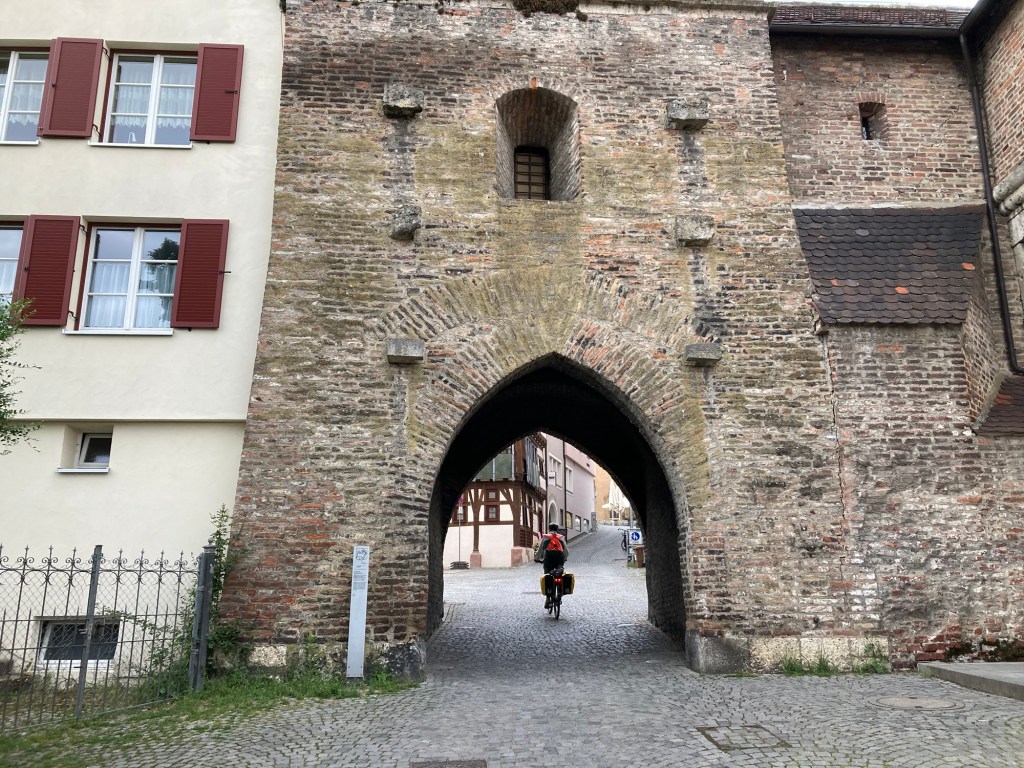
We found the gateway to Ulm! Eventually…

Our guidebook, published five years ago, helpfully warned of major construction works along the approach to Ulm. We assumed they’d be long finished.

We had not done our homework.
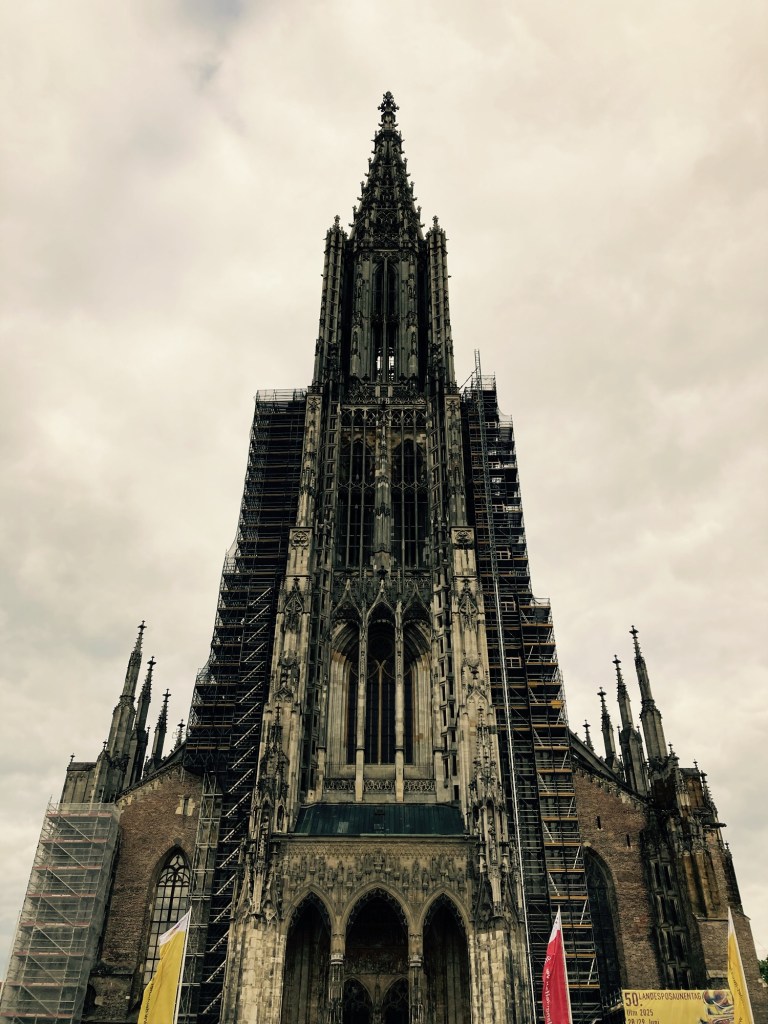
Impressive height: Minster and the scaffolding!

Ulm’s world-famous Minster, boasting the tallest church steeple in Christendom, took over 500 years to build. Construction began in 1381 and wrapped up in 1890, with a casual two-century pause somewhere in the middle while it transitioned from Catholic cathedral to Protestant minster. Renovations, which started in 2015, are scheduled to continue until 2030. Clearly, Ulm takes the long view.

So we shouldn’t have been surprised when, on the outskirts of town—with that soaring steeple within sight—the Danube Cycle Path ran into a literal wall of red road signs, metal fencing, and firm authority.
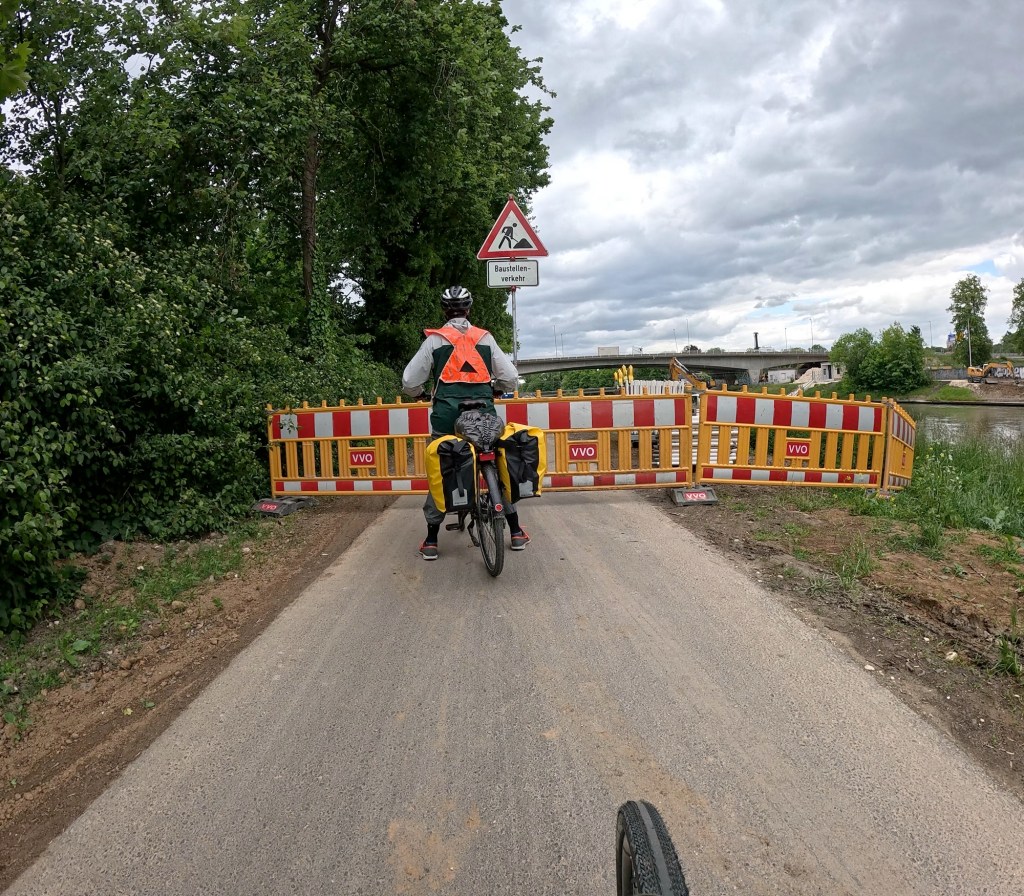
NO GO!! Road works ahead for the next several years???

We tried the usual tourist tactics—confused pointing, hopeful shrugging, miming alternative routes—but were met with a firm “NEIN” and some impressive hand gestures that strongly suggested, go away.

So we turned around. Slowly.

Looking for… anything, really. A path. A clue. Divine intervention.
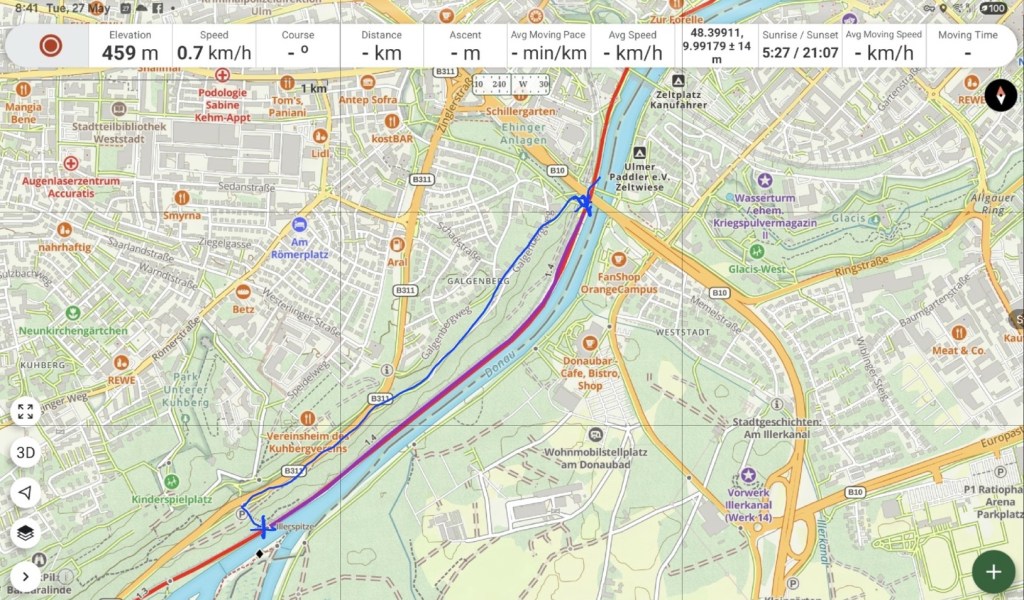
Detour map by CS: stop sign to hole in the ground

About a kilometre back, we spotted what might once have been a railway underpass, now reclaimed by moss and mystery. It didn’t appear on any map. It could lead to the road which we could hear somewhere overhead, or to Narnia. CS (Cycle Sidekick, not Lewis) went to investigate on foot. I stayed back with the bikes and a brave face.

Moments later, three Germans on sturdy electric bikes rolled up. I launched into an impromptu game of charades:

Lost Tourist 😞 → Blocked Road ✋🤚 → Detour? 🧐

The man in the group nodded in quiet understanding and, without a word, disappeared into the same tunnel where CS had vanished minutes earlier. We three not-so-young women looked at one another. New to the etiquette of cycle touring, I wondered if this is how route-finding works here: when in doubt, follow the most recent person who disappeared.
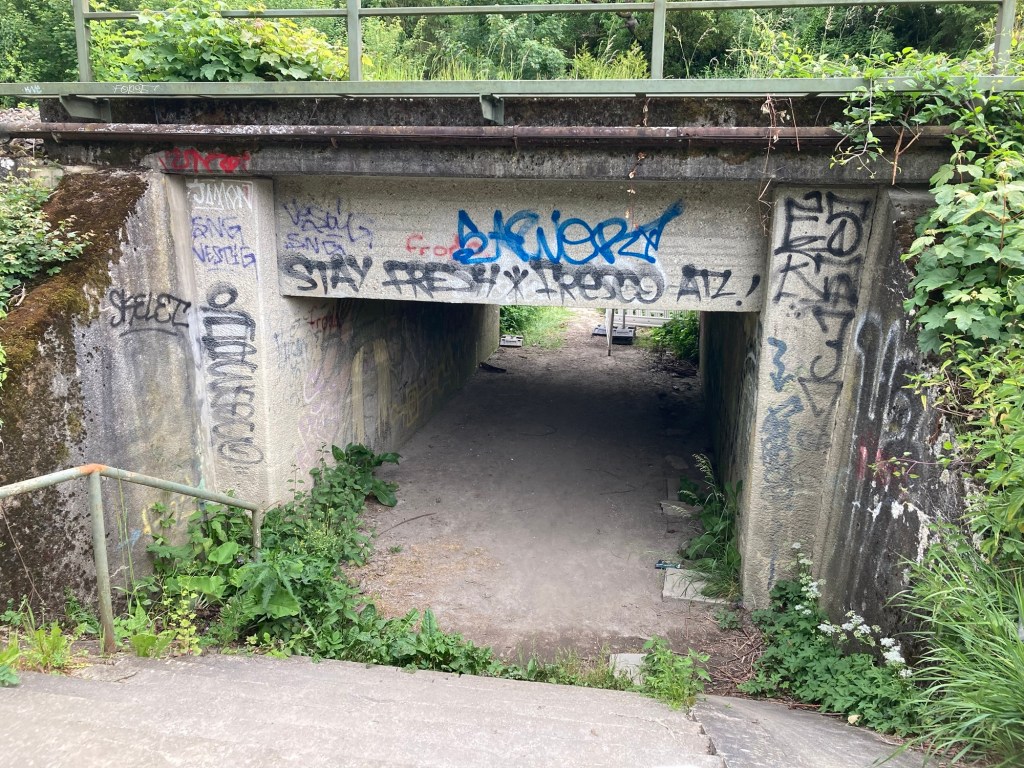
The hole in the earth

Just then, a much younger man emerged from the same underground passage where two older ones had disappeared, and began speaking to one of the German women in gestures scattered with sort-of English words. She looked puzzled: why would this man think she was married to a lost Australian on the other side of the rail track?

Thankfully, pretty soon, both husbands (hers and mine) reappeared. Mistaken identities were sorted and better still, we now appeared to have a way forward.

With no more ceremony, the young man grabbed my bike, still laden with two panniers and hauled it up some 30 crumbling steps of the underpass and onto a back lane somewhere above ground.

The rattle and shake of our way forward

We barely had time to thank him before he zipped back down to help the two other women with their far heavier e-bikes. Three lifts, three zips, and he was gone—vanished back into the tunnel like a character from a cycling fairy tale.

Obviously he was a ‘track angel’: those miraculous creatures who appear whenever you are faced with insurmountable problems, on a long road (whether hiking or riding) and disappear before you can whip out your camera and take a photo. If you have not met one, that is only because you have not needed one yet.

The river by our side

But it wasn’t just him. All week, cycling through Bavaria and Baden-Württemberg, we’ve been met by unexpected kindness. The sort that steadily dismantles the cliché you’ve learnt about German formality.

Unexpected, perhaps because the stereotypes are so deeply embedded. Germans, you are told, are efficient, punctual, law-abiding…no one said they were funny, warm, generous.

Early in the week, a young German cyclist had said to me wistfully, “I really want to visit Australia. Everyone there is so friendly.”

“Germans are friendly too!” I protested.

He remained unconvinced: “Maybe to foreigners. But to each other? We are… quite strict.”

Baker and friends, Fridingen

We all know, of course, that such generalisations can only be wrong. That the real story is told in individual moments of engagement, in snippets of conversation. Like when the owner of Fridingen’s Donauback Bakery, insists on giving us a bag of rolls—“German bread, to try!”—and refuses every attempt to pay. When the youngest monk in Beuron’s ancient monastery shares his passion for the art movement born within the walls of the cloister. Or the retired linguist who once cycled this same path we are on, gently unravels the highs and lows of our own upcoming route. And all the faster cyclists who stopped to explain a sign, translate a menu, or point us gently on our way.

And just when we thought the surprises were done for the day, the woman at Ulm’s tourist centre beamed and said, “Oh, but you must stay extra day! Deutsches Musikfest starts tomorrow.”

Organ in the Ulm Minster

There was free music, everywhere—from the ethereal organ concert under the soaring ceiling of the Minster to brass bands bouncing off the cobbled streets round the old city square. You can’t say no to such gifts: from the river, its shores and its people!!

Moop Mama, band from Munich

The Danube has carried us through more than towns and meadows—it has been a river of goodwill.
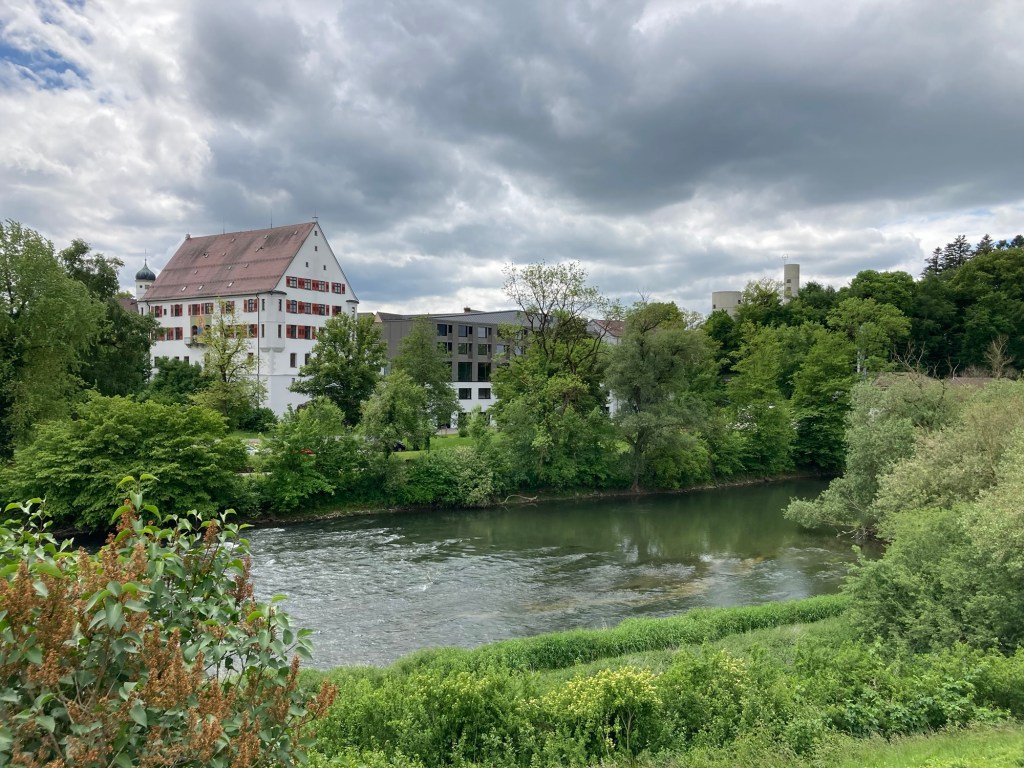
The Danube way: practically perfect despite a few challenges

So, with full panniers and bellies full of bread, we wobbled out of Ulm—serenaded by good memory, and carried by hearts full of kind vibes, a little pedal power and just a dash of curiousity about what we might loose and gain around the next bend of this river.
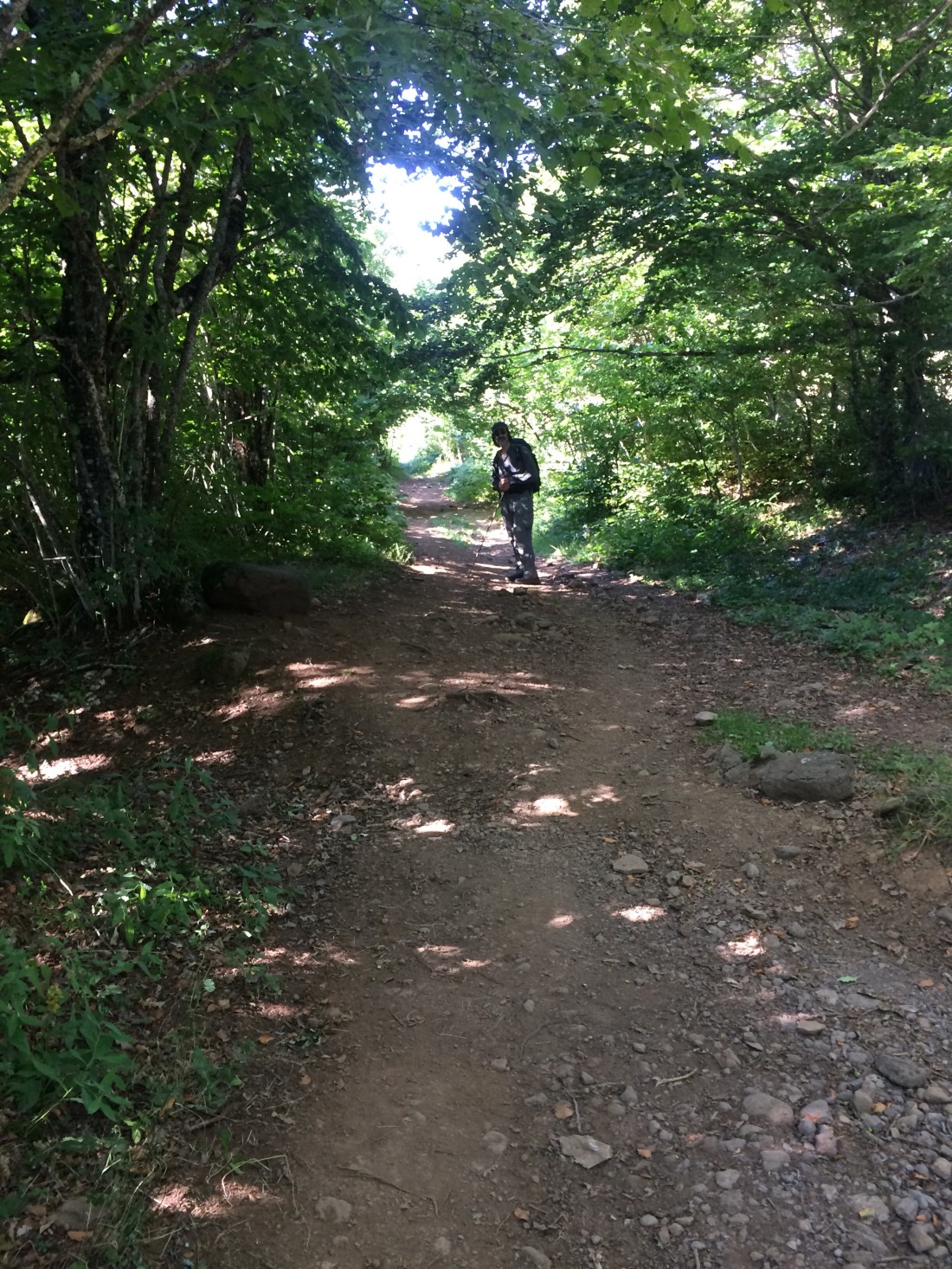
La Route Est Longue

Photo: One day in August 2018, on the Chemin de St. Jacques.

In 1978-79, American Jim introduced a young woman from Kolkata to what he called hiking (that is hours of walking and days at a time), and his long-time mate, Aussie Barbara, called ‘bush walking’. Jim and Barbara had hiked in the US, in Asia and been on heaps of bush-walks in Australia.

The Kolkata Bengalis are build for comfort not for speed or any mobility at all, really. Tagore the greatest Indian poet described his fellow-Bengalis thus:

‘Short of height and wide of girth.

Bengal’s children buttoned up.

Peacefully asleep.’

Against all odds, Jim and Barbara persuaded the Bengali girl to come on a four-day hike in the Flinders’ Ranges in South Australia. She failed to learn any bush craft. They let her off camp duties. They gave her the lightest pack. Still, while stumbling through the bush, falling over in every puddle, held up by the scruff of her neck, she caught their walking bug.

Photo: Pulled along by Barbara, Flinders Ranges, South Australia, 1978.

Jim is the older brother I never had. Many in Indonesia, Australia, and elsewhere know him as an academic who wrote and taught about 20th century Indonesia and world politics. For me he did what older siblings should do – they teach you the simple things of life. Jim taught me the pleasure of walking – walking long distances.

In the last three weeks, while I have walked about 400 kilometres on the Camino in France, Jim has been doing the real heavy lifting. He has completed the last visit to his beloved Indonesia and has begun the last leg of his unique through-hike, as the Americans call the really long wilderness walks.

In 2014, I walked 780 kms, with my own walking-buddy, from St. Jean-Pied-de-port to Santiago de Compostella. The day I limped into Burgos moaning from shin-split pain, we were overtaken by a man with a tee-shirt saying something like ‘walking for Parkinsons’. We later learnt that he was PD sufferer who was walking the Camino without support. Along the way, other walkers gathered around him, gave him the support he needed on the day, then walked on at their own pace. Each to her or his own Camino.

Jim didn’t really hike much after he lost his walking-buddy in 1996. Parkinson’s disease eventually forced him to stop walking, in the ordinary sense of the word. But he kept going with all the determination of the long-distance walker, that he was. Wisely, he found a track-angel because every hiker needs one and deserves one.

‘La route est longue’ the French say about the Camino and as a metaphor for life.

On a really long walk, the days run into each other. It is hard to remember where you stayed one night or how many kilometres you did another day or indeed what day of the week it is!

Putting one foot then another would be monotonous, except that the foot, even encased in the most expensive hiking shoes is ever-aware of the changing surface: here cautious on slippery rocks, and minutes later gratefully relaxing into silty softness. Legs tighten at even a five degree incline on the road. Hearts pound going up the mound that looked like a pimple on the topographical map.

Each step is made new by the details you can see when you move at walking pace: a tiny brown creature emerges out of foamy pupa, spiderweb hangs from the fencing wires like meters of fine silk. One day the moon shadow stays up all morning. You squint your camera into the light, but it dodges all attempts to record its unexpected presence. In some stretches of the walk autumn has already begun to lay down a carpet of leaves, but just across, spring is still in full bloom in the tiny purple and yellow flowers on the rock. Just when the heat is getting to you, the trees overhead shake off last night’s dew.

On one of those really tedious stretches of flat grey road, flecks from the sky might flutter past as blue butterflies. A dry rocky wasteland of a road. Signs for hunters all around. A man in a flack jacket. Three four-wheel drives mow down the dry grassy stretch beside the narrow track. Then two more men with guns and dogs. A shot far away. Three minutes later, a fawn doe stops you in her tracks. The one that got away, you breathe a sigh of relief.

Some days are perfect. These you recall in vivid detail. Just over a week ago now (around the time Jim went into the hospital for the last time) overnight rain had cooled the ground. We left Figeac in a soft drizzle. Along the way, the sun came out, smiling. The breeze cooled our way and pushed us up the last climb.  Most setttlements show themselves slowly, shyly. But Cajarc burst into view all at once as we reached the high ground, after 9 hours and 30 kilometers of walking.

And from long ago and far away, I can still recall my first ever hike. First night in Wilpena Pound Campsite. First gum leaf tea cooked in a ‘billy’ on the campfire (for the non-Aussie reader, if there are any, a billy is a tin can with a handle). Learning to pack the first borrowed back-pack. Jim is a bit ahead, staking out the way, calling out warnings ‘prickly bush’, ‘go round the big rock’, ‘puddle’…

Bonne Courage Mas Jim, as they say here in France, along the Way of St James.

Photo: End of a day’s walk with Jim and other walking-buddies, 1978