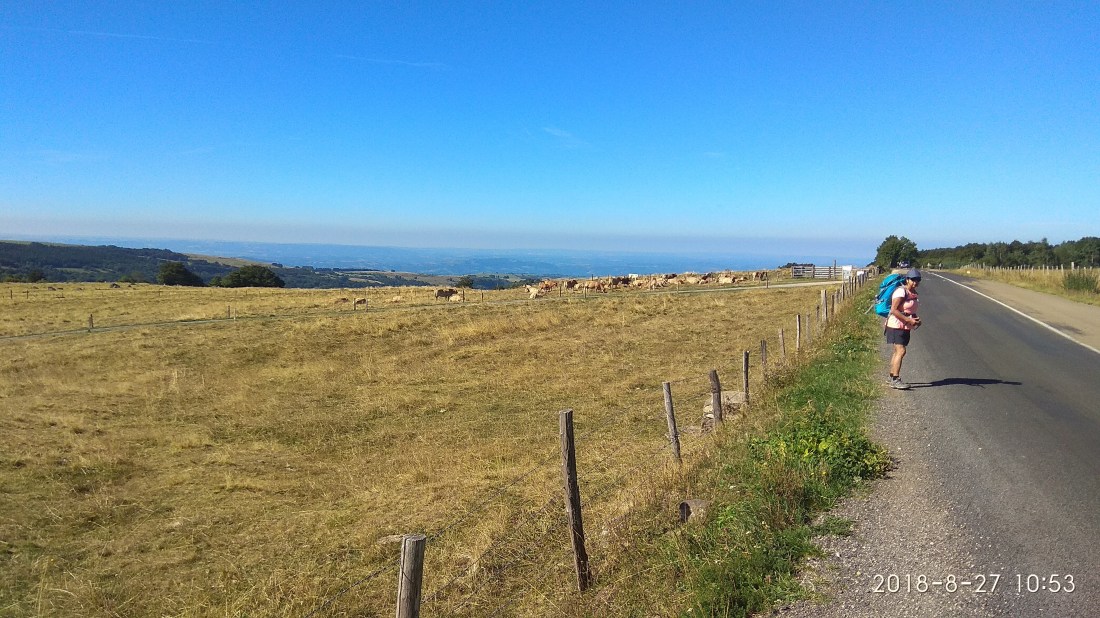

Photo: bitumen roads I loathe
Camino blogs and books are endlessly cheerful and helpful. But friend, cousin and blogger KD (not Lang, check her out at http://daytimedreamz.blogspot.in/ if you want) has asked for a blow by blow of the ‘slog’, ‘the bits you hate’. It turns out that a slog-blog is hard to write. Read on if you want to know why.
Saugues, in Upper Loir Valley, 43 kilometres from Le Puy along the GR 65 on the way to Santiago in Spain. Population – 2000. Cars – too many to count. Temperatures – rising.
A heatwave had swept through France in early August 2018. If you had walked through Saugues any time in the 20th century, the chances of getting temperatures over 30 degrees centigrade would have been nil to negligible (in Australian translation ‘Buckley’s or none’). In 2018, the mercury rose to 30 or more 12 times in August alone. At mid-day on 22 August it got up to to 31. If you don’t believe in climate change and think greenies are making this up, check out accuweather.com and NY Times on http://p.nytimes.com/email/re?location=4z5Q7LhI+KVBjmEgFdYACNmd6jwd34+mWAxqXJXikvjKUyEQPbfuA7oPETN/gXckaokVgSSO2yA=&campaign_id=61&instance_id=0&segment_id=5238&user_id=eb3d4c3f88598c8c16546fe5a3012e11®i_id=73312224ries)
From Le Puy the GR 65 passes through the Massif Central, the French highlands. Most days involve climbs and descents. On day three we climbed out of Monistrol through beautiful forests and on to a plateau, which rolled along for about 7 kilometers then descended 150 meters into a parched and dusty track with no shade. By now the mid-day sun is right overhead.
First sign of Saugues, the settlement which for hours had held out the promise of lunch, water, rest, was an ad for a patrol station! Unique. Never have I ever, in hikes across 4 continents seen a patrol station being advertised on a walking trail. Next, a 30 meter high wooden monstrosity, adervertising Saugues’ main attraction, the Museum of the Fantastic Beast of Gévaudan (Musée fantastique de la Bête du Gévaudan), not to be missed if you like being scared to death by four floors of display about giant wolves, which killed a hundred or more people in this area from 1764-70. Even if you give the museum a wide birth, you are accosted by images of these ogres in the main drag of the city and farewelled at the last round-about out of town by a grotesque metal sculpture of the creature standing across the cowering body of a female victim.
Hotted up cars, and their inevitable consequence, wrecks and service stations, complete the horror that is Saugues. No rest here for the wicked or the weary. So with mercury still rising, we leave town at 2, not anticipating that the remaining 11 kilometres to Le Villeret is going to be on flat, unvarying bitumen roads, with no trees. In retrospect I wondered if this torment was discreetly implied in Maggie Ramsay’s self-published My Camino Frances, which rather politely writes off the day as ‘not having much scenery’.
The next key moment in the slog is best described from the point of view of a 30 something French man washing a mechanical plough with a power hose on a concrete yard, 20 meters off the road. He dodges furiously as a small female, the colour of slow-roasted egg plants rushes into his pressure hose with a tall man the colour of sun-dried tomatoes, hot on her heels. The Tomato man is screaming ‘ je suis désolé monsieur! Ma femme tres chaud’ and other things that make even less sense than ‘I am desolate sir, because my wife is very hot.’ The young Frenchman manages to make the barest sense of what is going on, the woman is drenched to the skin and both strange creatures stagger off dripping with ‘Merci beaucoup.’
Half an hour later my clothes are dry and I am starting to feel the familiar heat-stroke symptoms again: rashes all over my back and waves of nausea. This time a trough of water, recently used by passing herds, by the side of a highway provides the necessary wet respite. Hindus believe cow-dung is sacred, so I am sure a bit of cow spittle can’t hurt. Still another hour, one foot then another, one foot then another…Villages appear in the distance like mirage and disappear. The road is always there, one step ahead, ashen, burnt out, cinder.
It’s 4 p.m. Google map shows we have done over 20 km. I know the end is nigh: death or the auberge where we are booked for the night. At Le Falzet, an old building is getting a make-over. A spout with a welcome sign of ‘au potable’ appears for the first time since we left Saugues. It’s been two hours and a life time since I have seen clean water. One final wetting of tee-shirt and we are off to our delightful rest for the night, Auberge Le Deux Pelerins (the Two Pilgrims Place).
Later in the evening, bathed, cooled, and two home made fruit liquors later, I wonder why so little is written about the contemporary pilgrim’s woes. Most of my dozen or so dinner companions have done the same 23 kilometers, in the same 30 degrees heat. Most did not think it was the worst day’s walk. Beautiful, 20 year old Elle (not her real name – but she looks a bit like a super model) likes walking in the heat. It reminds her of summer walks with her father. She finds the last hour of each day a drag – her feet hurt after about 4 hours of walking. But by the time she wakes the next morning, she recalls only the delicious food and the delightful host of the auberge and she walks again.
Cecile (all names are fake of course) is my age. And like me she is a bad sleeper. She hates those morning when she has just fallen asleep at 4 a.m and the alarm goes off at 6. But she sets off nonetheless with the hope of a better night’s sleep to come. ‘It is like childbirth,’ she says. ‘You forget labour pain – a mother’s brain is designed to forget. Otherwise, no one would have a second baby. Same with the Chemin. Every day you have pain. Every night you forget!’ She gets a round of knowing laughter from the women.

Photo: the daily happy ending at dinner
That is the first problem with trying to blog the slog – when you are that exhausted, you can’t write things down. The next morning, you can’t really remember. There are no photos to jog your memory either – if you still have the energy to take photos, you are nowhere near the end of your tether. So I keep trying in every conversation, to find variations on the theme of ‘when the hike is a slog’, ‘the hard bits of the day’, ‘what parts of this do you hate’ and so on
A week later, I talk to Philip, the only Malaysian I have ever seen on any of my many long-distance hikes and also the man with the whitest teeth. At 48, Philip has pretty much ‘climbed every mountain. And forded every stream’. His nightmare is a day of sub-zero temperatures. Weird. I recall walking in across the French border into Spain in February 2014, as snowflakes floated down all over our rain gear – delight. Nightmares, it seems, are highly individual.
Books and blogs provide distances, temperatures, elevations. Many calculate scales of difficulty on the basis of objective criteria. But the slog-scale is too personal to be standardised or even usefully shared. My system overloads very quickly with heat and bitumen. Those with bad knees suffer whenever a path descends. Philip the smiling Malaysian hates the cold. For Cecile the slog scale operates inversely with the amount of sleep the night before.
To misquote the most famous of opening lines: ‘Happy pilgrims are all alike; every overwrought pilgrim is unhappy in her very own way.’ (Tolstoy, well, not exactly.)
 Reading the Road