Kakadu Road-trip by EV: sensing grandeur, navigating limits

Kakadu National Park is vast – any way you think about it. Located at the Top End, it is Australia’s largest terrestrial national park and home to a whopping 30% of Australian bird life.

Something of the grandeur and gravitas of this place begins to make sense when James, a young Bininj man, budding lawyer and Park Ranger, guiding us around the rock art at Burrungkuy, relates a conversation with his uncle, who is one of the traditional owners of this part of Kakadu.

James to his uncle: ‘some people say there have been humans here 60,000 years. What do you think’. Uncle says: ‘Our ancestors have been here for ever!’ 60,000, infinity, what’s the difference, anyway? James concludes.

Iconic but not necessarily ancient, Anbangang rock art gallery, Burrungkuy

Kakadu is one of just four places in Australia (and just 38 in the world) that the United Nations lists as ‘world heritage site’ under both natural and cultural categories.

We are here in the last week of August, when Wurrkeng (the coolest season) is giving way to the start Kurrung – in mainstream ‘Aussie’, it’s almost spring. About 200,000 tourists visit Kakadu each year – not a great number considering the vastness of the park – nearly 20,000 sq kms. So, even in high tourist season, even on the main road that takes you into Jabiru township, from the gates of the park and back out to Highway 1 at Pine Creek – a total drive of 230 kms+ – you are likely to see more animals than cars, especially in the early morning, including some non-natives, like feral pigs, but plenty of natives too and birds who might just be passing through.

Birds at dawn, Mamaluka Wetlands

Getting to the sublime via the ridiculous

Kakadu might feel remote. But it is just 150 Kms from Darwin to the gates of the national park. And another 100 kms or so will bring you to the little settlement of Jabiru with various accommodation options, or Cooinda with slightly more expensive options.
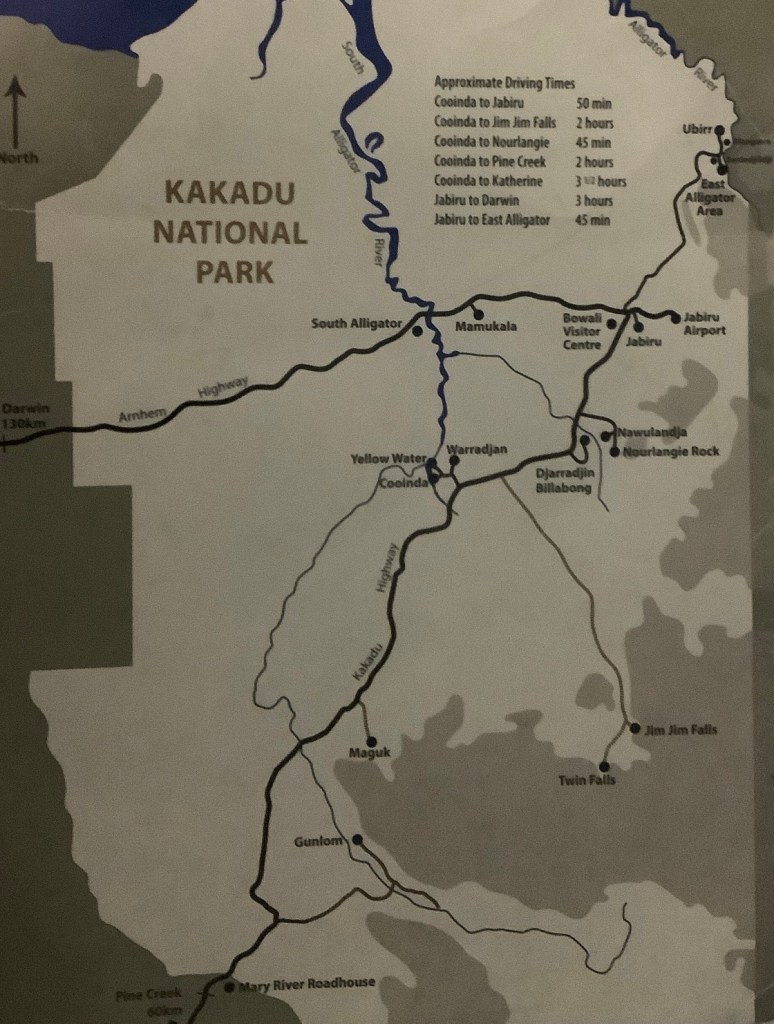
Darwin has excellent fast chargers. Just south-east of Darwin, Palmerston is your last fast charger until you get back to Katherine. This means minimally 540 kms, plus the driving inside Kakadu park. All this calculation is bringing on an attack of range anxiety for Co-Pilot – so we stop to top up at Palmerston. Unnecessary.

And talking about the ridiculous, at Humpty Doo, you cannot miss the world’s only boxing crocodile.
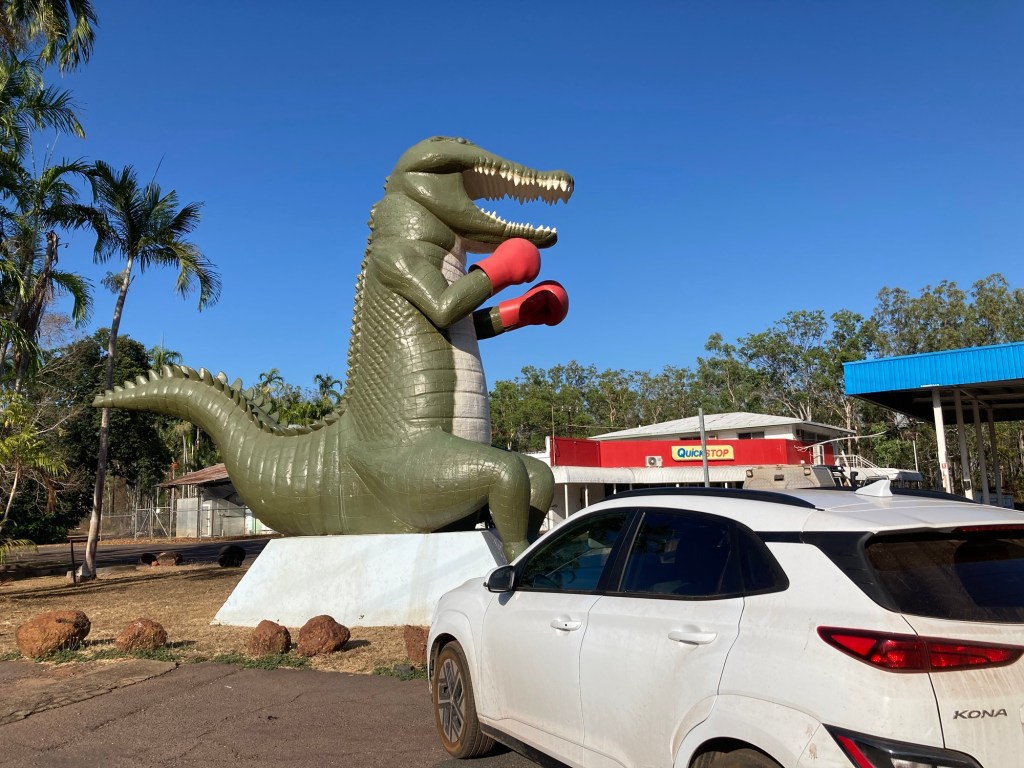
Humpty Doo petrol station, just as useful to us as its boxing croc

There are AC chargers available both at Jabiru and Cooinda. So there is no real cause for range or charger anxiety. You can charge your car overnight if you are happy to pay for a powered caravan site or you can charge on a 3 phase plug at an hourly rate of $10 at Aurora Kakadu Lodge.

Where in Kakadu

Unless you spend your lifetime here, or fly over it for a bird’s eye view, you are never going to see most of Kakadu. Criss-crossed with rivers and marshes, much of the park is not passable by any terrestrial vehicle most of us would drive.

We decided, even before setting off from Perth, to put some limits on this road trip. We go only where the road can take us – and that too is limited by the capacities of a 2 wheel drive.

But our stars are in alignment in Kakadu. Just in the two-and-half days we have here, Co-Pilot finds three marvellous tours with indigenous guides, of rock art sites and a crocodile habitat.

Crocodiles at Cahill’s Crossing

But Jim Jim, the famously high plunge-waterfall is beyond our reach – 60 kms on gravel roads marked 4WD only. I feel like I am missing out on something really important, I say to our guide James, who is clearly wise beyond his years. He says: ‘Ah, you can miss out on Jim Jim for ever. It is just a trickle now – if you get there, it might disappoint. Come back in rainy season and it’s a 200 metre high wall of water. Blows your mind. Then again, the road there might be washed out! But you are enjoying now, yes?’

Let me see: breakfast with the birds at Mamaluka, fishing with crocodiles at high tide at Cahill’s Crossing, two open air galleries of rock art, old, new, undated, by artists named and unknown. And we finish up at Ubirr with sunset on the rocks. Yes, thanks. Enjoying – now!
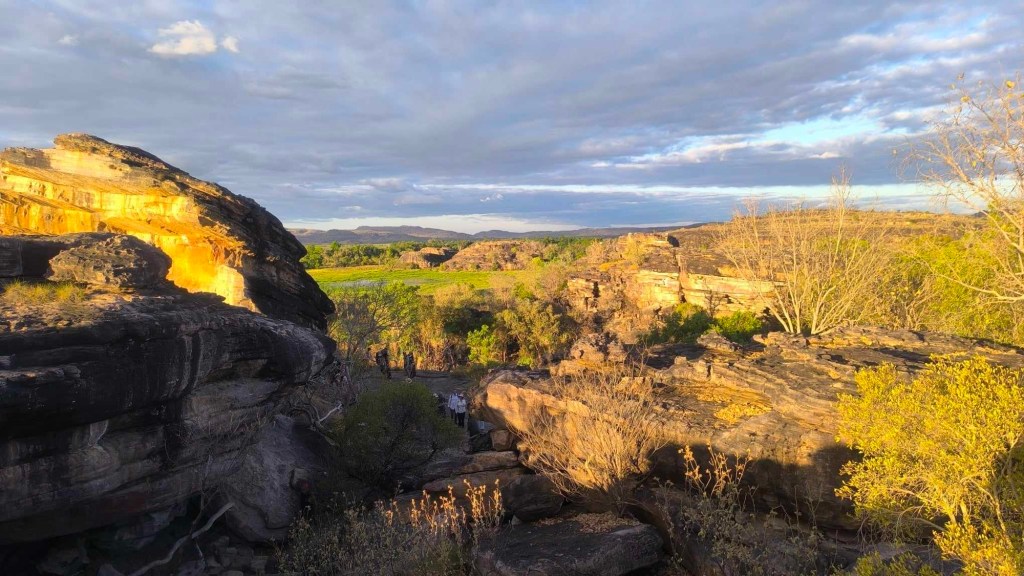
Sunset at Ubirr, photo credit Co-Pilot

Litchfield National Park, NT: range-perfect for EV tripping

Entering Northern Territory on Highway 1 from WA

Much to our shame, neither I nor Co-Pilot knew of Litchfield National Park until a Territorian EV fellow-traveler saved us from missing out on this glorious region of Northern Territory, which deserves to be on every EV road-tripper’s bucket-list.

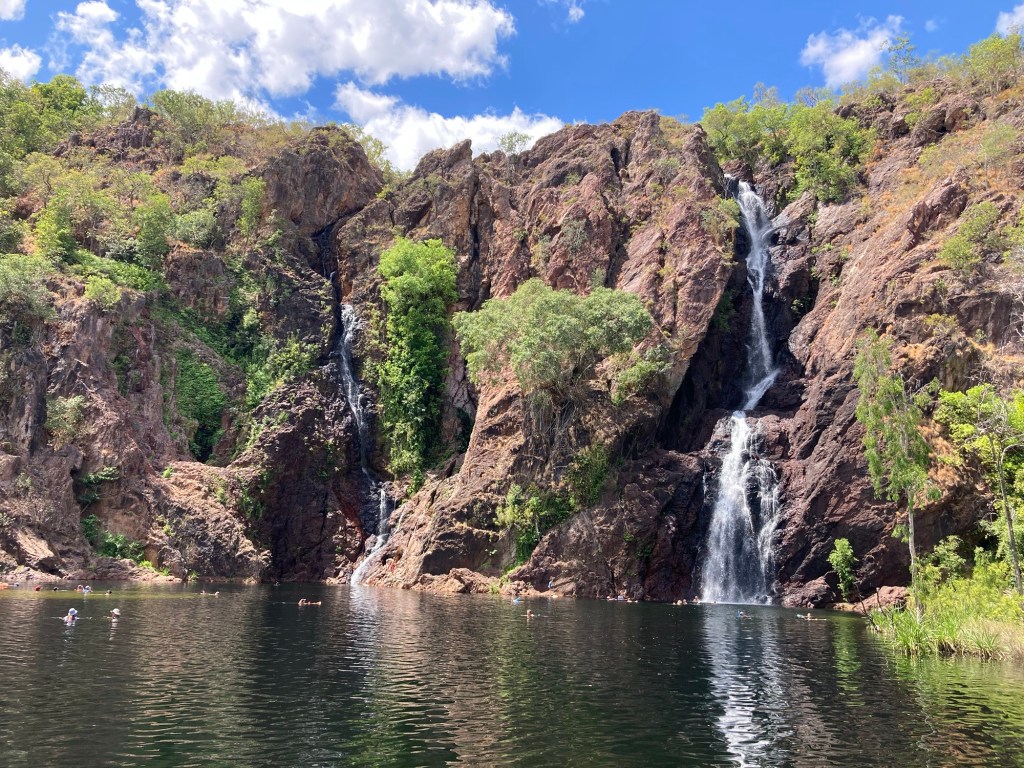
Litchfield’s easily accessible and perfectly pristine waterfalls running into Hollywood-film-worthy water holes are a big tourist drawcard. In late August, just past the peak point of tourist traffic in NT, however, crowds are not overwhelming. The view is wildly enticing as you plunge into the crystal clear Wangi waterhole – while secure in the knowledge that your car is parked just a couple of hundred metres away.

Wangi Falls

Litchfield is memorably quirky – you might even say ‘totally bats’! Tolmer Gorge hosts thousands of Orange Horseshoe Bats and just off Wangi Falls, in the monsoon forrest, ‘endangered’ Ghost Bats hang upside down, screeching in the dappled light – perhaps trying to draw attention to the plight of the planet.

Real bats at Litchfield

Even more fascinating are the Litchfield white ants. Our way through northern Western Australia had been lined with termite mounds of various shapes, sizes and colours. But Litchfield is uniquely endowed with these distant cousins of the cockroach, as the ranger informs us, at a talk at the world’s one and only Magnetic Termite Mounds Viewing Platform! Called ‘magnetic termites’ or the ‘Bushman’s compass’, these astounding architects who have been building here for several million years, are still befuddling human scientists by constructing their mounds with a precise north-south orientation!

And if you are more into the arts, you just have to see the magnificent creations of the Cathedral Termites.

A work of figurative sculpture? Or Cathedral Termite mound, Litchfield

Getting There

As Highway 1 runs into Northern Territory from Western Australia (WA stories here), the gestalt change is palpable.

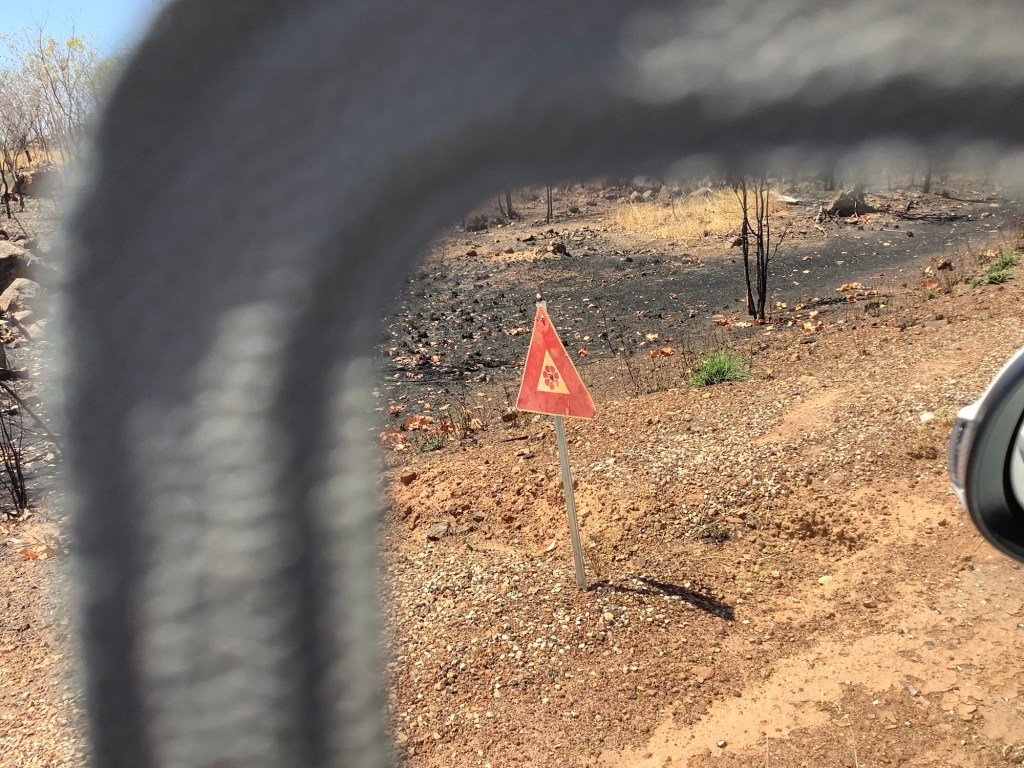
Immediately, the speed limit rises to 130 km/hour having been 110 all the way in WA. The road surface has more visible damage and there is an unfamiliar road sign, which turns out to be a ‘temporary road hazzard’ warning. There are an awful lot of these along the 180 km road from the WA border to Timber Creek – our first stop and first EV charge in Northern Territory.

This pretty red flower is a warning?

There are no fast chargers between Kununurra in WA and Katherine in the NT, a distance of over 500 kms. The stop at Timber Creek Caravan Park is probably the best option for an EV coming in from the West and heading to Litchfield. If you book a room for the night, you can charge your car on a caravan socket, without any additional cost. The compound gates are locked at night, providing a sense of security.

But for an EV we would probably not have stopped at Timber Creek, which turns out to be a particularly charming introduction to NT’s small town accommodation, with its own croc-feeding hour each evening, and a rowdy bar, firmly separated from the dining room for reasons, that become obvious as the evening becomes more ‘spirited’.

The higher speed limit in NT is not welcome from our point of view. Through WA’s Pilbara and Kimberley regions, faced with undependable fast chargers, and trying to make the most of each charge, we have got into the habit of leaving at dawn, driving at a leisurely pace until the volume of traffic increases, making lower than normal speeds untenable.

So, Day 2 in NT, we leave before 6 – a time to meander, enjoying and watching out for the marsupials which are smaller and more plentiful here. With the sun in my eye, even at 80 km an hour, I manage to surprise a couple of large pheasants. It is not till nearly 9 that I see the first truck coming up behind us. But by now, it feels safe to pick up speed, as the marsupials have mostly disappeared back under the foliage and our range anxiety is soothed by the closeness to Katherine where a DC charger, our first in NT, awaits.

I have to confess, it is fun to drive at 130 km/hr (even a tad more when overtaking), but only if you don’t mind running over a small lizard or hitting a tiny bird. Speed kills, even when it does not kill a human.

Accessible

From Katherine onwards, charging is a breeze. There is a fast charger again at Adelaide River, which is only about 50 kms from the entry to Litchfield National Park. So, the 530 kms from Timber Creek to Litchfield is a pretty chilled drive.

Banyan Tree Resort (it used to be called Caravan Park) feels like something out of 1980’s Ubud. If you book a room you can charge your car at a caravan site for $20 a night.

At Banyan Tree Resort, they know what to do with ICE cars

There are several other accommodation options close by, where charging on powered sites should be possible – though like everywhere else some of these places are more accommodating of EVs than others.

Still, I left Litchfield with some regret. We missed seeing the Lost City, which you can only reach with a 4WD. Nor did we have the time to hike the Table Top hiking trail, which takes 5 days, connects the four main water holes in the park, and sounds absolutely divine.

But for all else in Litchfield Park, EVie (our trusty Kona Electric) was the perfect machine. You can enjoy Litchfield National Park in your EV with absolutely no cause for ‘range’/‘charger’/any-other anxiety the popular media currently attributes to EV driving.