‘As it turned out, the march to Rheims was nothing but a holiday excursion:…’. So wrote Mark Twain of Joan of Arc’s march into Reims, a bit unlikely as Joan was marching at the head several thousand armed men in July 1429.
The line does, however, describe entirely accurately our leisurely walk out of the Hauts-de-France region into Reims, at the heart of the Champagne district’s (more correctly in current official parlance, the Marne Department of the Grand Est Province) and the 12th largest city in France. It is also the largest city we traverse on our entire 1200 km hike on GR 145 from England, through France and Switzerland.

Laon’s grand Cathedral waves the the modern pilgrim off with images of some ‘kickass women’ including Saint Teresa of Calcutta (better known as Mother Teresa) and a Black Madonna.

Black Madonna have colourful histories (puns not intended). They were often seen by medieval populations as immensely powerful, and of course, like all representations of female power, highly suspect. Laon’s original Black Madonna was destroyed in the French revolution. The current version, a relatively placid looking figure, was installed as far as I can tell, in the mid-19th century.
Just outside the Laon city walls, you can tumble down through narrow back alleys, between houses. Do you remember how it felt to run down a slippery slide when you were at primary school – rather than sit and slide like the good kids? Well that’s how it felt, except that as Leonard Cohen puts it, these days ‘I ache in the places I used to play’.
Knees notwithstanding, the sliding reduced the distance to Corbeny (our final stage in Hauts-de-France) by nearly 3 kms, to a more manageable 27 km, though we probably missed some stunning views reported by walkers who take the prescribed route out from Laon.

A tedious 6 km on the edge of a road, then a long straight Chemin du Roi (King’s Road) through woods, and another tedious climb on a sealed road brought us to Corbeny and a perfect pilgrim accommodation, on Rue de Dames – a road built to facilitate women travelling for assignations with kings.

Following morning, we crossed River Ainse and entered the Champagne district.
It might be more apt to say that Champagne slowly dawned on us. First, a welcoming little epicerie in the tiny town of Cormicy, open just at the right time. And minutes later our first view of the acres and acres of grape vines.
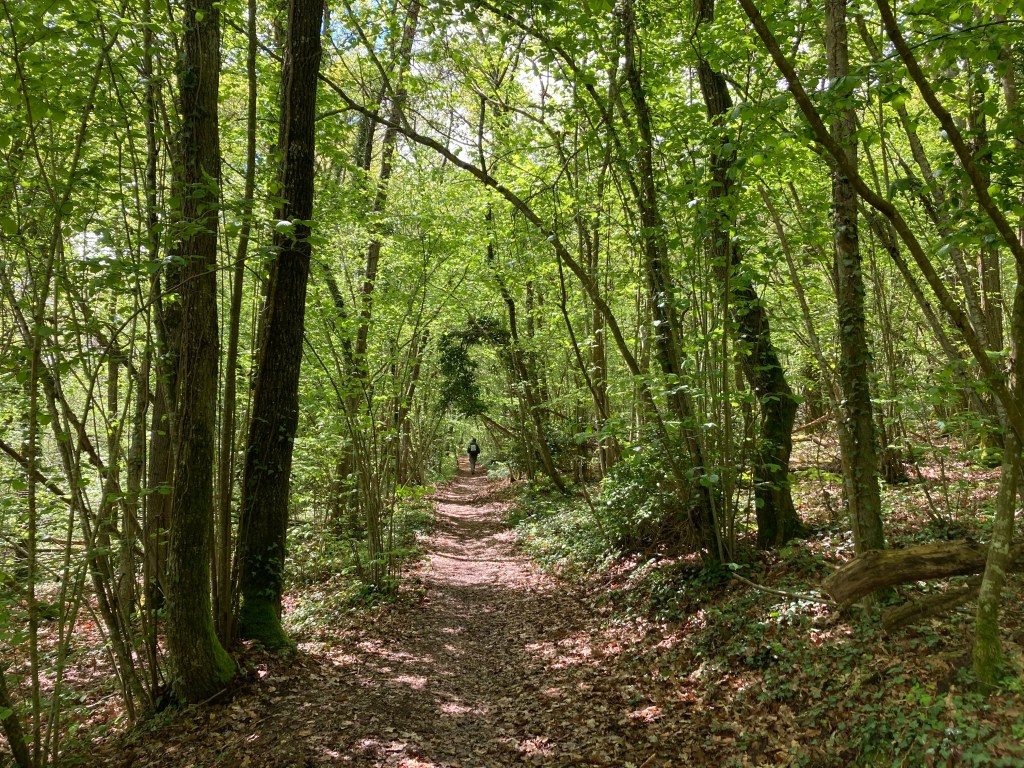
Two more days of walking between vineyards, forests and along canals brought us to Reims.

After nearly a month of mostly tiny towns and villages, it was exciting to be in a great city built around opulent squares, historic buildings and brimming wth tourist attractions. So we took a day off walking, hoping to indulge in some cultural tourism.
But, but but… it is Sunday, it is rainy, and as Monday is VE Day National Holiday in France, almost everyone has shut shop and gone off for a long weekend to Greece 🙄 Yes, the excellent English speaking staff of the expensive hotel might just be able to find a Champagne tour which though exorbitant includes several complimentary bottles of the stuff… but stop! Walking Buddy is a teetotaller. Estimates of how much champagne one person can drink in a day or carry in her rucksack the next morning were not promising.

Reims, and indeed the region more broadly has much to attract the tourist generally and the walker specifically. But May might not be the best month to walk in any part of France. For the record, there are 14 days of prescribed national holidays in France, including the Christmas and New Year period. The remainder of the year has 11 National Days, of which 4 are in May. Every weekend in May is thus a long weekend and most things, including most eateries, are closed.

Sunday, 7 May, there is nothing to do, but ponder on the famous UNESCO world-heritage listed Cathedral Notre Dame of Reims, where the Kings of France used to be crowned and whose biggest current tourist attraction seems to be the stained glass window designed by artist Marc Chagall.
The most famous name associated with this Cathedral is however Joan of Arc, who saved Reims from being razed by the English army.
A statue (from the 1850s) of a young woman on a horse, her sword unsheathed, graces the front of the cathedral. Her eyes are wide open, and I imagine, blazing.

Joan was tried and burnt for heresy, aged 19. The key evidence against her was that she dressed in male clothes!! At her captors’ insistence she agreed to wear what the church regarded as proper women’s clothing. But later the judges visiting her cell found her again in her habitual soldiering gear. When challenged, she supposedly told them “It is both more seemly and proper to dress like this when surrounded by men, than wearing a woman’s clothes.”
Inside the Reims Cathedral, the 1902 marble and bronze figure of Joan is clearly in female clothing. She has been ‘frocked,’ she has been muted. In sainthood, she has been denied her choice of clothing. The up-turned eyes of the girl on the horse are now closed in surrender.
The young village girl who was cross-dressing and slaying bad guys long before Buffy the Vampire Slayer was imagined, who should have been the Patron Saint of Girl Power, has been re-cast as good little Saint Joan to be accommodated inside the constraints of the Catholic Church.

On a day with little to do, Reims is a good place to think about how a defiant girl might be disciplined, punished and beatified – all to put her in her place as a woman.
A Mothers’ Day post about defiant women one meets on the VF




 Reading the Road