Exmouth: Electripping the Northern Way to Ningaloo

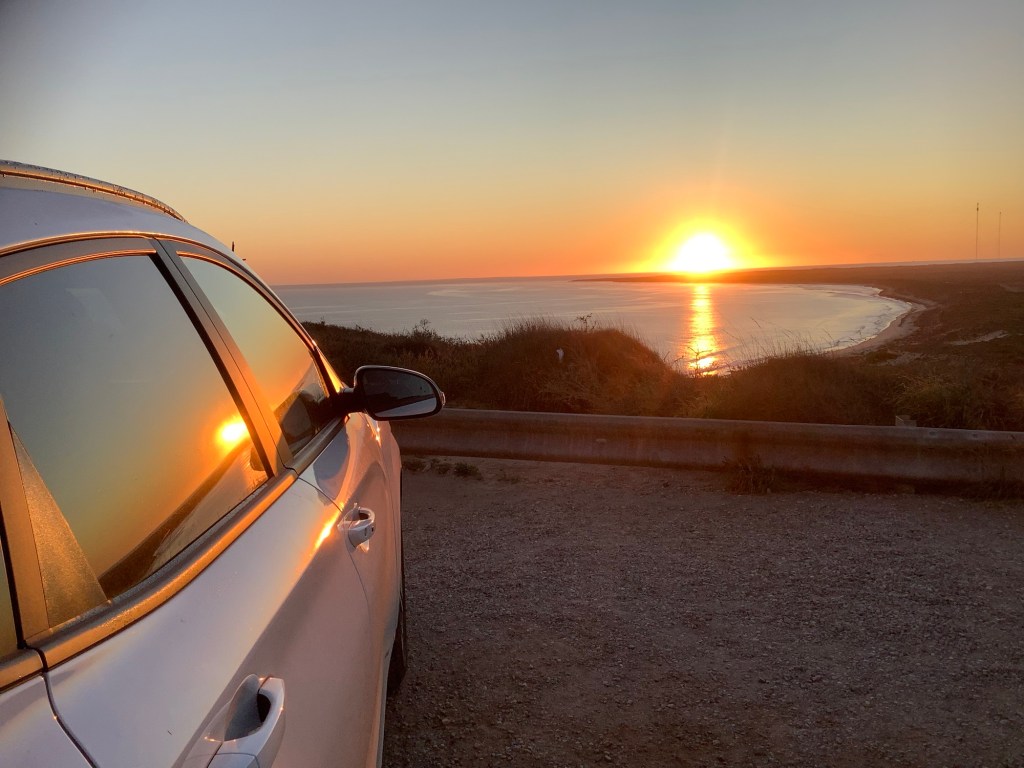
Sunrise at Vlamingh Head Lighthouse, Exmouth

Many West Australian beaches are ‘world famous’ for their sunsets. But there can’t be too many places in this wide country (4000 kms east to west) where you can see the sun rise and set from exactly the same spot.

Exmouth is a tourist mecca for many reasons. Its population of 3,500 can soar to 20,000 in high season.

About 15 kilometres north of the town centre, the Vlamingh Head lighthouse sits on a tiny 74 metre-high hillock. At sunset, cars are cheek by jowl all the way up and down its curly driveway, jostling for a space to see the sun go down.
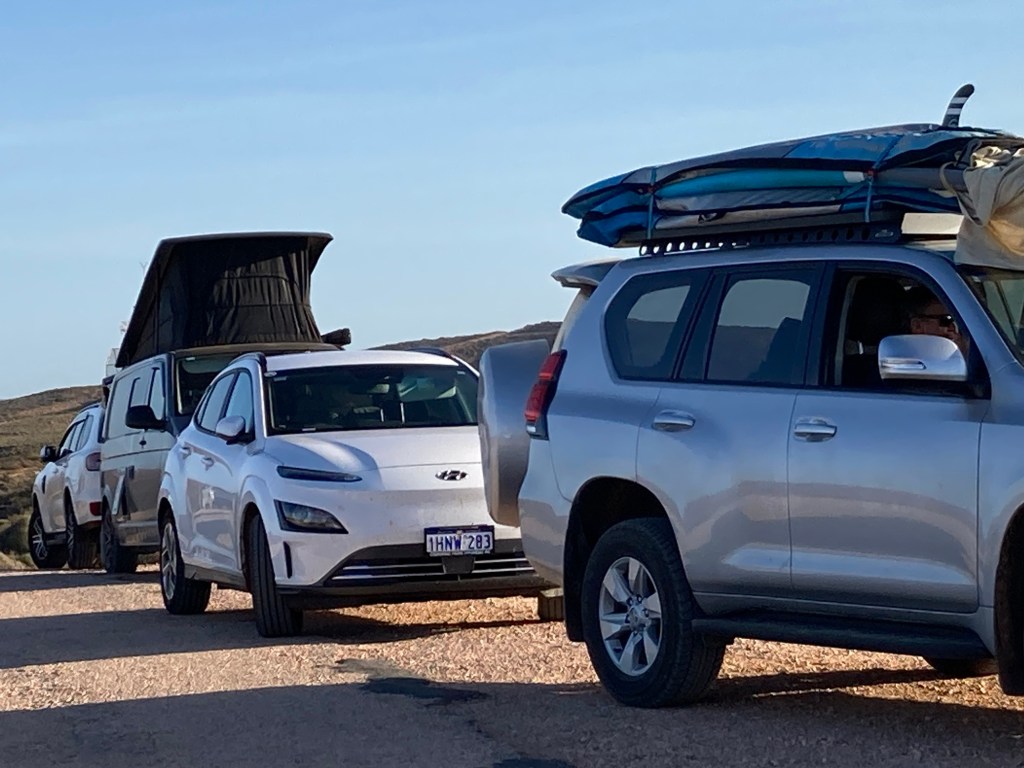
Sunset crowd on Vlamingh Head

At dawn, as I silently slip EVie into place, there are just 3 cars, hoping for a cloudless horizon.

At 6:42, the sun peeps out of the strip of ocean, just visble beyond the east coast of the promontory. For a little time, it seems to glide up the horizon, coppery, like a harvest-moon. Then, in a flash, a glowing orb leaps out of the waters east of the pointy beachhead, floods the narrow wedge of land, sends a beam of light into the water across the headland, and dazzles everything in its wake. Sun rise at Ningaloo – priceless…
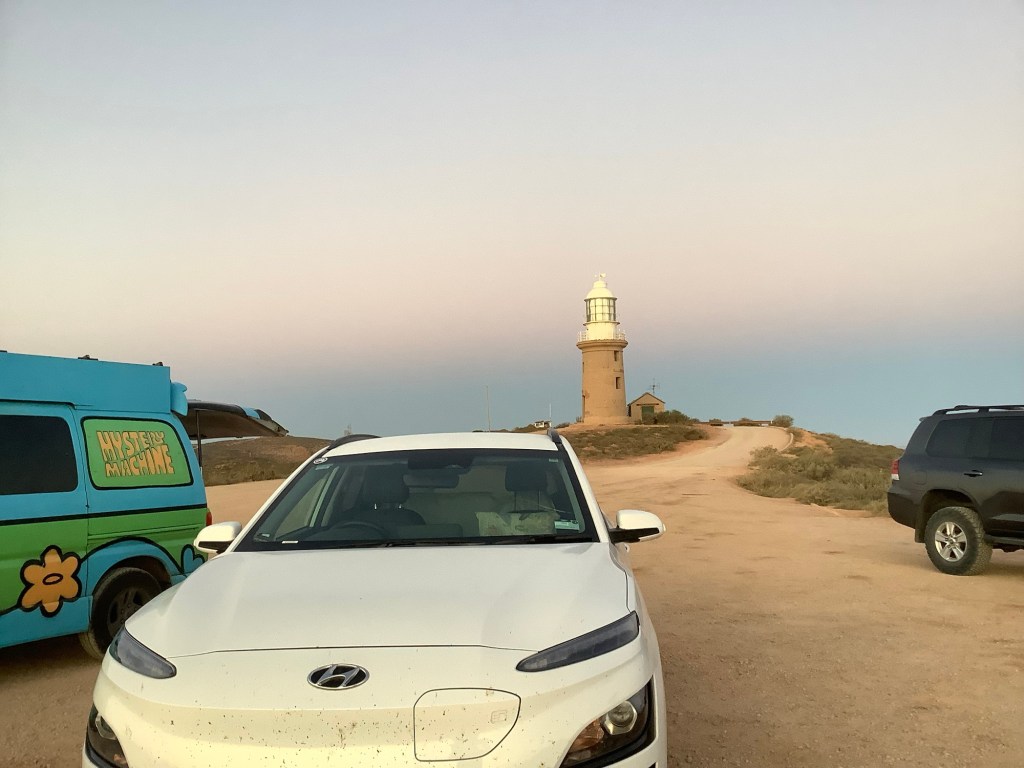
Looking back at the lighthouse at dawn

The drive from Karijini to Exmouth went precisely to plan, with three dependable chargers on the way: Tom Price (25 kw), Pardoo (50 kw) and Nanutarra (150 kw). There is a more direct route from Tom Price to Nanutarra, but with a long unsealed stretch, it is a lot slower.

The little town of Exmouth has everything you need to explore Cape Range National Park, including a bank of four fast chargers, convieniently located in the car park at the tourist information centre.

After sunrise, you can slide quietly back down from the lighthouse towards the beach and follow the turn of the only road, heading south, along the line of the Ningaloo reef, into the Cape Range National Park. This is the northernmost section of the Ningaloo World Heritage area.

So much to do along this one road

First stop after day-break, the Observation Bird Hide in Mangrove Bay. To someone whose idea of mangroves are the fearsome Sunderbans in Eastern India, this one looks like a beautiful miniature – almost manicured with a clear lagoon in the middle surrounded by the distinctive mangrove root system. Bird calls fill the morning air. But mostly, the birds are hiding or darting past at the speed of light, and the jumping fish are just silver flashes in the pond.

There is so much to do along the 88 km stretch of road from the charging station in Exmouth to the Yardie Creek Camp site at the southern end of Cape Range Park. There seems to be a beach for every watery activity ever imagined. You don’t need to be brave enough to swim with the whale sharks (I wasn’t), or pay some exorbitant amount for an organised activity further out to sea (but plenty available if that is your pleasure).

You can spend the hours of high tide at Oyster Stacks, snorkling amongst the corals with hundreds of magnificently coloured fish; walk around the Mandu Mandu Gorge trail, then cool off riding the current at Turquoise Bay – and, don’t panic when a huge fish or sting ray floats in on the same current right underneath you! In season, you can see whales breaching from beaches on both sides of the promontory. At Mauritius Beach, at sunset, they might put on a mesmerising show with an ensemble of surfers as corps de ballet – it’s magic if you happen to be there!

When tired, just idle on any beach in the park and marvel at the massive waves crashing on the horizon – breaking against ‘Australia’s largest fringing coral reef’ and ‘the world’s only large reef located so close to a landmass.’

Yardie Creek Campsite is the furthest from Exmouth fast charger

Cape Range Park provides a perfect opportunity for camping with an EV as you are never further than 88 kms from the WA EV fast charging station in Exmouth. Every one of the 500 wilderness camping sites is booked out 6 months ahead, the day the bookings open! We missed out.

Yardie Creek Road is a smooth and scenic drive: with the ocean flashing in and out of view on one side, and on the other, the gentle rise of the Cape Range (just over 300 metres at its highest), closing in and sliding away. It all seems too accessible.

Yardie Creek Road beteween the ocean and the hills

And then suddenly it is not. The sealed road comes to an abrupt end at the Yardie Creek camp. To get further into the Ningaloo National Park you need wings or sails or at the very least, a 4WD.
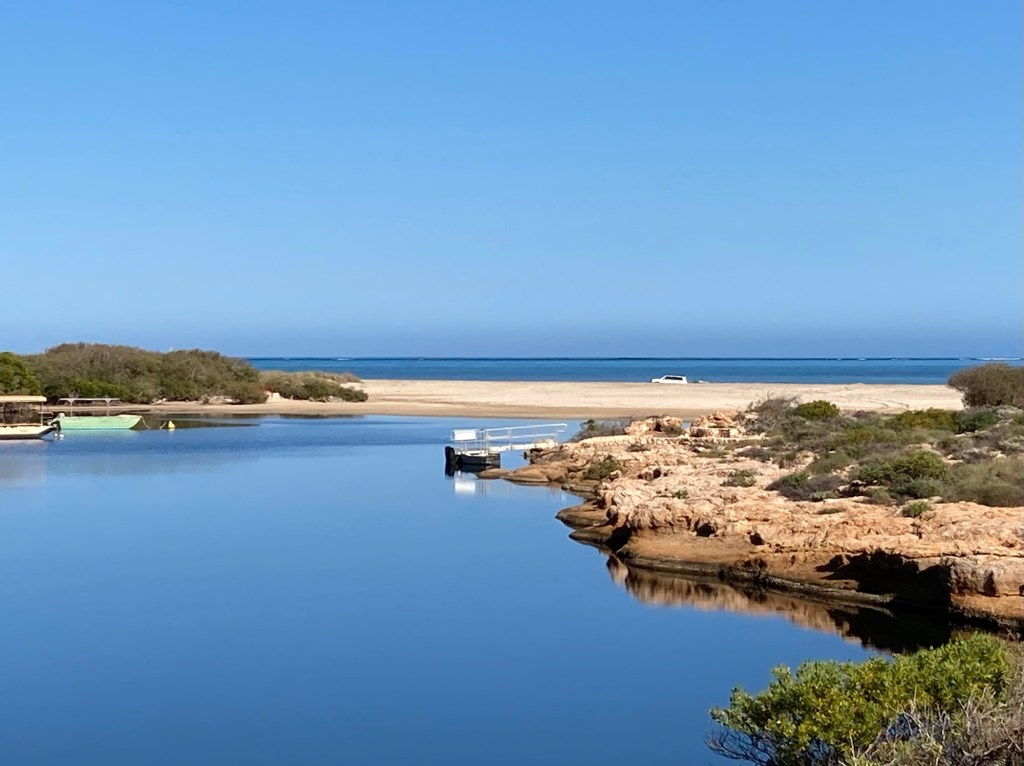
Where the river doesn’t reach the sea

A final walk takes you up the Yardie River, which like the road, comes to a stop suddenly, without quite reaching its natural destination, the ocean – it just pools there, its journey suspended…

Later, talking to some locals I learn that the river only reaches the ocean during rare major flood events. Perhap this is metaphor, a warning, about longings: the river’s for the ocean and mine for the way ahead, which leaves the sealed road, changes to gravel and a few metres ahead, into sand dunes.
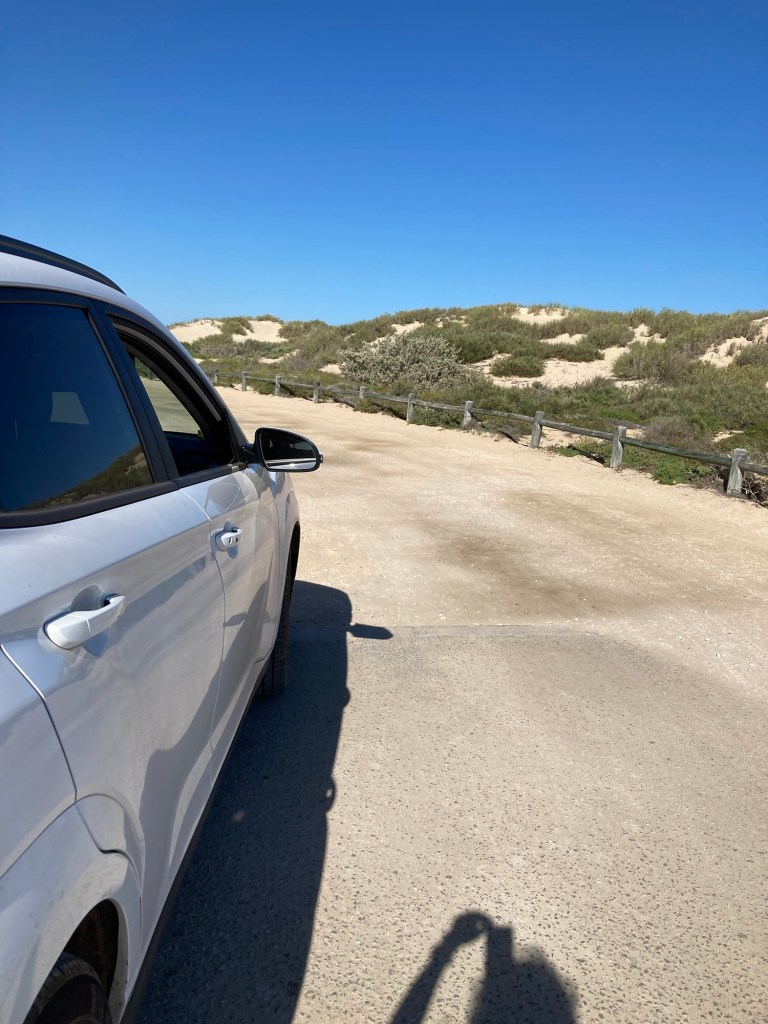
End of the road for EVie

But surely, we are not foolish enough to think we can go wherever we want, whenever we want? We know: every vehicle necessarily has its limits, every road some end.
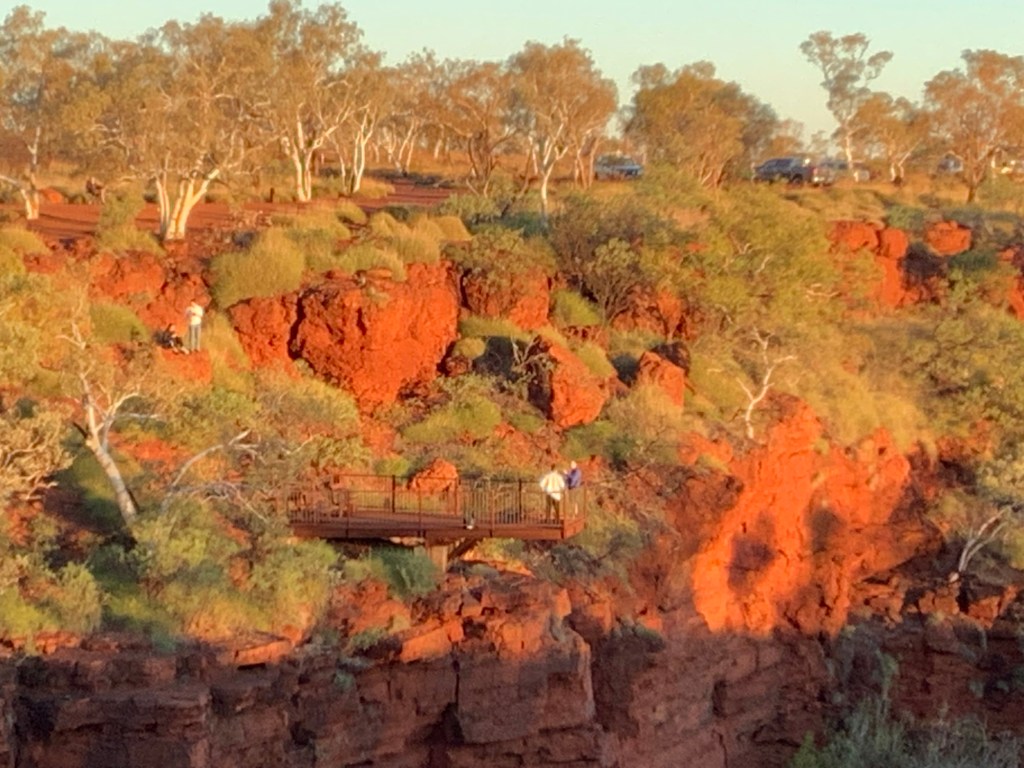
Inside Karijini: a perfect drive through an ancient land

Joffre Gorge at sunset, from the Eco Retreat side

In 2015, a headline in Conde Nast, perhaps the trendiest of travel magazines, said ‘Electric Car Road Trips are the next big thing’. Ten years later, here in outback Western Australia, my fellow grey nomads still look quizical or dismissive, at best curious, when you join a conversation about cars, costs and distances – what else would you talk about on these open roads?

Watching your first sunset with a bunch of other tourists at Joffre Gorge, just 5 minutes walk from your glamping tent, you are just grateful to have this view.

All the way from Cheela Plains I have had a Bangla folk song buzzing in my head:

গ্রামছাড়া ওই রাঙা মাটির পথ আমার মন ভুলায় রে। That red earth path out of the village is making me forget myself, says the refrain.

A dingo welcomes us soon after we turn into Karijini Drive.

If you are driving an EV, you are most likely to enter Karijini from the western side having fully charged up at Tom Price. Your first look out, Mount Sheila, its table-flat top, surrounded by memorial stones, invites a contemplative silence. Makes you appreciate the silence of your car, without an engine that roars or heats up!

Mount Shiela Lookout, soon after you turn into Karijini Drive

If like us, you have booked at Karijini Eco Retreat, back your car into the driveway of your glamping tent and enjoy your expansive back-yard all the way to the horizon.

Our home in Karijini

It is hard not to gush when you talk about Karijini. Even its name is sweet on your tongue, as if belonging to some fairy-tale princess in an exotic land. Use a little imagination (we grown-ups like to call it planning) and just like that fairy tale, Karijini will let you into her magic.

Fully charged up at Tom Price, incidentally at 747 metres elevation, the ‘top town’ in Western Australia, we rolled along 80 kms of beautifully sealed, mostly flat roads, into the National Park, with more than 300 kms still in the tank.

With one exception (Hamersley), the gorges and pools that draw visitors to Karijini are within 50 kilometres of our accommodation. So, there is plenty of range to take in all the main attractions.

You park on the top of the gorges, then walk to the look-out. Or if you are like me, you will want to walk down the marked and graded trails, into the waterways below. ‘Whatever else you do, do NOT miss the Fern Pool’ says a lovely attendant at the Karijini Visitor’s Centre.

Fern Pool, Karijini, not a Hollywood set!

The only problem is, every one of the gorges is mesmerising. Even the carparks provide photo opportunities, like anthills as large as our car and taller than basketball players, and tiny Spinifex Pigeons which won’t stay still for a photo!

Spinifex Pigeon male showing off at the top of Dales Gorge

And then there are the walks, the edgiest down into Weano, which goes from level 4 to level 5 as you scramble and wade and when necessary swim and eventually squeeze between rock walls to the red stone and grey-green waters at the bottom.

Weano Gorge, edgy walk!

You’ve got to be there to know how good that feels!

Final entry to the pool, just wide enough to squeeze through

And before you know it, your three days are gone. And you realise that Hamersley Gorge will take more time and planning.

Having gone to most of the places that any car may go (and beyond where only feet will do) in Karijni National Park, we returned to Tom Price with more than 20 percent still in the battery. With better planning or less time spent taking photos, it might have been possble to get to Hamersley Gorge – the road is partly unsealed but accessible without 4WD in most seasons. But after two full days and three starry nights at Karijini, we are booked into Exmouth, the gateway to yet another famed West Australian National Park.

Sadly, an EV cannot help with time management🙄

Slow Road to Karijini

Sun rise at Eco Retreat Karijini


Karijini, Western Australia’s second largest National Park: the sun is a smudged vermilion marriage mark on the earth’s forehead – my Bengali iconography evokes a bride’s shyly sweet morning after the wedding night before. The sound track is the song of unknown birds. The fragrance on the cold morning breeze is an unfamiliar presence for this urban dweller from the Australian coastal south.

Years of hoping, months of planning, three days and 1600 kilometres of driving has brought us from Fremantle on the south-west coast of Western Australia to the ‘glamping’ spot in the Karijini Eco Retreat.

Read any travel magazine and you would think it is impossible to get here without one of those humungus 4WD diesel-fed vehicles. The travel editor of a WA-based newspaper dismissed my plan of driving to Karijini in at electric car, with his smirk barely hidden behind a curt email ‘Good luck with your EV in outback WA!’

Over a pleasant dinner at the Cheela Plains Station, our last stop before Karijini, I pin down a friendly grey nomad, almost by definition driving a 4WD dragging a motor home. He pays over $250 for every 500 kilometres or so. And that is not including the environmental cost of fumes from thousands of ICE cars in and out of these ancient and fragile landscapes.

Big Cars at the vast Cheela Plains

According to recent government figures 650,000 people visit Karijini each year. It takes a lot of cars to transport all those people!

EVs are not a final solution of course, but with no tailpipe emissions, they are a move in the right direction for pleasure travel.

‘How about it then – a trip around Oz, taking in the national parks?’ I had asked Co-Pilot. He had said ‘why not?’

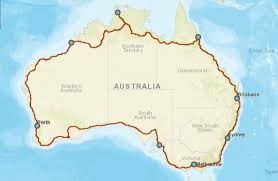
National Highway 1

I could think of many reasons. I wanted a pleasant trip to beautiful places, not some adventure story of breakdowns and heroic rescues. The Plugshare app showed fast chargers, thin on the ground once you headed north from Perth. The WA government’s planned WA EV network is getting built – but we are not quite there yet.

Also, I was a bit concerned that our two-year-old EVie (a Hyundai Kona Electric 2022, Extended Range) will develop an inferiority complex, sitting between the Big Cars in an over-crowded caravan park, struggling to suck enough electrons from a Caravan socket overnight.

On a good day, with a full tank, EVie has a projected range of 480 kms – but open roads, high speeds and bad weather can easily reduce that by 20%. Yes, Range Anxiety is rearing its ugly head again. What if some of those chargers are broken? ‘We’ll call a friend’, said Co-Pilot.

‘Friends’ refers to … ahem, shall we call them EV-angels? Some 30 or so EV drivers have completed the 13,000+ kilometre drive around Australia – some of them more than once. Several live in our neighbourhood in and around Perth and have been generous with their time, advice and encouragment. Our first leg is straightforward: a 450 km drive to Geraldton. And there is a fast charger about half-way at Jurien Bay.

But EVs cannot prevent human errors. 150 kms into the journey, a sinking realisation – my iPad is not with me! The thought of surviving 80 days without my digital companion is unthinkable. We turn back adding an extra 300 km to our day and an extra hour and a half of charging time. Not auspicious.

Definitely the best when you running late and need a charge!

We make Jurien Bay about dinner time: the fast charger is avalable and conveniently located across the carpark from a friendly fish and chip joint! There used to be an Ampol charger at the station across the street – but has been broken for 6 months (Non-functional chargers might turn out to be a bit of a theme – but let’s see.)

Day 2, Geraldton to Carnarvon is smooth. And Overlander Roadhouse, run by a Samoan woman and staffed by a group of awesome Vietnamese Australians, offers unexpectedly good food and a fast WA EV Network charger.

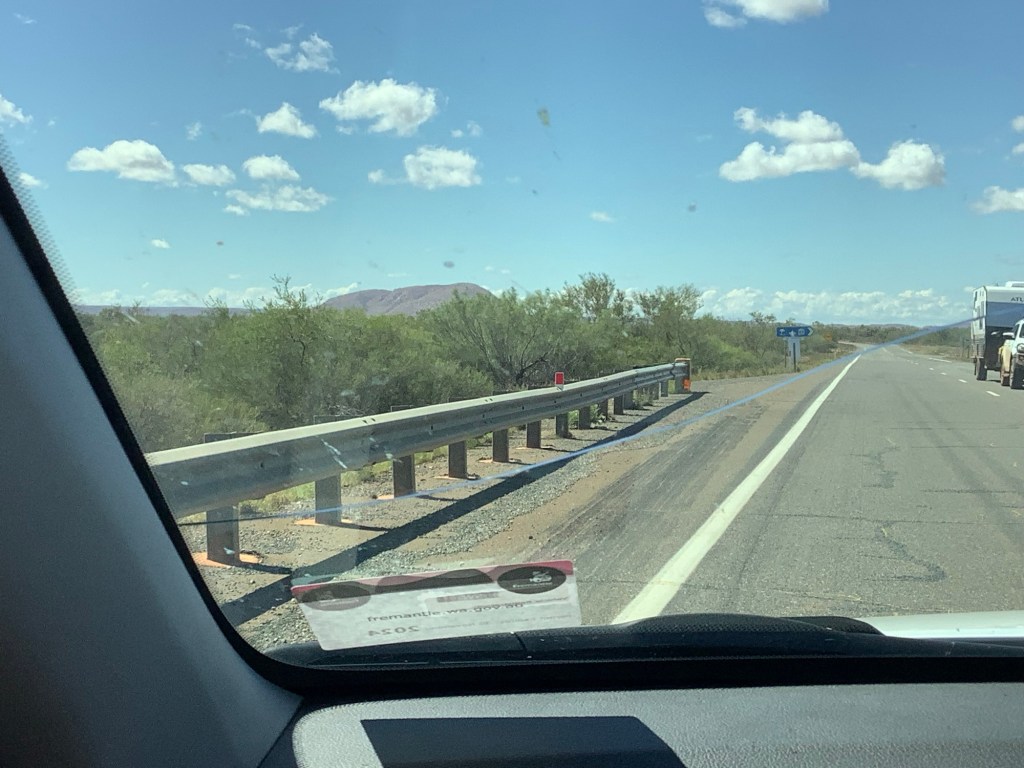
But somewhere along the way an 18-inch crack has appeared on the windscreen.

See the thin blue line?

By the time we reach Carnarvon, the one windscreen repair place in town is closed and remain stubbornly shut the next morning. Though it is reassuring to learn that locals think ‘if you ain’t got a cracked windscreen you ain’t driven in the Pilbara.’

From Carnarvon it is 700 kms to Tom Price where we are booked for the night – it will be less than 2 hours drive into Karijini the follwing morning. We are almost there.

But not quite. The plan was to charge at the newly installed WA EV network charger at Minilya, 140 kms along the way. According to the Plugshare app, it has been working some of the time, even though there is red tape around it clearly asking people to keep out! For us it would not work🙄

Hmmmm???

Co-Pilot tried pleading. I tried abuse. C-P rang the operator. Man at the other end sounded unconvinced by our assertion that anyone had been able to use it. Officially, the charger is ‘not yet active’ – no amount of ‘but we are desperate’ would move him. Next charger: Nanutarra, where we arrived having driven 368 kms on a single charge with just 22 km in the tank and frayed nerves. Neither of us felt like driving another 300 kms to Tom Price.

We stopped for the night at Cheela Plains Station just in time for a magnificent sunset. We got the last room and, yes, they could add us in for dinner.

A perfect place to spend an evening on the way to Karijini, EV or ICE

We are almost there – one sleep, less than 200 kilometres and two perfectly dependable, free chargers provided by Rio Tinto – our next sunset will be at Karijini.

As they say (may be they don’t yet, but soon will): EVs are great for going places. But they won’t compensate for human follies.