
Range Anxiety is the EV’s contribution to the English language. The term entered the Oxford English Dictionary in 2013: ‘worry on the part of a person driving an electric car that the battery will run out of power before the destination or a suitable charging point is reached.’
In some parts of the world, such anxiety is, arguably, a matter of the individual psyche (https://www.pitchcare.com/news-media/range-anxiety-fact-or-fiction.html). But in much of this vast land, basic infrastructure for these cars (ie. charging stations) is in its infancy, so unregulated that you need a half a dozen different apps and attachments to be able to access a sufficient number of chargers on any long trip. Add to that the sparseness of most things in outback WA, and you have a perfect habitat for the dreaded Range Anxiety in the novice EV driver’s head!
Just 45 minutes and 50 km out of Fremantle, the speedometer indicates we have used 11% battery and one of my apps is showing ‘McDonalds, Mundaring’ charger nearby – motor car owners staggering under petrol price rises, please take note: it is free. But it will take an hour and 45 minutes to fill up the car!!! So begins a long debate between me and my Range Anxiety (henceforth RA).
Me: we don’t need to top up the battery
RA: more experienced drivers say you should top up when you can when you are on unfamiliar roads.
Me: Not unfamiliar!! We drove to Adelaide in a clapped out Honda Civic…
RA: Yes, in 1988…
I take the point but persist, pointing at a popular app: look, we get to the next charger at Merredin in 250 kms – we have plenty of battery to do that.
RA: but what if the Merredin one is not working? Or if your car will not charge as fast as the app says?
‘What if’ is always Anxiety’s killer punch! New car, we don’t know its quirks. And we know the uncertainties around charging points. They can work differently for different cars. For instance, our Hyundai Kona Extended Range goes a longer distance per charge, but depending on the charging technology, it can be much slower to charge up than its cousin, the Hyundai Ionic 5. And some chargers indeed are damaged, vandalised or simply may not charge at the anticipated rate. And everything from temperature to rain to road surface can affect the range of an electric car. Anxiety wins. We stop for nearly 2 hours to add just 50 kms of additional range.
It would be 2 days before we worked out that the last 10% of battery is always the slowest to charge up – not worth the time unless you really need the full range. On Day 1, we are at the bottom of a steep learning curve.
At the Merredin Community and Leisure Centre charging is happily, yet again, free and the rate of charging substantially faster than at Mundaring. Even so, it will be 6 hours before the car is fully charged. This time we bargain Anxiety down – 80% charge will get us comfortably to our destination for the night. And that will be done by about 4 in the afternoon. We tether the car to the charger and walk to Merredin’s only eatery operating this Sunday afternoon!
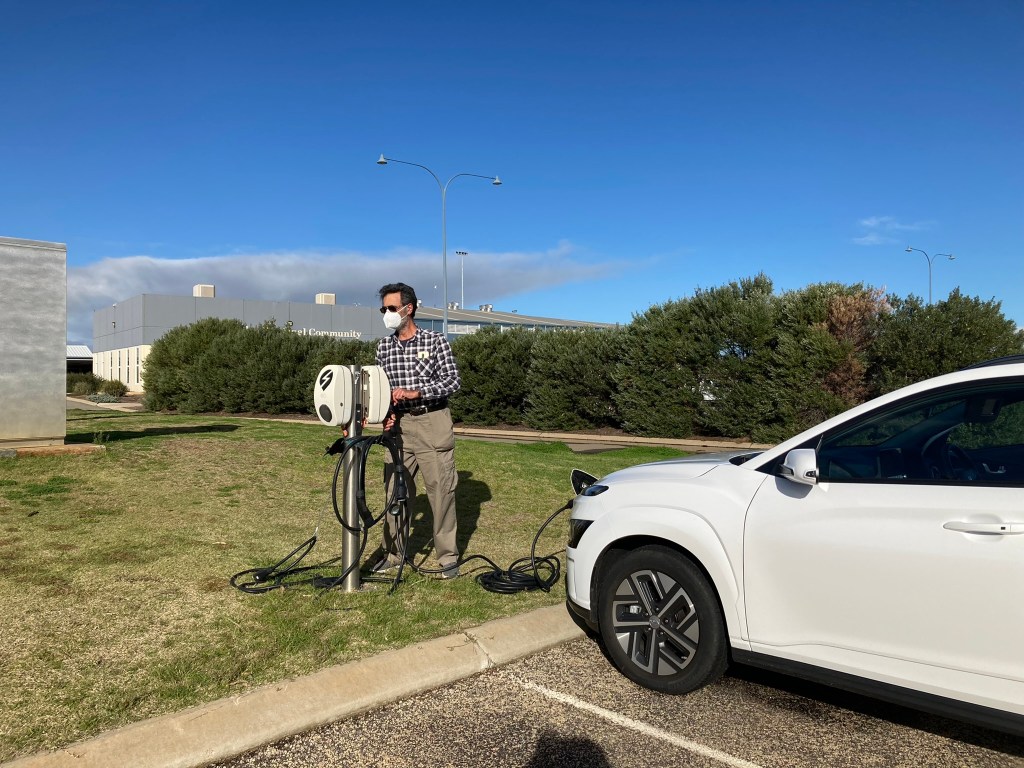
And this is when the real problems start. My co-pilot finds a Tesla charger which promises a faster charge. So we run back and carefully follow the instructions to un-tether our car from the charger: but the plug won’t release! First gentle persuasion, then increasingly forceful coaxing – the thing won’t budge! We try randomly turning things off and on several times – same result each time – the car remains fixed to the charger. Co-pilot searches the web – but this is not a common problem and consequently the web offers no solution!!
Following my damsel-in-distress instinct, I hail a group of men playing bowls. The lovely gentlemen, between them, have a thousand years of driving experience but are seriously befuddled by a car without a motor!
Meanwhile co-pilot has EV expert, J, on the phone and he too has never encountered a clingy charger until now. Yet, somehow, J talks co-pilot through the options and (phew!) at some point, after repeatedly hitting an ‘unlock everything’ button on the driver’s door (which we did not know existed until this point), the charger releases it’s grip on the car!! This process has taken an hour and we still have quite some charging to do before we can be confident about reaching our accommodation for the night.

So, to the TESLA charger we go and it works and the car screen shows that we will get the charge we need (without too much concession to Range Anxiety) by about 5 pm. And this charger too, is free!!
Meanwhile, our accommodation arrangements have gone awry, for reasons too tedious to explain. Eventually, we drive 3 hours in the dark and rain, the ‘range’ gauge dropping rapidly as headlights, wipers, de-misters, all draw on battery power. For our first night, we have no options but the caravanpark at Coolgardie, where you would not want to stay except in an emergency! But on the positive side, there is a caravan park plug point at which the car charges very slowly for the next 12 hours – and that is just enough to get us to the next charger in the morning.

Best thing ever: total ‘fuel’ cost for 600 km of driving? $0
First test for the long-distance EV driver: meet and beat Range Anxiety.
That done, with a little planning and some intriguing chargers (wait for the next post), the trip is turning out to be both entertaining and educational!


 Reading the Road