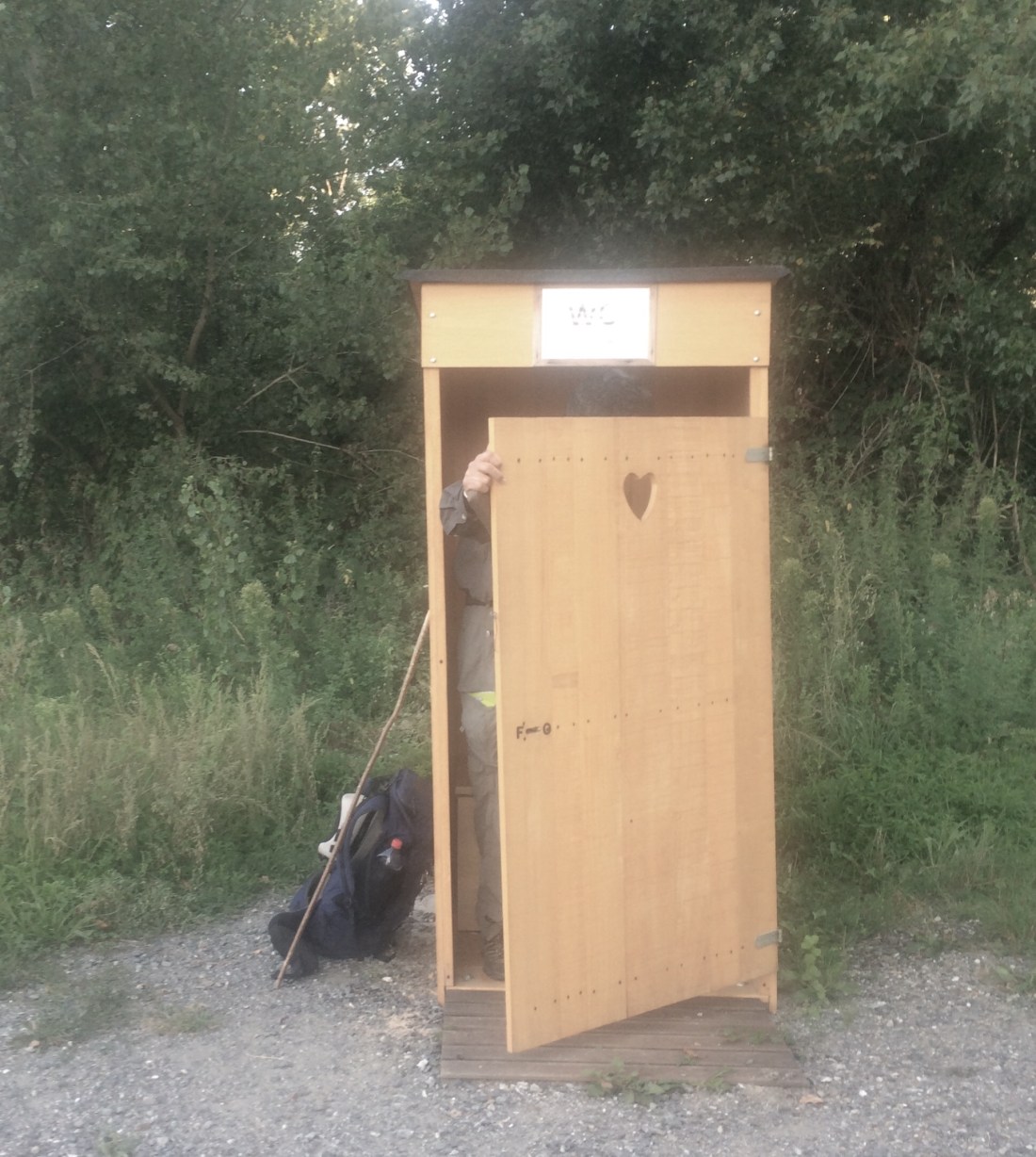
When Nature Calls

Whether you are living in the slums of Kolkata or walking the Camino, when nature calls, the answer is best given in a clean toilet. This b[og]log takes its cue from World Toilet Day, earlier this week, on Monday 19 November, a day on which the United Nations asks us to contemplate the importance of the water closet.

First, the big picture: the number of people walking the Camino is rising every year. In 2017, 278,498 souls arrived in Santiago on foot. Doubtless those numbers will be higher again this year. Every walker would have traipsed through the last 100 kms in the Spanish province of Galicia. But even in distant parts of the route, the numbers are large. On a Monday in late August, we started from Le Puy in France, along with 60 or more other pilgrims. More pilgrims joined in at several towns further along the Way – every one of them with mortal bodies and a UN acknowledged right to a clean toilet.

Over the next two weeks, as this gypsy village moved along France’s GR 65, through the Upper Loir Valley, the mercury regularly breached 30 degrees centigrade (see ‘Blogging the Slog’). Thankfully this early section was flush with loos, though I should note, with an apology for the pun, that many were dry toilets, i.e. without flushes. Usually located just before the entry to a village and sometimes in the middle of nowhere, they deserve the gratitude not just of the travellers, But also the householders on the periphery of the villages, whose secluded yards might otherwise be too inviting for walkers with over-full bladders.

Once we reached the Lot Valley, however, such facilities got thinner on the ground and progressively, how shall I put it, more rudimentary in their design. Some ‘composting toilets’ don’t really bear discussion in polite company.

Past Condom, not a prophylactic but a beautiful town in the Gers district of France, public loos appear so rarely and so erratically, that the walkers, no longer able to confidently predict the distance to the next WC, have to take their business wherever they can, if you get my drift. The problem is aggravated when the village cafes are shut at weekends or Mondays or Thursdays or any other days a particular French commune or village chooses to shut down; it becomes diabolical when, in addition, large chunks of the day are spent walking through vineyards, which are mostly pretty shorn after the autumn harvest, or pasture after pasture of burnt out sunflower. Nowhere to hide!

I was keen to investigate the unequal distribution of public toilets in France when one Sunday morning, we arrived in Commune Flamerans, in the Department of Gers in the Region of Occitanie. Market stalls were being set up in the square but not one open cafe in sight. Barely 11, it was already hot as hades and having drunk a litre of water in the last hour, I was busting to go!

Here’s how my first conversation in the village started:

Me: ‘Excuse me, do you speak English?’

He: (with appropriate gesture): ‘A little’

Me: ‘Do you know if there is a public toilet near by?’

He (with authority): ‘I should know. I am Mayor, of here.’

So there I was, personally escorted by the Mayor, to the spiffing new commune toilet, just before he was due to open the fete and unveil a painted portrait of himself.

Duly relieved, I was profoundly grateful for the very well-equipped lavatory but was too polite to mention that some strategically placed signage would be really helpful to walkers on GR 65. The Mayor was keen to explain the role of his administration in the toilet stakes. It turns out that in France the building and maintenance of toilets is split between the ‘commune’ level of government, which sits somewhere below the ‘department’ level, and the ‘village’, which sits below the commune. Some of the prosperous communes maintain public facilities as a matter of course. Others see no reason to invest in the comfort of walkers who are marginal to their economies. On the other hand, some of the less prosperous communes have started building loos, recognising the income the Camino walkers generate for the tiny hamlets. But then again the really backward areas can’t afford such initiatives.

Gratifying though it was to get a lesson in ‘French Provincial Political Economy of Latrines 101’, it offered no practical solutions for those desperately seeking toilets in France.

Once in Spain, things got much simpler, though not necessarily better – there simply are NO public toilets in provincial Spain. On the other hand, village cafes stay predictably open and where there is coffee, there is, usually, a ‘servicio’. Beware, though, as beautifully manicured parklands which lead you in an out of the largest cities have their loos carefully hidden away from the prying eyes of long distance walkers! The 8 kms along the city’s green-belt into Burgos ceases to be a walk-in-the-park, when an hour in you realise there is not a loo in sight and the place is teeming with dog-walkers, children, and an assortment of exercise junkies! To put it in Australian vernacular: ‘Ya’ got Buckley’s and None of a pee in peace here’ – unless, that is, you are a mongrel dog, in which case go right ahead, and wee around every second tree.

And then there is that notorious stretch on the Meseta, 17 kms of straight flat path through open fields. In autumn, after the crops have been cut, nothing grows here, except a few spindly trees, sparse and irregular, on the sides of the track. Try crouching down behind one skinny trunk, with knees swollen, and calves hard as rock from a thousand kilometres of walking!

But I have no choice. So, I get to the thickest trunk in miles. The ground under the tree is covered in used toilet paper, evidence that this is no virgin territory! Many, many others, have gone here, right here, before me. Hallowed though this Camino soil might be, I am not brave enough to put my back pack down. I wrap my arms around the tree and squirm slowly into position, unsteady from the weight on my back. That’s when I realise that penis-envy is a real thing. I so so so wish I could do this standing up!

[NB: this is not the spot on the Meseta. There are many such spots along the Way]

Seriously though, the WHO says more than 2 billion people around the world don’t have clean toilets <http://www.who.int/news-room/fact-sheets/detail/sanitation>. So I guess, it will be a while before we can legitimately ask the UN to turn its attention to our piddling little needs on the Camino de Santiago! But for the hundreds of thousands who walk (and pee) here, it might be worth contemplating whether we really want to turn this UNESCO world heritage site into a used toilet-paper trail.

The ‘Feel’ of the Way


Photo: Abbey Church of St. Foy, Conques, in the mist.

In round figures Santiago is 1500 kilometres from Le Puy-en-Velay. St. Jean Pied-du-Port, at the bottom of the mountain border between France and Spain, is the half-way mark. Imagine setting off to walk from Kolkata to Delhi and arriving in, say, Varanasi. Or think about walking from Banda Aceh to Pekanbaru and getting to Medan. 750 kilometres of walking deserves a pause for thought.

There are some 80 or 90 ‘departments’ (districts) in France (French walkers seemed unsure of total numbers – some said 99). The Camino (Chemin de St Jacques in France, or very commonly the Way, after the Hollywood movie of that name) passes through a dozen or so of these ‘departments’, each with its own cheese and wine and little quirks. The size of a district is prescribed to be no more than a day’s horse-ride from any point within it to its capital. Clearly this was a determination of some import prior to the advent of motorised transport, which no one has seen fit to revise in the context of technological change.

Thirty to forty days of walking brings the pilgrim from the wealthy Upper Loir Valley, through the strangely barren areas of Lower Lot to Pays Basque, the last French district, before the Way crosses into Spain’s Basque province, more or less seamlessly.

Late September, sunrise is nudging 8 a.m. Just past the Autumn Equinox, the enormous honey-blonde Harvest Moon lights up the path, for the walkers setting out before dawn. The pilgrims are travelling south-west towards the Pyrenees. If the hiker is on the right track, the sun rises just behind her left ear every morning.

Early morning in the Pyrenees-Atlantique area of France, just before we enter Basque Country, the mist sits like a rings of smoke on the the ground. Here and there, the tree foliage stands out like spiky hair above the misty grey scarf hiding the trunk. You walk in and out of puddles of mist. Later in the morning, the glassy blue snow caps of the Pyrenees are visible a hundred miles before the pilgrims will climb through the passes into Spain.

The rising sun to my left, moonlit dawn in September, the first glimpse of the Pyrénées, would have been as true a thousand years ago as it is today, though the summer heat was less intense and the path more wooded in the Middle Ages. On the other hand, in this century, satellites, mobile phones and especially the little red and white way markers of the GR 65, have made navigation easy and walkers are in no danger of being savaged by packs of wolves!

Time and technology have transformed the way we walk the Camino, of course. Nonetheless, the walker’s relationship to the world around remains visceral in a way that seems to transcend time.

In Lyon, a young engineer points to the Basilica Notre-Dame de Fourvière, towering over the landscape: ‘You see there – enormous church, dominating over the population. It’s saying like “beware little people, we the powerful are always watching you. Don’t do anything to challenge us!”’ The atheist post-colonial Indian tourist agrees readily – Churches are indeed, above all monuments to the greed and power of institutionalised religion; their glorious architectural forms mere covers for exploitation, first of the local peasantry and then of colonised populations all over the world.

As a walker on the Camino, the spire of the church is almost always the first sign of human settlement that comes into view. Things, even immense ones like cathedrals, appear only very slowly when you are walking. You see the tiniest cross on the horizon. If you are lucky and the road is flat, you might get there in 10 minutes. More likely, the path will go up and down and around a hillside, and the church will disappear a few times before becoming a real, fixed location, that you can actually depend on.

Usually a church means a village, which in turn holds out the promise of a cafe or a grocery, clean water to refill bottles, to throw over your burning face, or wash the mud off your knees where you stumbled. Even when the church is a mere shell, abandoned by whatever community once surrounded it, its porch will provide relief when the weather is inclement. In the Middle Ages of course the Church was pretty much the only institution that stood between the pilgrim and death from illness and starvation. Even today, in the middle of a 20 or 30 km walk, the sight of a church inevitably warms the heart. That moment’s sense of relief is not tempered by the intellectual critique that seemed so convincing to the tourist in Lyon, just two days before the start of the hike!

About 5 weeks into our journey, we had walked 10 kilometres one morning, before catching the first glimpse of a town. As always, a medieval church peering over the hill ahead alerted us to the impending coffee and tart for a kilometre or two before we got there. The 12th century building is now a museum. Monday mornings can be dead in many small towns. But Lectour was jumping. The patisserie invited with the smell of freshly bake croissants and provided the world’s best apple turn-overs. Town square was crowded, with bikes and cars buzzing around; people eating and drinking coffee al fresco. There was even a ‘petit casino’ – mini mart. The public toilets were spotless and there were welcome signs of ‘eau potable’ (drinking water) at the entry point to the town and again at exit.

Three hours later when the temperature climbed to 29, this town would have been palpably different. The slow 50 meter climb up to it would have felt like a nightmare. Outdoor cafes would have lost their charm. By 1 the bakery would be shut. The mid-day sun would have wiped out the shadow of the old church building over the town square, which would seem either deserted or too crowded for comfort.

When you are a tourist, you see a place, read the information to learn about this particular place which you have driven or flown in to see. It is already special and valorised as a ‘must see’ before you arrive. When you walk, you feel a place, as a step along the road. The road which brings you there is more important than the place per se. A travel writer is for ever trying to capture the ‘feel of a place’. For the walker that feel depends as much on the place as the state of her blisters or the weight of his backpack or the angle of the sun.

And the walker is by definition transient. The pilgrim never stays long enough to feel a place except as a brief moment in time. A different home every night. The traditional pilgrim hostels in Spain won’t let anyone stay for more than a night. Each town a one-night stand, fickle as the walker is.

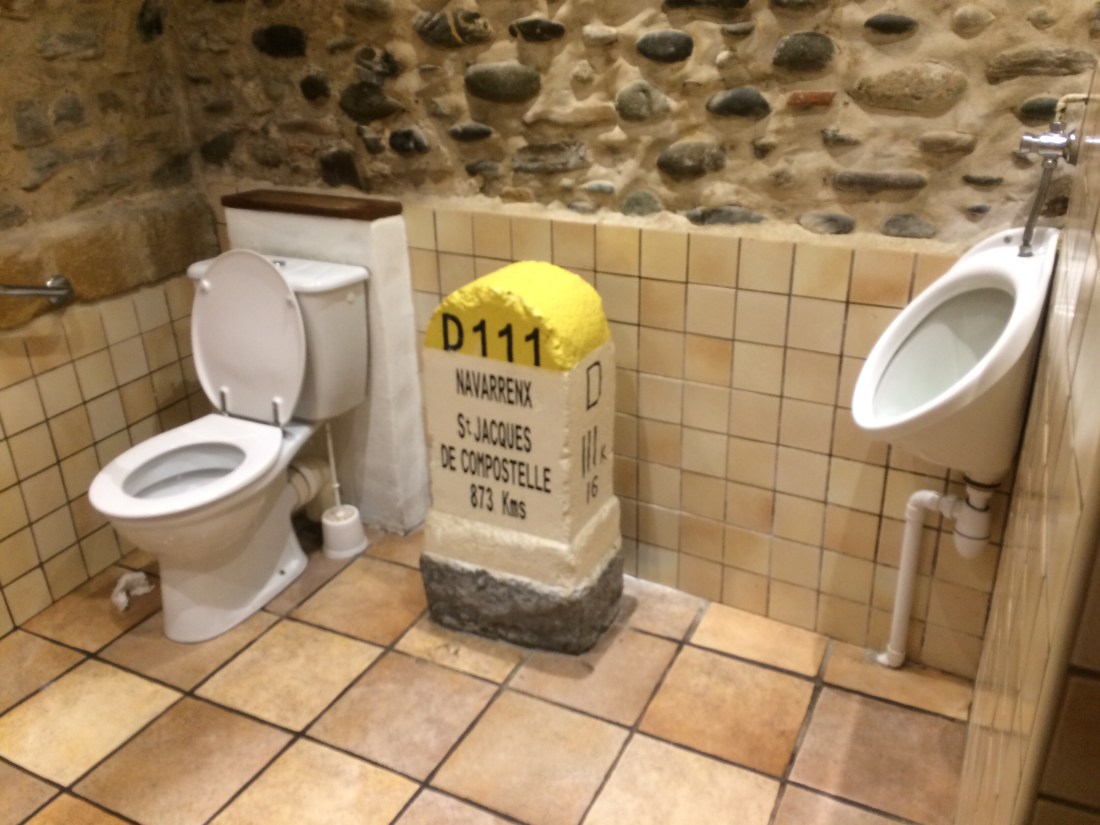
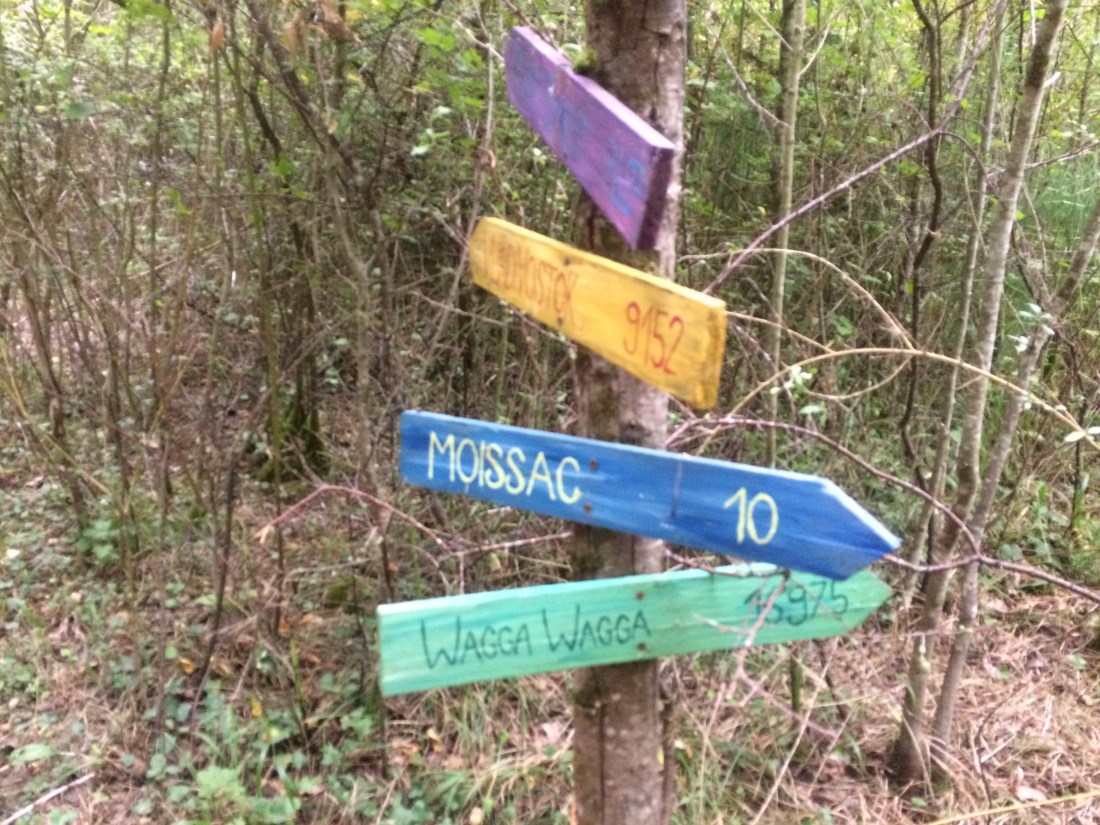
Even milestones are unstable on the Camino. For three days in a row, we saw markers claiming to be a 1000 kilometres from Santiago! There are milestones scattered along the way marking distances to everywhere from Bali to Goa to Wagga Wagga!

Photo: Wagga Wagga 16975 m or kms?! Signpost in a squatter commune near Moissac.

Yes, milestones are a joke here. You can flush ‘em down the toilet.

img_6163

Photo: Cafe just outside the fortified town of Navarrenx.

But over time, some locations have taken on a sort of ritual significance – St Jean Pied de Port is one of them. This startlingly beautiful walled town, on the bank of the River Nive, surrounded by mountains is the starting point for many contemporary pilgrims. In summer, on average 400 pilgrims take off from here towards Santiago, each day. Now in autumn, those numbers have dropped to about 250, the Pilgrim Office tells us.

As we walk down St Jean’s cobbled main street, Rue de la Citadelle, a group of Koreans, who are about to start, cheer us wth ‘wow’s, as veteran walkers with 750 kms under our belt. For many who started from Le Puy, St Jean is the end point. For me the endorphin and the resulting euphoria at reaching this milestone, is tempered by the farewells to friends of the road, most of whom I will never see again, and with whom I have nothing in common other than the strange practice of walking day after day on a road paved with legends and myths for over a thousand years.

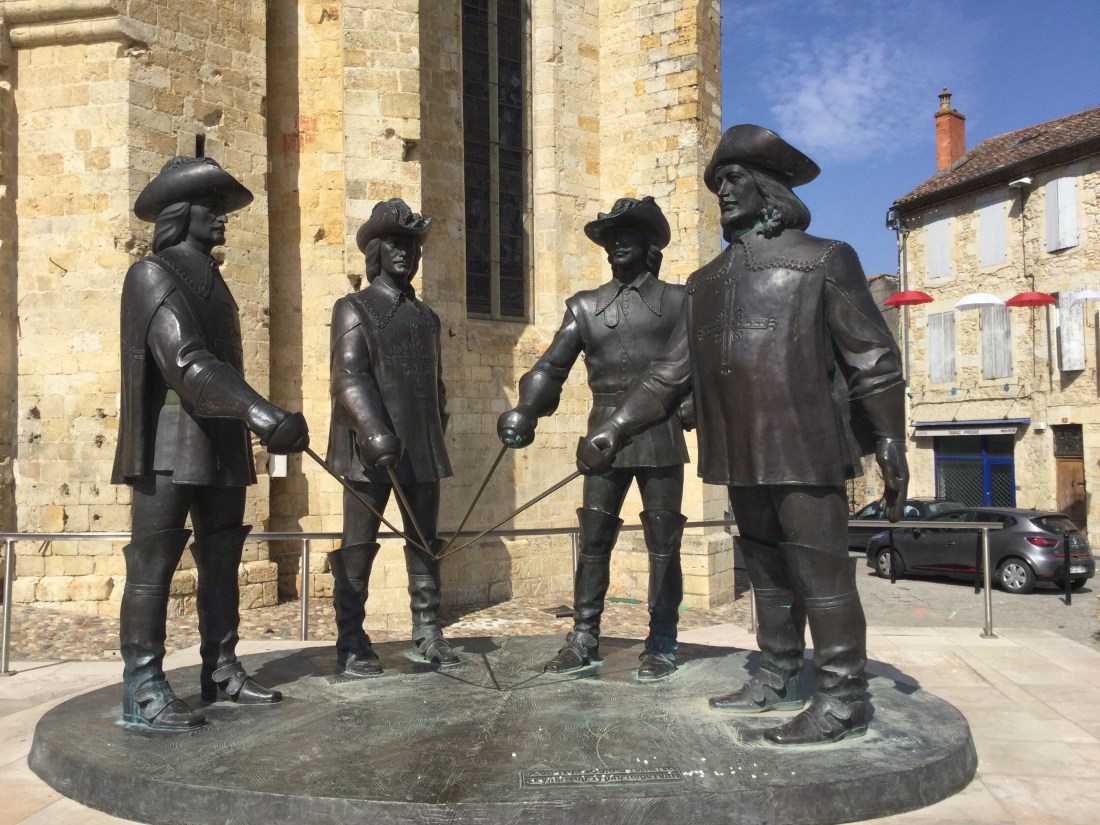
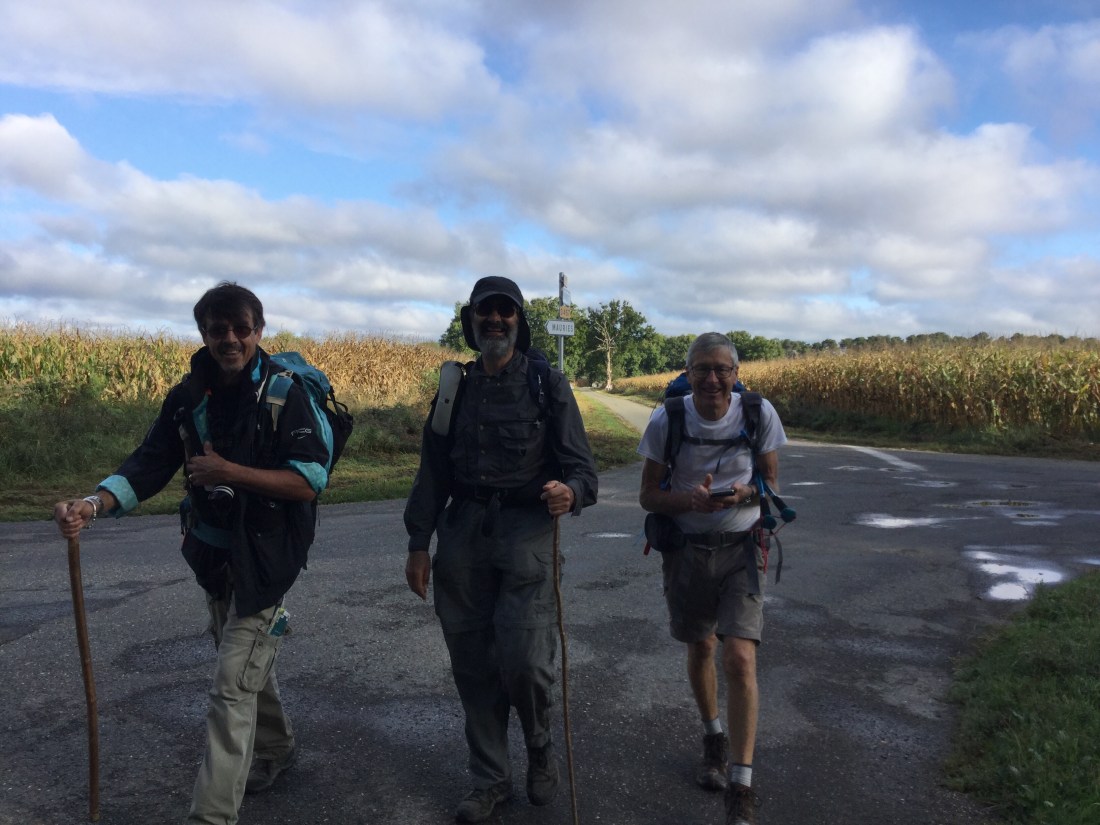
Legends: Three Musketeers and d’Artagnan at the official 1000kms from Santiago milestone

Myths? Three Musketeers still on the Way? Photo by d’Artagnan.

Blogging the Slog

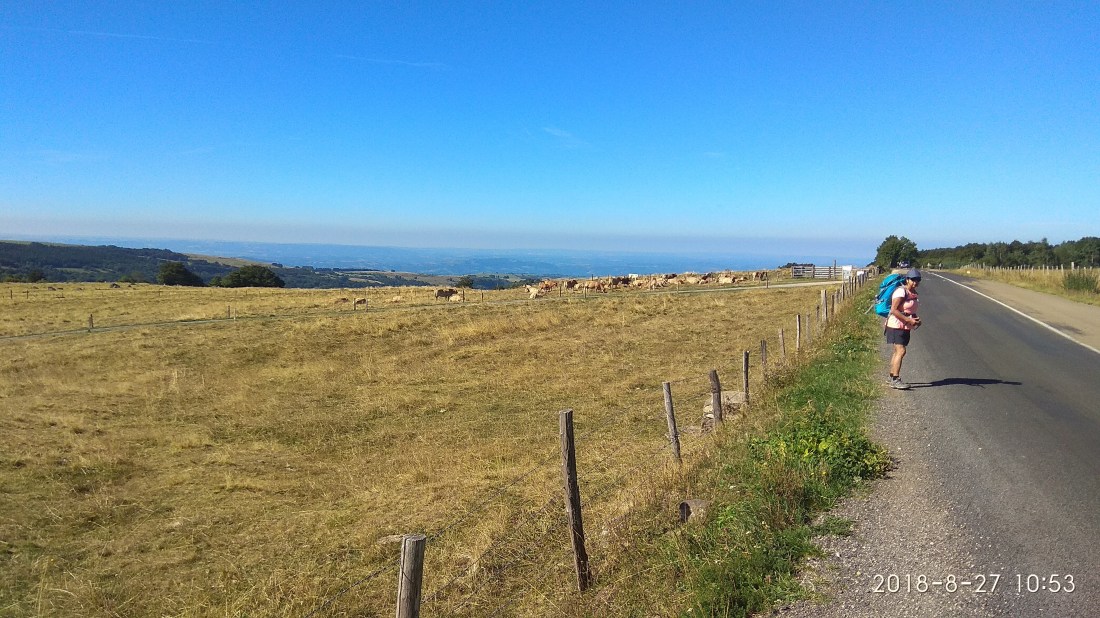
Photo: bitumen roads I loathe

Camino blogs and books are endlessly cheerful and helpful. But friend, cousin and blogger KD (not Lang, check her out at http://daytimedreamz.blogspot.in/ if you want) has asked for a blow by blow of the ‘slog’, ‘the bits you hate’. It turns out that a slog-blog is hard to write. Read on if you want to know why.

Saugues, in Upper Loir Valley, 43 kilometres from Le Puy along the GR 65 on the way to Santiago in Spain. Population – 2000. Cars – too many to count. Temperatures – rising.

A heatwave had swept through France in early August 2018. If you had walked through Saugues any time in the 20th century, the chances of getting temperatures over 30 degrees centigrade would have been nil to negligible (in Australian translation ‘Buckley’s or none’). In 2018, the mercury rose to 30 or more 12 times in August alone. At mid-day on 22 August it got up to to 31. If you don’t believe in climate change and think greenies are making this up, check out accuweather.com and NY Times on http://p.nytimes.com/email/re?location=4z5Q7LhI+KVBjmEgFdYACNmd6jwd34+mWAxqXJXikvjKUyEQPbfuA7oPETN/gXckaokVgSSO2yA=&campaign_id=61&instance_id=0&segment_id=5238&user_id=eb3d4c3f88598c8c16546fe5a3012e11&regi_id=73312224ries)

From Le Puy the GR 65 passes through the Massif Central, the French highlands. Most days involve climbs and descents. On day three we climbed out of Monistrol through beautiful forests and on to a plateau, which rolled along for about 7 kilometers then descended 150 meters into a parched and dusty track with no shade. By now the mid-day sun is right overhead.

First sign of Saugues, the settlement which for hours had held out the promise of lunch, water, rest, was an ad for a patrol station! Unique. Never have I ever, in hikes across 4 continents seen a patrol station being advertised on a walking trail. Next, a 30 meter high wooden monstrosity, adervertising Saugues’ main attraction, the Museum of the Fantastic Beast of Gévaudan (Musée fantastique de la Bête du Gévaudan), not to be missed if you like being scared to death by four floors of display about giant wolves, which killed a hundred or more people in this area from 1764-70. Even if you give the museum a wide birth, you are accosted by images of these ogres in the main drag of the city and farewelled at the last round-about out of town by a grotesque metal sculpture of the creature standing across the cowering body of a female victim.

Hotted up cars, and their inevitable consequence, wrecks and service stations, complete the horror that is Saugues. No rest here for the wicked or the weary. So with mercury still rising, we leave town at 2, not anticipating that the remaining 11 kilometres to Le Villeret is going to be on flat, unvarying bitumen roads, with no trees. In retrospect I wondered if this torment was discreetly implied in Maggie Ramsay’s self-published My Camino Frances, which rather politely writes off the day as ‘not having much scenery’.

The next key moment in the slog is best described from the point of view of a 30 something French man washing a mechanical plough with a power hose on a concrete yard, 20 meters off the road. He dodges furiously as a small female, the colour of slow-roasted egg plants rushes into his pressure hose with a tall man the colour of sun-dried tomatoes, hot on her heels. The Tomato man is screaming ‘ je suis désolé monsieur! Ma femme tres chaud’ and other things that make even less sense than ‘I am desolate sir, because my wife is very hot.’ The young Frenchman manages to make the barest sense of what is going on, the woman is drenched to the skin and both strange creatures stagger off dripping with ‘Merci beaucoup.’

Half an hour later my clothes are dry and I am starting to feel the familiar heat-stroke symptoms again: rashes all over my back and waves of nausea. This time a trough of water, recently used by passing herds, by the side of a highway provides the necessary wet respite. Hindus believe cow-dung is sacred, so I am sure a bit of cow spittle can’t hurt. Still another hour, one foot then another, one foot then another…Villages appear in the distance like mirage and disappear. The road is always there, one step ahead, ashen, burnt out, cinder.

It’s 4 p.m. Google map shows we have done over 20 km. I know the end is nigh: death or the auberge where we are booked for the night. At Le Falzet, an old building is getting a make-over. A spout with a welcome sign of ‘au potable’ appears for the first time since we left Saugues. It’s been two hours and a life time since I have seen clean water. One final wetting of tee-shirt and we are off to our delightful rest for the night, Auberge Le Deux Pelerins (the Two Pilgrims Place).

Later in the evening, bathed, cooled, and two home made fruit liquors later, I wonder why so little is written about the contemporary pilgrim’s woes. Most of my dozen or so dinner companions have done the same 23 kilometers, in the same 30 degrees heat. Most did not think it was the worst day’s walk. Beautiful, 20 year old Elle (not her real name – but she looks a bit like a super model) likes walking in the heat. It reminds her of summer walks with her father. She finds the last hour of each day a drag – her feet hurt after about 4 hours of walking. But by the time she wakes the next morning, she recalls only the delicious food and the delightful host of the auberge and she walks again.

Cecile (all names are fake of course) is my age. And like me she is a bad sleeper. She hates those morning when she has just fallen asleep at 4 a.m and the alarm goes off at 6. But she sets off nonetheless with the hope of a better night’s sleep to come. ‘It is like childbirth,’ she says. ‘You forget labour pain – a mother’s brain is designed to forget. Otherwise, no one would have a second baby. Same with the Chemin. Every day you have pain. Every night you forget!’ She gets a round of knowing laughter from the women.

Photo: the daily happy ending at dinner

That is the first problem with trying to blog the slog – when you are that exhausted, you can’t write things down. The next morning, you can’t really remember. There are no photos to jog your memory either – if you still have the energy to take photos, you are nowhere near the end of your tether. So I keep trying in every conversation, to find variations on the theme of ‘when the hike is a slog’, ‘the hard bits of the day’, ‘what parts of this do you hate’ and so on

A week later, I talk to Philip, the only Malaysian I have ever seen on any of my many long-distance hikes and also the man with the whitest teeth. At 48, Philip has pretty much ‘climbed every mountain. And forded every stream’. His nightmare is a day of sub-zero temperatures. Weird. I recall walking in across the French border into Spain in February 2014, as snowflakes floated down all over our rain gear – delight. Nightmares, it seems, are highly individual.

Books and blogs provide distances, temperatures, elevations. Many calculate scales of difficulty on the basis of objective criteria. But the slog-scale is too personal to be standardised or even usefully shared. My system overloads very quickly with heat and bitumen. Those with bad knees suffer whenever a path descends. Philip the smiling Malaysian hates the cold. For Cecile the slog scale operates inversely with the amount of sleep the night before.

To misquote the most famous of opening lines: ‘Happy pilgrims are all alike; every overwrought pilgrim is unhappy in her very own way.’ (Tolstoy, well, not exactly.)