
The South West Coast path is mostly so narrow you can neither overtake nor pass anyone, without some polite interaction. Mostly the conversation goes like this:
Me: ‘Good morning’
Other: ‘It is indeed. Beautiful. Enjoy it’.
But I have grown bold having walked more than a month, over 400 kilometres right across the top of the Exmoor National Park, and the Counties of Devon and Cornwall. For the record, in this time, we have experienced one misty morning and 5 minutes of drizzle, both in June.
So I add: ‘It is glorious here every day!’ This usually elicits invitations (which sound more like threats) to come back in winter, when the path is a slew of mud and dung, and the ocean is gulping down chunks off the rock face.
Every few days we do indeed find that bits of the path have fallen away, where walkers are diverted further up the hill, into paddocks. 2014 recorded the largest Atlantic storms in 60 years along parts of this coast.
The South West Coast footpath is an important part of tourism infrastructure, providing access to the beaches, coves and historic sites of interest. In Cornwall alone, it generates £300 million a year and supports 7500 jobs (PhD thesis by Claire Siobhan Earlie, Plymouth University). A retired engineer-turned-B&B-host tells us over breakfast that the rate of erosion has been much the same for 10,000 years. Still, Cornwall was one of the first counties in the UK to declare ‘climate emergency’, whatever that means.
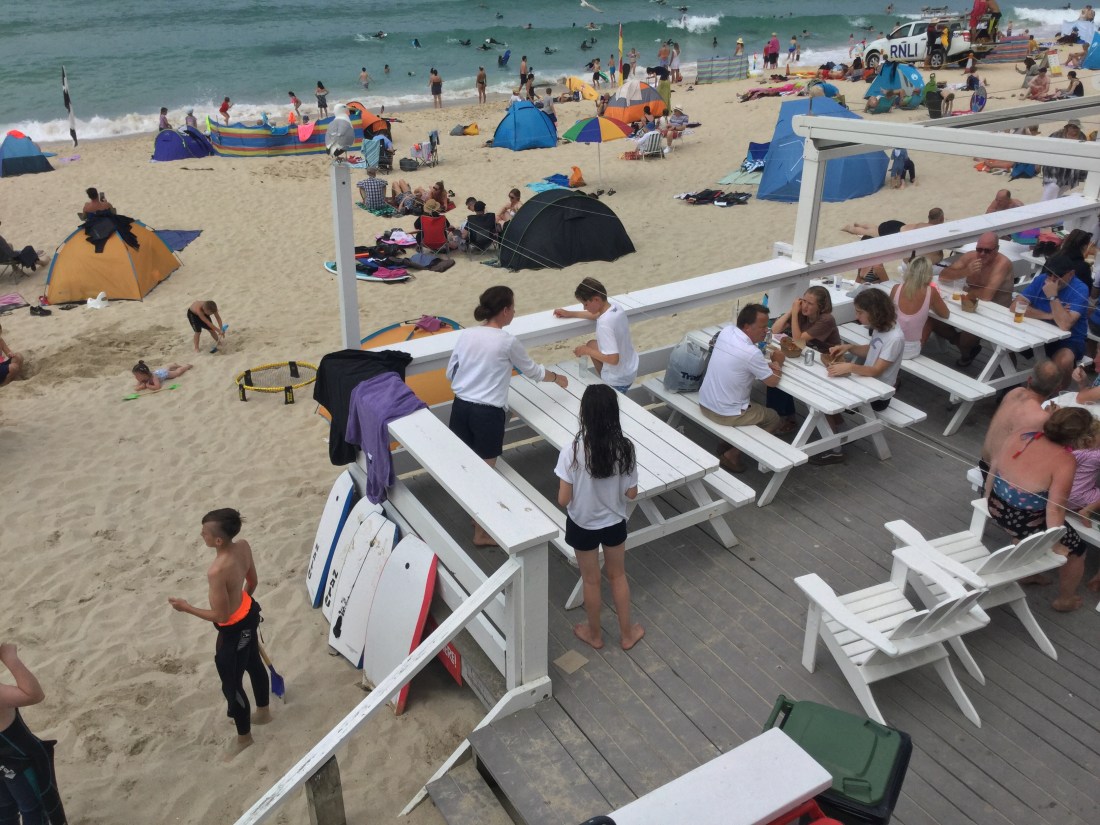
For now though, the weather is perfect one day and just a tad warm the next. And thousands of summer revellers are using the path to get to their favourite sunny July activity.
Old and new tourist destinations are dotted along the South West Coast Path. In towns like Penzance, the railway line in the 1800s laid the foundations for summer tourism, with visitors flocking to the beaches nearby, some sandy, mostly rocky, but invitingly warm compared to other parts of Britain. The many rugged parts of the coast have inspired generations of artists, novelists and film-makers. From Rebecca <https://en.wikipedia.org/wiki/Rebecca_(novel)> to Poldark <https://en.wikipedia.org/wiki/Poldark> the Atlantic coast from Hartland Quay to Falmouth has repeatedly starred as the brooding, darkly angsty extension to moody heroes and sultry heroines. Indeed, the morning at the end of June, as we left the Hartland Quay Inn, the last coastal hotel in North Devon, the film crew for the latest version of Rebecca were rolling in.
TV’s Doc Martin has boosted the recognition of Port Isaac. Rick Stein outlets and other eateries have put Padstow on the world’s gourmet map. St Ives even has a Tate Galley to bring in the ‘Culcha-wallahs’ from around the world. Then there are towns like Hayle, which lost everything when the mining boom in Cornwall ended in the 19th century and now depend on the cheap end of tourist and retirees market for their survival.
Near such towns and the many other attractions strewn along the path, you can find yourself in a traffic jam, with dogs off leashes, kids in thongs, beer-guts and couples insisting on hand-holding where you can barely walk in a single-file. For most, the path is merely a means to take the shortest route to a destination where cars cannot reach. So the crowds melt away quickly, leaving most of the 1000 kms thinly populated with ramblers, hikers and trail runners.
Runners pass by like the wind. Ramblers are a hard to define. But it’s a very British thing (see https://www.ramblers.org.uk/) and for some reason most ramblers we have met along the way are white men of a ‘certain age’. Some of the ramblers might also be long-distance walkers, but more likely they have gone over the same ground time and again, so that they know their own parambulating patch like their own back yard. Ramblers stop to chat, encourage and inform. They know every turn in the path and every cove where you might see a seal, or where a boat went down ‘just a few years ago’ (in 1981, for instance, between Mousehole and Penzance).
Long distance walkers are even fewer and further between. We have met, perhaps a dozen who are walking one or two weeks at a time and planning to complete the path in a few years or decades. And have met just 6 or 7 who are trying to complete the path end to end – in one go.
Between Tintagel and Port Isaac, we run into several groups of teenagers hiking and camping for three days as part of their ‘Duke of Edinburgh Award’ <https://en.wikipedia.org/wiki/The_Duke_of_Edinburgh%27s_Award>. One of them has a special assignment to interview hikers who are going the ‘whole way’ and I am the first one she has spotted!
My young interrogator wants to know why I am walking and what are the ‘key challenges’. The second one is easy: having the discipline to do a hard day’s walk and to get up the next day and do it again and again and again. Unlike tourists, hikers have no sense of destination. Unlike the runners we don’t keep time. Unlike ramblers, we don’t develop that abiding bond and knowledge of the place. Unlike dog-walkers, we are not doing it in the best interest of another being. Why did I set out on a long walk? I’m trying to figure that one out as I go, I tell her.
‘Mal’ (not his real name) is the only English ‘end-to-ender’ we have met. The other half-dozen have all been young Germans. We met Mal about a week into our walk. His rucksack weighs at least 4 times mine. He is carrying a tent, which he pitches wherever he can find a flat bit of land. With enough beer at the last pub on the day’s walk, he can fall asleep anywhere. I can hear him fifty paces away when he is labouring up a hill behind me. I admire Mal, but cannot imagine being without the creature comforts of a bed and a shower at the end of the day. I even have my bag carried when a section of the walk seems too long or too hard.

The South West Coast Path has to please a large and diverse clientele. And thanks to an army of volunteers from the National Trust, the South West Coast Path Association and a myriad of other agencies, it remains user-friendly, for the very few Mal-s at one end of the user-spectrum and at the other, the throngs armed with Trip Advisor’s top-ten lists, out to take selfies at the ‘second scariest cliff’ or the ‘largest Cornish Pasty’ in the world. And, then there’s all of us in between.
Two hundred years ago, this path was part of a crowded, morbid, polluted, industrial corridor, ravaged by centuries of mining for tin and copper and quarrying for granite and other hard stones. Some scars from mining still remain. But with a little help from humans, most of the pits are growing over and blending back into magical wild gardens.

As you walk the path, right on the edge of an ocean that’s rising ever faster, as you scour for the next signpost advising you of another rockfall, another diversion, you have to wonder what will remain of this much-trodden footpath in another 200 years?


 Reading the Road