Cornwall Coast: Notes from a Camino Addict II

Dateline: Fowey (said Foy)

On the Camino, the walker is pulled along the 800 km (or 1000 or 1400, or whatever) by the promise of a grand entrance into Santiago, buoyed by the community of pilgrims, of which she is a member the moment she starts on the Way. South West Coast Path has neither the spectacular end marker nor a community bound by a common goal.

Once the first flush of a new adventure has worn off, walking, then walking some more, then again the next day and the day after…it gets to you, it’s hard. When refracted through sprained knees and strained shoulders, scenic beauty fails to inspire. As Raynor Winn writes (in the delightful Salt Path, Penguin, 2018) it’s just ‘up and down and down and up and blue and green, and blue green, blue, blue, green green, blue…’ endlessly on and on.

‘I came so far for beauty

I left so much behind

My patience and my family

My masterpiece unsigned

I thought I’d be rewarded

For such a lonely choice’

I played Leonard Cohen’s ‘such a very hopeless voice’ over and again in my head.

Those who read the earlier ‘Camino addict’ blog might recall, that on day 13, of our walk on the SWCP, we stumbled into Morwenstow and found ourselves in a ‘free house’ once used by pilgrims on their way to the port town of Fowey, from whence they set sail to Northern Spain.(see https://readingontheroad54893552.wordpress.com/2019/07/12/camino-addicts-notes-from-uks-south-west-coast-path/).

The Saints’ Way crosses Cornwall from Padstow in the North to Fowey in the South. It has its own Camino ‘passport’ with Fowey as the final stamp. This route is less than 50 km long and there is no record of any medieval pilgrim having trudged 420 km along the coastline (that is, the SWCP), just to take the scenic route to Fowey. But then again, all over Europe new Camino Ways are being found, recovered, re-invented. So why not the Camino Coastal Cornwall?

The real work of long distance walking is done by your head – legs are incidental. And the idea of a Camino to Fowey works to re-set my mind to the task.

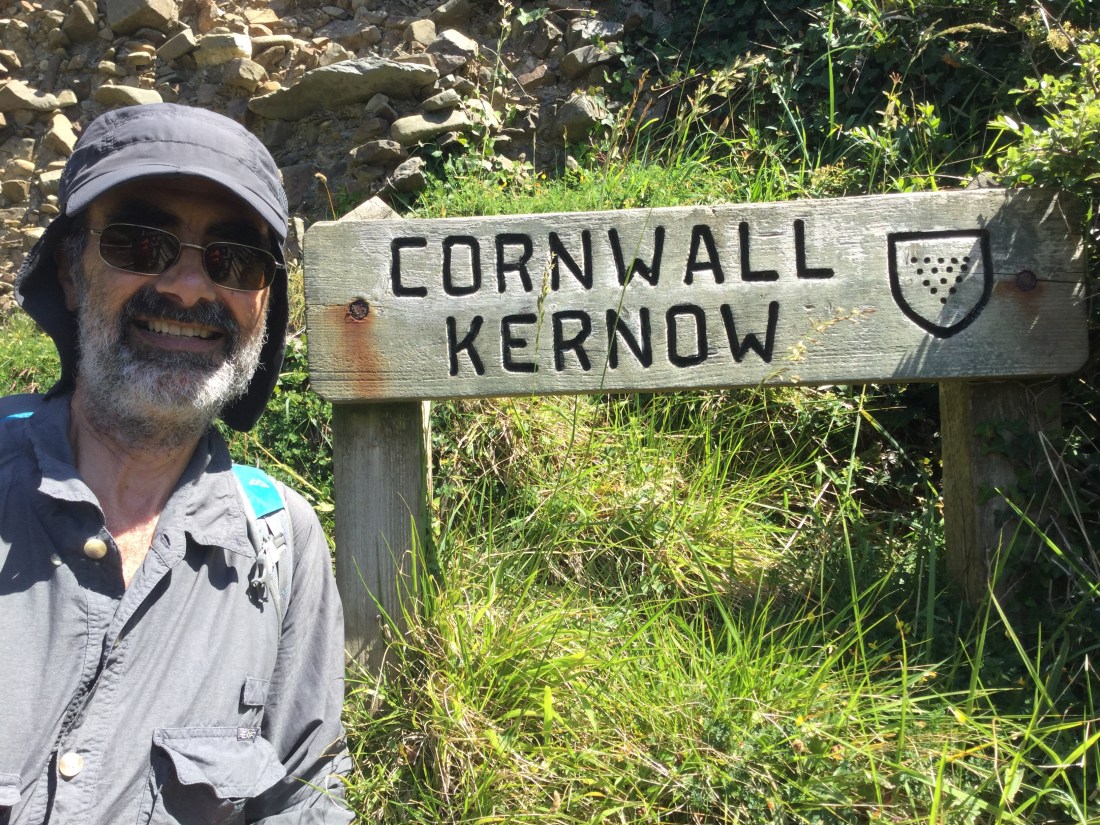
Leaving Morwenstow we climb over the highest cliff of the Cornish Coast, passing Higher Sharpnose Point, stopping to take the obligatory photo of this little diversion. It is not a path that anyone needs to actually traverse – just a bit of bravado for one’s social media.

Often, our path brings us into tourist destinations; mostly we miss the attractions. When you have walked anywhere between 5 and 8 hours, there is little time and less will to chase up those special sights. We are a bit fazed when on the long climb down to Tintagel (King Arthur territory, see https://www.theguardian.com/uk-news/2019/aug/08/controversial-and-late-tintagel-footbridge-in-cornwall-to-open) two well-dressed women ask us for direction to the ‘viewing point’. Anywhere really, I want to say, just look around.

Since Hartland Point, the ocean has been almost continuously by our side, somewhere just below the cliffs. Our soundtrack: its incessant lunges onto the shores, and

‘Its melancholy, long, withdrawing roar,

Retreating to the breath.’ (As in Matthew Arnold’s maddeningly perfect verse).

Now and then birds hit a high note rising above the water’s groan. Nearer the beaches the gulls and the motor boats out-screech each other.

Just 6 days after Morwenstow, my Camino idea, farfetched as it was, had so receded that I even forgot to visit Saint Petroc’s Church where the Saints’ Way officially starts. We didn’t get in till 4 p.m. and we had 20 km to do the next day. St Petroc didn’t put his Church quite in my way, so he’ll have to do without me.
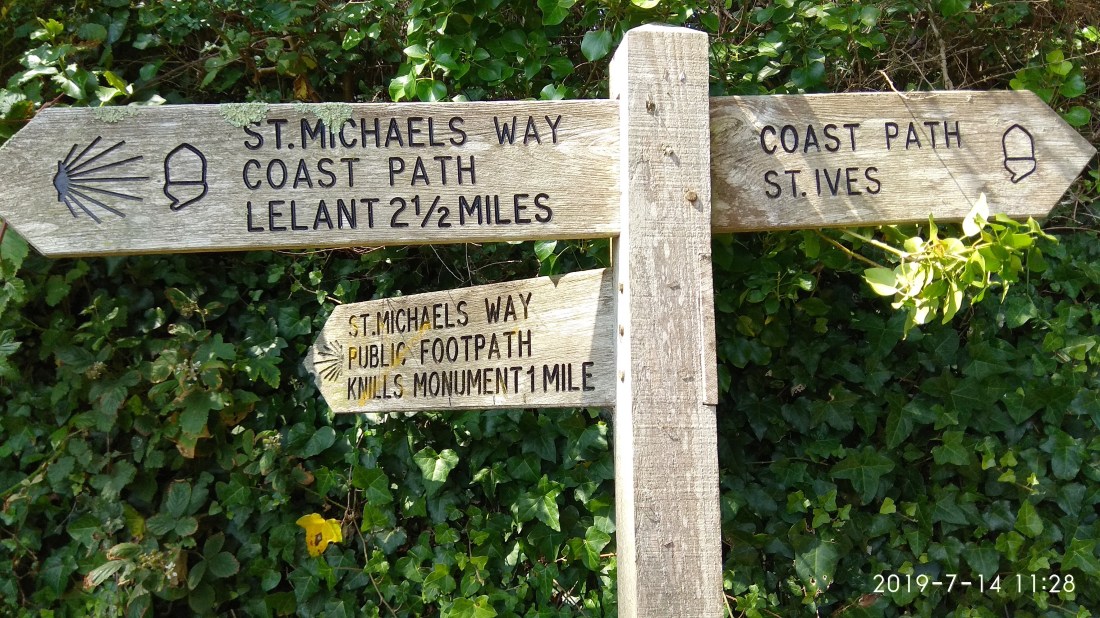
But the following Sunday, half way between Hayle and St. Ives, the path, marked with the Camino shell way-marker, passes right through the grounds of St. Uny’s church, Lelant. Another Camino, St Michaels Way, officially opened by the Spanish Ambassador in 1994, starts from here, crosses the narrowest section of Cornwall, just 13 km to end at St Michael’s Mount.

On the SWCP, it is five days before we get to the Mount, where a biblical vision unfolds daily: the ocean parts, literally, as water pulls away to the east and the west, revealing a narrow 500 metres long land bridge from the small village of Marazion to the tiny tidal island, St Michael’s Mount. Every evening through summer, tourists with fine cameras take time-lapse shots of the ocean closing over the path, evidence that the oceans didn’t just part for Moses.

We get to Fowey nearly 6 weeks after we started at Minehead and more than a month after I learnt about the Camino connections at Morwenstow.

The volunteer at the Information Centre gushes about Fowey’s newly discovered Camino status as the final port in UK o. Most exciting, some pilgrim documents have been found in the basement of ‘Number 9 South St’ right in the centre of town! Of course, she loved the film and of course knows someone who has done the Camino and so on. ‘In the hey day of the Camino,’ the town’s tour guide says, ‘three dedicated ships sailed continuously between Fowey and ports in Northern Spain.’ Then with amazing precision he adds, ‘the trip cost 7 shilling and 6.’ How do you know, I ask. ‘Osmosis’, he says, ‘We are learning a lot about the Camino Santiago lately’…

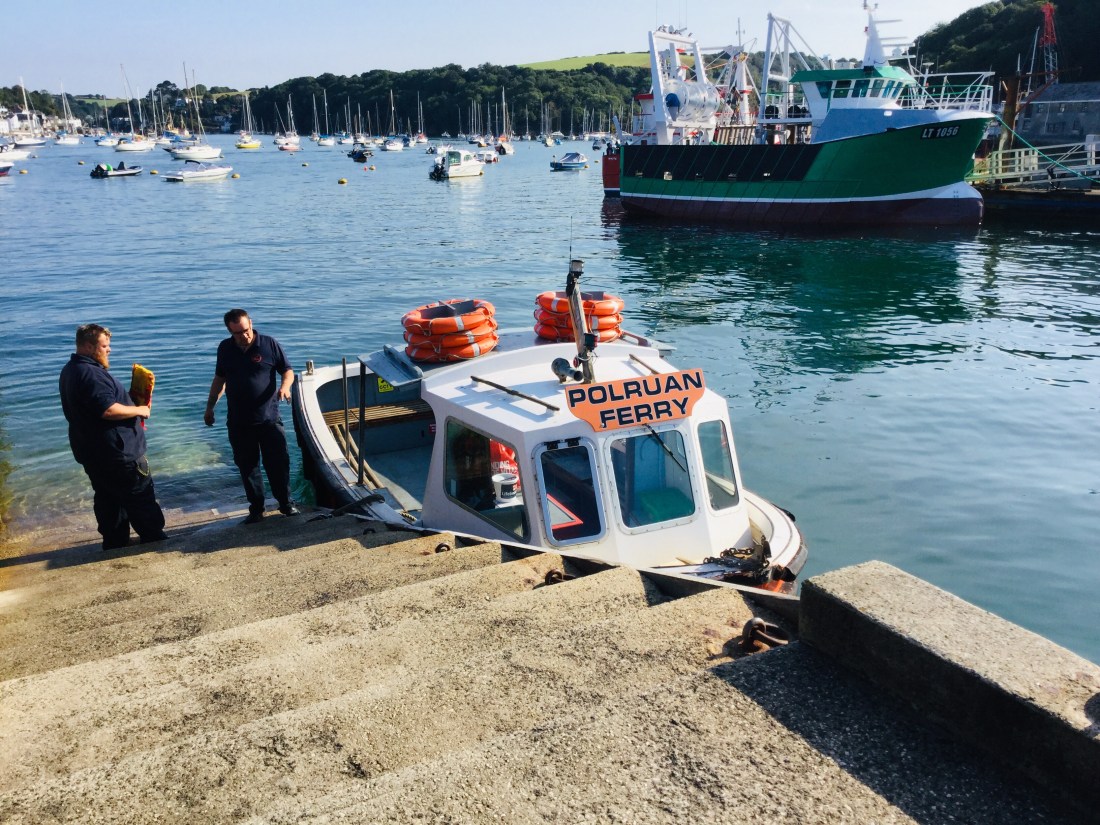
We take a ferry out, 2 quid, and 10 minutes across the mouth of River Fowey to Polruan and keep walking.
Camino Addict’s Notes from UK’s South West Coast Path

Dateline: Morwenstow

From the Camino addict’s point of view, there is more to Morwenstow than meets the eye, which is a very good thing, because not much meets the eye: a pretty ordinary looking old church, a farm cafe, an old pub and half-dozen assorted small dwellings. (Those unaware of this ailment called Camino Addiction, please go to <https://readingontheroad54893552.wordpress.com/2018/08/14/first-post/> on this site or google Camino, and you will find dozens of sites where walkers are talking incessantly about trails which start from various points in Europe and end in the Cathedral of Santiago in North Western Spain.) Of course, for the addict, the Camino is never far away. The foreshore in Minehead, the little tourist town where the South West Coast Path officially begins, is way-marked with shells. ‘Just decoration’ the young lass at the tourist office says, ‘No connection to the Camino’. But two weeks into the walk the Camino appears again, immanent and emphatic, an old love who won’t be forgotten, even though you are in this exciting new venture with this much younger road.

The official website for the South West Coast Path grades the section across the border of North Devon into Cornwall as ‘severe’, which is the highest in their four point scale of difficulty. Most through-hikers will take about 10 hours from Hartland Quay, the last hotel on the coast of North Devon to Bude, the first tourist town in Cornwall. We, very fortunately, have managed to book one of just 4 rooms available in Morwenstow, above the old pub called Bush Inn. So just 13 kilometres of treacherous roads rather than the 25 to Bude.

We had reached the Atlantic coast the day before, when at Hartland Point in Devon, marked only by a car park and a shack selling packaged soup, the Bristol Channel officially folds seamlessly into the ocean. From afar the Atlantic is still as a pond, rolling calmly off the edge of the earth. Closer up, sections of the stony shore have been slashed to shreds with vicious claws. Elsewhere, cliffs are chiseled into abstract angular sculptures which change shape with every turn in the path and this path wriggles like a snake, constantly, Boulders rise from the deep like temples.

The Atlantic is not the only architect of this scenery. These coasts have been stripped for slate and quartz for centuries. A variety of technologies for cutting and hauling stone have shaped much of the shoreline over which the current walking track is laid. With the quarries gone, the ocean has fully reclaimed its coast, which is eroding now, the papers say, at an alarming rate.

Our very own first hand experience of ‘alarming erosion’ comes an hour or so before Morwenstow. For various reason we are unusually late starting out. Our Hartland Quay hotel manager says ‘this is the most difficult day’s walking of the entire path’. We are more than usually apprehensive because we haven’t yet discovered that for the next 100 miles, every bar-tender insists that the next 10 are the hardest miles of the route. None of them appear to have walked much beyond the ten-mile radius of their pub. They do however know the near-by coast like the back of their own hands and can scare the daylights out of most outsiders (which is everyone who has not lived in that particular village for at least 30 years) with vivid descriptions of the rugged rocks and stormy seas.

The walk on this day is indeed gruelling. After about four hours of long climbs and sharp descents we enter the hallowed land of Cornwall, with due genuflection to WB’s (Walking Buddy) ancestors who left this lofty land for the sandy beaches in a flat land down under a hundred years ago. A few minutes after passing what might have been (not sure because one high rock feels much like another when you have been climbing all day) the second highest coastal cliff in Cornwall, about 230 metres above sea level, we arrived at what was definitely the end of the road, literally in the brambles, with no path ahead of us and where the right foot had to be placed precariously a foot below the left just to keep standing. A slightly bent wire fence separated us from the grazing cows on the hillside to our left! I’m not quite sure what was on the right; I wasn’t going to look. WB does not like crossing legal lines such as fencing. But this was no time to be finicky. We scrambled over the wires, fortunately not electrified or barbed, up the hill without a second thought and for once I was happy to be walking amongst cattle!

At the stiles, which we knew separated one paddock from another or paddocks from the path, we saw the small, mostly washed out piece of typed notice about the recent landfall, which has forced a re-direction of the route – yes, through this paddock! I guess we had missed the notice earlier on the path, at some point before it had fallen into the ocean, or the notice had been blown away.

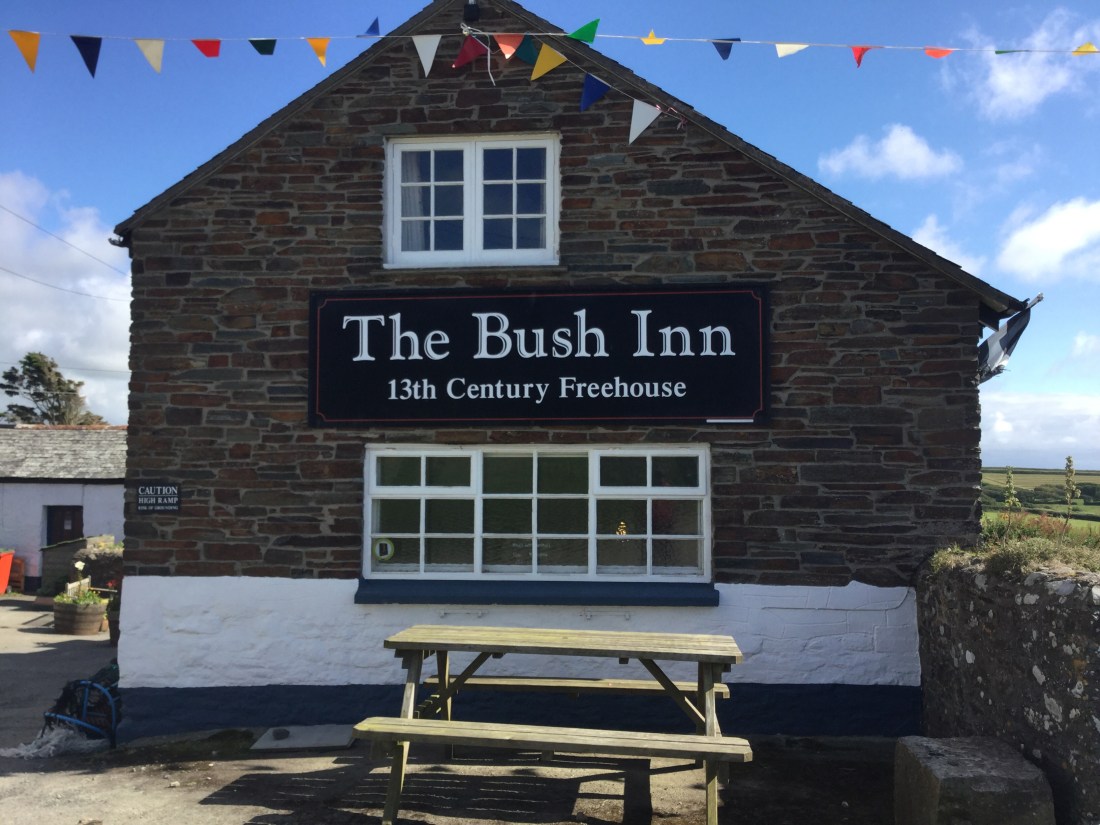
Soon after this exciting diversion a church spire came into view. On the Camino almost inevitably the pilgrim sees the medieval church long before arriving in a village. But on the SWCP the distant view of an old church makes Morwenstow unique. Our hearts quickened with anticipation of our night’s stop as we arrived in front of a pretty ordinary looking two-storey building with a huge sign ‘Bush Inn: 13th century Freehouse’. My Camino Amigos will have guessed by now that this building had once given shelter to pilgrims on their way to Santiago.

‘The Bush Inn has a long history of hospitality dating back to 950 AD’, said the information sheet in our room. ‘It is believed at that time to have been the monk’s rest for those on the pilgrimage route from Wales to Spain who crossed Cornwall between the North Devon ports and Fowey.’ The South West Coast Path will later pass through Fowey, but alas, there are no more pilgrim boats from there to Northern Spain. Morwenstow to Fowey is about 420 kilometres. The Camino is coming with us, sort of, on this new journey we are on.

Post-script: It turns out that Bush Inn was expecting us on 30 June. When we didn’t arrive and they could not get us on the mobile number they had from our booking.com reservation, they called the only hotel in Hartland Quay, guessing correctly that, like most long distance walkers on this route, we would have stopped there on the day before getting to Morwenstow. Hartland Quay confirmed we were indeed there and the hosts at Bush Inn, simply moved our reservation to the next day, 1 July, with absolutely no penalty! As WB was profusely apologising to the wonderful surveyor-turned hotelier about putting him to so much trouble , the lady of the house explained to me quietly that they had been really worried about us: ‘Some walkers fall down you see and ‘ave to be fetched by helicopters. Mostly in winter of course. But cattle go over all the time. And dogs too…’

Yes, the walk into Cornwall takes your breath away in all sorts of ways. As our Morwenstow landlord put it: ‘the cliffs get MMOCCHH bigger as soon as yer’ cross into Cornwall from England’. We had crossed the second tallest Atlantic cliff in all of Britain today, he says, and tomorrow, we will cross the tallest.