Blogging the Slog

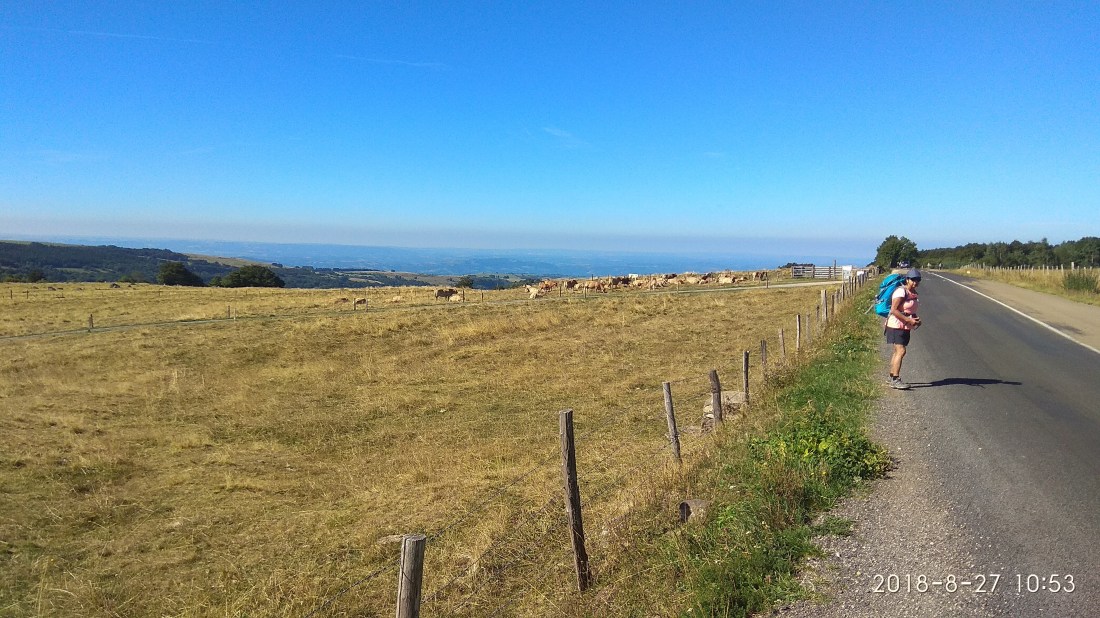
Photo: bitumen roads I loathe

Camino blogs and books are endlessly cheerful and helpful. But friend, cousin and blogger KD (not Lang, check her out at http://daytimedreamz.blogspot.in/ if you want) has asked for a blow by blow of the ‘slog’, ‘the bits you hate’. It turns out that a slog-blog is hard to write. Read on if you want to know why.

Saugues, in Upper Loir Valley, 43 kilometres from Le Puy along the GR 65 on the way to Santiago in Spain. Population – 2000. Cars – too many to count. Temperatures – rising.

A heatwave had swept through France in early August 2018. If you had walked through Saugues any time in the 20th century, the chances of getting temperatures over 30 degrees centigrade would have been nil to negligible (in Australian translation ‘Buckley’s or none’). In 2018, the mercury rose to 30 or more 12 times in August alone. At mid-day on 22 August it got up to to 31. If you don’t believe in climate change and think greenies are making this up, check out accuweather.com and NY Times on http://p.nytimes.com/email/re?location=4z5Q7LhI+KVBjmEgFdYACNmd6jwd34+mWAxqXJXikvjKUyEQPbfuA7oPETN/gXckaokVgSSO2yA=&campaign_id=61&instance_id=0&segment_id=5238&user_id=eb3d4c3f88598c8c16546fe5a3012e11&regi_id=73312224ries)

From Le Puy the GR 65 passes through the Massif Central, the French highlands. Most days involve climbs and descents. On day three we climbed out of Monistrol through beautiful forests and on to a plateau, which rolled along for about 7 kilometers then descended 150 meters into a parched and dusty track with no shade. By now the mid-day sun is right overhead.

First sign of Saugues, the settlement which for hours had held out the promise of lunch, water, rest, was an ad for a patrol station! Unique. Never have I ever, in hikes across 4 continents seen a patrol station being advertised on a walking trail. Next, a 30 meter high wooden monstrosity, adervertising Saugues’ main attraction, the Museum of the Fantastic Beast of Gévaudan (Musée fantastique de la Bête du Gévaudan), not to be missed if you like being scared to death by four floors of display about giant wolves, which killed a hundred or more people in this area from 1764-70. Even if you give the museum a wide birth, you are accosted by images of these ogres in the main drag of the city and farewelled at the last round-about out of town by a grotesque metal sculpture of the creature standing across the cowering body of a female victim.

Hotted up cars, and their inevitable consequence, wrecks and service stations, complete the horror that is Saugues. No rest here for the wicked or the weary. So with mercury still rising, we leave town at 2, not anticipating that the remaining 11 kilometres to Le Villeret is going to be on flat, unvarying bitumen roads, with no trees. In retrospect I wondered if this torment was discreetly implied in Maggie Ramsay’s self-published My Camino Frances, which rather politely writes off the day as ‘not having much scenery’.

The next key moment in the slog is best described from the point of view of a 30 something French man washing a mechanical plough with a power hose on a concrete yard, 20 meters off the road. He dodges furiously as a small female, the colour of slow-roasted egg plants rushes into his pressure hose with a tall man the colour of sun-dried tomatoes, hot on her heels. The Tomato man is screaming ‘ je suis désolé monsieur! Ma femme tres chaud’ and other things that make even less sense than ‘I am desolate sir, because my wife is very hot.’ The young Frenchman manages to make the barest sense of what is going on, the woman is drenched to the skin and both strange creatures stagger off dripping with ‘Merci beaucoup.’

Half an hour later my clothes are dry and I am starting to feel the familiar heat-stroke symptoms again: rashes all over my back and waves of nausea. This time a trough of water, recently used by passing herds, by the side of a highway provides the necessary wet respite. Hindus believe cow-dung is sacred, so I am sure a bit of cow spittle can’t hurt. Still another hour, one foot then another, one foot then another…Villages appear in the distance like mirage and disappear. The road is always there, one step ahead, ashen, burnt out, cinder.

It’s 4 p.m. Google map shows we have done over 20 km. I know the end is nigh: death or the auberge where we are booked for the night. At Le Falzet, an old building is getting a make-over. A spout with a welcome sign of ‘au potable’ appears for the first time since we left Saugues. It’s been two hours and a life time since I have seen clean water. One final wetting of tee-shirt and we are off to our delightful rest for the night, Auberge Le Deux Pelerins (the Two Pilgrims Place).

Later in the evening, bathed, cooled, and two home made fruit liquors later, I wonder why so little is written about the contemporary pilgrim’s woes. Most of my dozen or so dinner companions have done the same 23 kilometers, in the same 30 degrees heat. Most did not think it was the worst day’s walk. Beautiful, 20 year old Elle (not her real name – but she looks a bit like a super model) likes walking in the heat. It reminds her of summer walks with her father. She finds the last hour of each day a drag – her feet hurt after about 4 hours of walking. But by the time she wakes the next morning, she recalls only the delicious food and the delightful host of the auberge and she walks again.

Cecile (all names are fake of course) is my age. And like me she is a bad sleeper. She hates those morning when she has just fallen asleep at 4 a.m and the alarm goes off at 6. But she sets off nonetheless with the hope of a better night’s sleep to come. ‘It is like childbirth,’ she says. ‘You forget labour pain – a mother’s brain is designed to forget. Otherwise, no one would have a second baby. Same with the Chemin. Every day you have pain. Every night you forget!’ She gets a round of knowing laughter from the women.

Photo: the daily happy ending at dinner

That is the first problem with trying to blog the slog – when you are that exhausted, you can’t write things down. The next morning, you can’t really remember. There are no photos to jog your memory either – if you still have the energy to take photos, you are nowhere near the end of your tether. So I keep trying in every conversation, to find variations on the theme of ‘when the hike is a slog’, ‘the hard bits of the day’, ‘what parts of this do you hate’ and so on

A week later, I talk to Philip, the only Malaysian I have ever seen on any of my many long-distance hikes and also the man with the whitest teeth. At 48, Philip has pretty much ‘climbed every mountain. And forded every stream’. His nightmare is a day of sub-zero temperatures. Weird. I recall walking in across the French border into Spain in February 2014, as snowflakes floated down all over our rain gear – delight. Nightmares, it seems, are highly individual.

Books and blogs provide distances, temperatures, elevations. Many calculate scales of difficulty on the basis of objective criteria. But the slog-scale is too personal to be standardised or even usefully shared. My system overloads very quickly with heat and bitumen. Those with bad knees suffer whenever a path descends. Philip the smiling Malaysian hates the cold. For Cecile the slog scale operates inversely with the amount of sleep the night before.

To misquote the most famous of opening lines: ‘Happy pilgrims are all alike; every overwrought pilgrim is unhappy in her very own way.’ (Tolstoy, well, not exactly.)

Holy Mary Mother of God! She’s Black!!

Ursula Le Guin could have written her ‘Epiphany’ in Le Puy:

Mrs Le Guin has found God.

Yes. But she found the wrong one!

Absolutely typical…

And …‘she is black’.

In Le Puy’s Cathedrale Notre Dame a small black female form has more or less taken over from the white-bloke God typically presented in institutionalised faiths. In Le Puy, the powerful Black Madonna sits remote and distant on the huge black and gold background of the High Altar. She is so small and so black that you can barely see her face or that of her black baby son poking like a mask out of the centre of his mother’s robe. And every day of the summer months at a special mass at 7 in the morning she blesses a hundred or more pilgrims setting off on journeys across France and Spain towards Santiago.

Mrs Le Guin could have found the black-she-God at some 180 holy sites in France and another 400 or more sites across Europe. Most of these black Mamas seem to pack quite some miraculous Grrrrl Power.

Le Puy is one of the oldest Marian shrines, going back perhaps to the First Century. But the current sculpture is a replica from the late 1800s. Historians agree that the original statue was probably an Egyptian carving brought to Le Puy before the 11th century. Records from late 1700s say that she was made of wood, bandaged up like a mummy and had been painted over and over again. That Madonna and Child was burnt down during the French Revolution, reportedly, with the arsonists chanting ‘Down with the Egyptian’.

So let me extend Ursula Le Guin’s ‘Epiphany’. When a black(ish) woman (NB: Krishna is etymologically the female form of ‘Dark’ in Sanskrit) goes walkabout, she finds, quite correctly, that God is female, black, of indeterminate age (what woman tells you her correct age?) and origin, a migrant, doing what she can to fit into the local culture and who has been idolised and burnt down at the whim of men.

Nothing to see here.

There was more to see at Lyon’s Basilica Notre-Dame de Fourvière. Built in 1880 (or thereabouts) to bless French war efforts against Germany, it towers over the city, dwarfing the much older Lyon Cathedral in the centre of the old city. Notre dame de Fourvière is now deliberately international and multi-lingual with ‘hail Mary’ inscribed along it’s entry stairwell in many world languages, including several Asian and African ones. On display too are newly cast Mary figurines from around the world, including some beautiful black ones.

A family of Tamils who live in Germany draw my attention to the ‘Notre Dame de la Sante de Vailankanni’. Wiki tells me that Vailankanni a small town in Tamil Nadu and one of India’s own largest Catholic pilgrimages. It draws 20 million pilgrims a year, beating Rome hands down it would seem! The Vailankanni Madonna replica has been installed in Lyon, wearing a white sari with red and gold border emulating the Hindu Goddess of wealth, Lakshmi and just like the goddess Lakshmi in most modern representations, Sante de Vailankanni has the colour of a pukka memsahib, perfect peaches and cream! The Tamil family and I crack jokes about the Indian Barbie, though deep down every Indian woman is conditioned to dream of white skin. But, in a land where black Madonnas ooze power and passion, and white girls abound, the poor pale creature from deep dark Southern India can only disappoint, particularly as she stands next to the beautiful, politically correct, post-modern, dark brown, Italian contribution to the Mother of God gallery in Lyon’s number 2 Church.

Down in the heart of city, in the medieval Lyon Cathedral, I finally find something a skeptic can believe in. A huge photograph of ‘Sante Teresa de Calcutta’ looms out of a chapel, currently under construction. In Calcutta, her adopted home and my city of birth, Mother Teresa seemed quite human, and yet needed no Papal sanction to be recognised as a mother and a saint by the deprived and the destitute of the city. Here, in this grand old building she is instantly recognisable as the icon cast in the heat, poverty, and contradictions of the third world. Her life simply defies ordinary logic. A girl born in 1910 somewhere in the Ottoman Empire, somehow found her way to India at the age of 19. She never saw her own mother again. She spent the next 70 years working for the wretched of the earth, and is now adored as a Saint in the grandest edifices of the Western world.

Even the crustiest skeptic feels a little bit of a miracle when an old nun from her home town in India appears as a Saint in a glorious tourist venue in a glamorous French city! Hallelujah Santa Teresa of Calcutta and thanks for reminding me of my real home.

J’utilise Google Translator

Photo: Long walk up to Cathedrale Notre-Dame du  Puy.

With no more French between us than ‘Parlez vous Anglais, Madame’, my Walking Buddy (henceforth WB) and I are off to hike the GR 65, the Camino from Le Puy-en-Velay.

In Le Puy’s Chambre d’hotes L’Epicurium’, WB (whose French is vastly better than mine) does well establishing that he is indeed the Australian with a booking for two nights, until time comes to say thank you: ‘Terimakasih Monsieur’ says WB. I don’t think you can expect a hotelier in small town near the Loire valley in France to speak Indonesian!

But never fear; they say ‘the Camino provides’. Here in Le Puy it provides an English speaking host whose vast experience of Northern Territory and Sydney convinces him that I am ‘the real Australian’ and not Indian as I am claiming to be. There are more Australians coming to his hotel today and what’s more in our lovely room, in amongst the books left behind by visitors past is the Aussie novel, Jasper Jones. Jasper’s creator, Craig Silvey lives somewhere in our neighbourhood in Fremantle. And who better to send us off on our ‘walkabout’ in distant lands, than Jasper Jones the canny, adventurous, mysterious, mythical, ‘real Australian’!

Australian presence is notable on the Way. Indians, not so much. An American nun at Le Puy’s Notre Dame Cathedral says that in her two years she has seen more than 10,000 pilgrims set off from here, ‘I never noticed any Indians.’ One or two might have slipped past unnoticed, but Indians are rarely so inscrutable. As a statistical Hindu, atheist-Indian-Australian, I am an unusual beast on a medieval Catholic pilgrimage, a road laid in large part to expand and defend Christendom.

Over the summer months close to a thousand peregrines depart from Le Puy weekly. Most will walk a couple of hundred kilometres to one of the many holy sites scattered along the way to Santiago de Compostela in Galicia, North West Spain. Depending on which precise route you follow, Santiago is about 1600 kilometres from here. We will go as far as we can in three months because three months is all that Australians can have, visa-free, in the EU zone.

The Australian Department of Foreign Affairs and Trade (DFAT) website notes special ‘bilateral’ arrangements with individual European governments, allowing Australians to stay in the EU for longer periods. But they must have forgotten to tell the Europeans that. WB and Google Translate (henceforth GT) have written to pretty much every European Consular authority in Canberra, quoting the DFAT website. None appeared to be aware of any special agreement.

So three months it is. ‘As far as we can go’ isn’t a real target. I need ‘realistic targets’, ‘achievable goals’. Two decades in institutional roles dominated by ‘Strategic Planning’ has turned a mild character flaw into a mental illness. So the uncertainty over destination is unnerving me.

I am trying to draw on my Indian heritage. In the Bhagavat Gita the Great Lord Krishna tells the Great Warrior Arjuna to ‘perform all actions appropriate for a prince, while in your heart, renouncing any thought about results’. Right action for its own sake, means is as important as the end – that sort of stuff. So I’m telling myself that cliche that every travel writer quotes and no one quite knows who first said it:

The journey IS the destination.

Perhaps this Camino will be a lesson in accepting uncertainties.

The Camino provides

I first heard that from Louis (not his real name) in 2014 while walking the Camino Frances route in Spain. Louis was walking the same 780 kms from St Jean Pied de Port to Santiago, for the 7th time. He was 36. Soon after we met Louis told me he had been diagnosed with schizophrenia at 17, and lives with his mother in a ‘very small apartment’ near Paris. The first time he walked the Camino, he felt so well, he gave up taking his medicines. Since then, Louis has walked the Camino for a month each year, and that one month in the year he isn’t sick.

We walked on and off with Louis for nearly 500 kms. By the time we got into Santiago, he seemed to be showing some of the signs of the disease he had described in the course of the long hours on the road. Or perhaps he was feeling the euphoria that is every pilgrim’s due when s/he reaches the end of the journey. Or he might have been high on the cheap red wine which comes free with every Spanish meal. No, he said, ‘It is time to go back.’

In a medical sense, the Camino doesn’t cure diseases. But the road makes you feel strong. It proves to you that you are in good health: because if you are walking hours a day, day after day, week after week, how could you possibly be ill?

….

‘Ok. Great placebo. Better than vitamins. So what’s to write home about?’ bestie and fellow academic AM, threw out a challenge when I mused about ‘perhaps doing a blog.’

‘Half of our generation seems to be walking and blogging. There is a huge over production of publications in all formats. Why would you write when you could read? No shortage of great literature!’

She is right. Camino blogs and books abound. But mostly they are about Camino Frances, starting in St.Jean Pied de Port, moving west to east along the top of Spain. There are very few accounts in English of the section from Le Puy in France, due south along GR 65 to St Jean Pied-du-Port right on the border with Spain.

For this section, the most commonly used guide book in English is the LightFoot Guide to the Via Podiensis. The funniest is the novel, Two Steps Forward. One wants to be useful to others, but there may be more compelling reasons to write.

Some of the great writers of travel say that you need to write to understand your surrounding. Nobel laureate V.S. Naipaul (he’s been in the news lately since he died) puts it like this: ‘On my early walks, because I was writing about Africa, I saw Africa,’ In the Enigma of Arrival, he weaves walking through the Wiltshire countryside with writing and later in the novel, with books and paintings to understand the changing lives of the surrounding community. ‘So much of this I saw with the literary eye, or with the aid of literature.’ Naipaul writes.

Flying half way across the world from Australia to France just to go for a very VERY long walk for 3 months does sound a tad odd. But in this century, several thousand Australians have walked the Camino de Santiago or some part of it. Precise numbers are hard to get. But by all accounts our numbers are growing. Some are here because they have found God. Others are walking rather than waiting for Godot. And along the way, just like in the play, there are the bedraggled, the weary and the philosophical. Many of us are writing to explain the magic to ourselves and to any readers might who come on the hike from the comfort of their home computers.