Picture: incomplete, imperfect

‘I thought I saw an eagle. It might have been a vulture. I never could decide’ (Leonard Cohen)

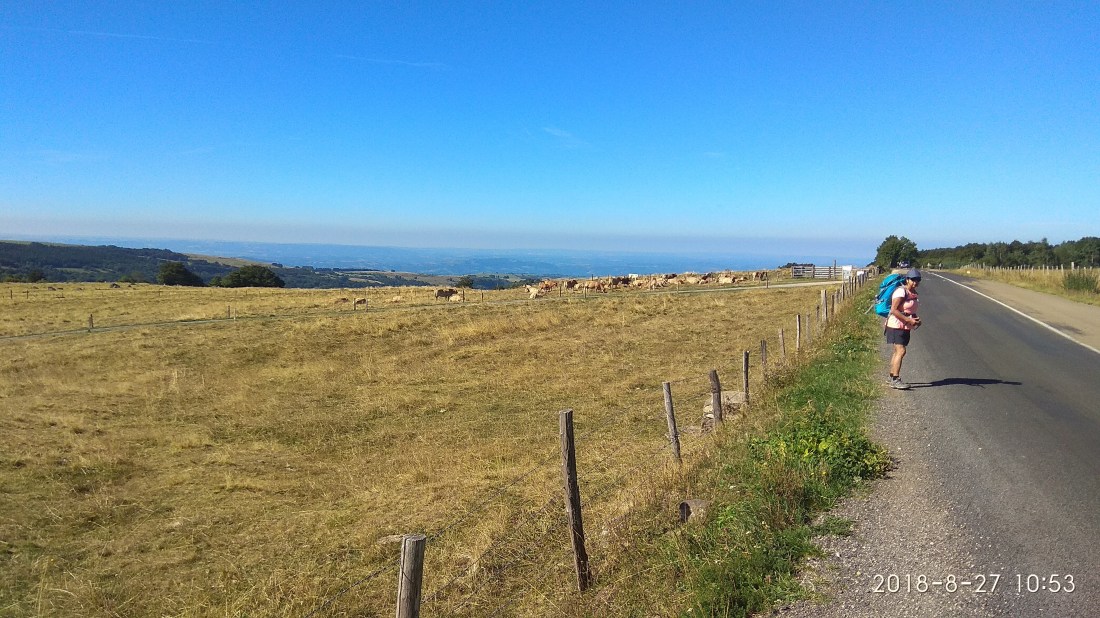
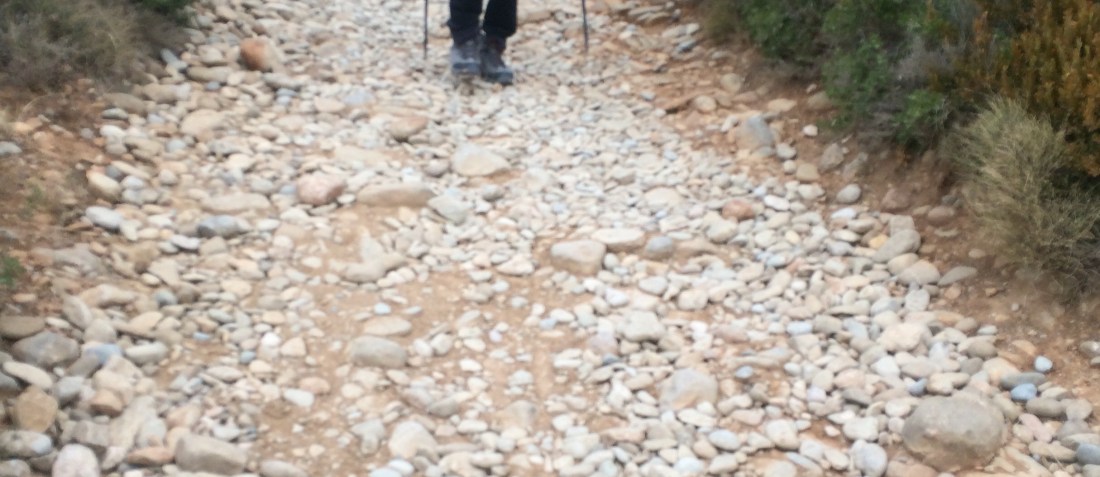
The 20 km hike from Orisson in France to Roncesvalles in Spain on a crisp autumn morning is bliss – if you don’t mind a slow but constant climb of 700 metres through meadows, then tumbling down 500 metres at about 20 degrees incline, on a track made up entirely of unstable rocks!
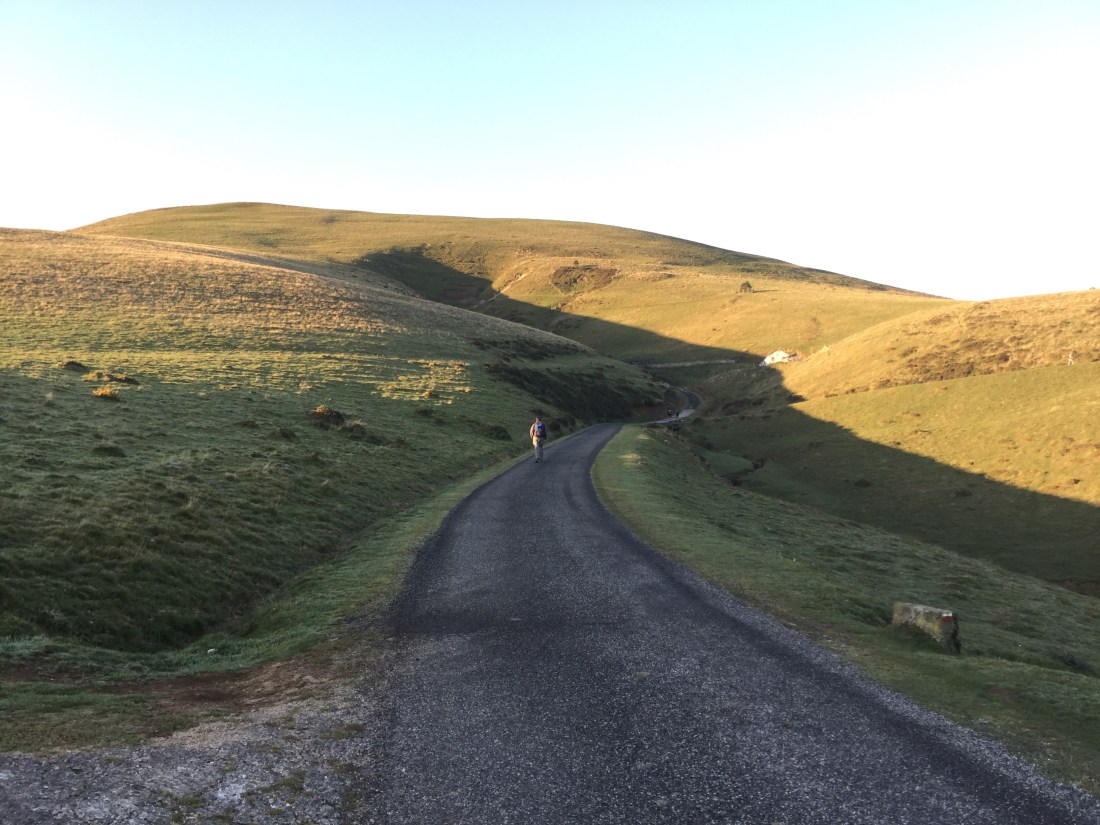
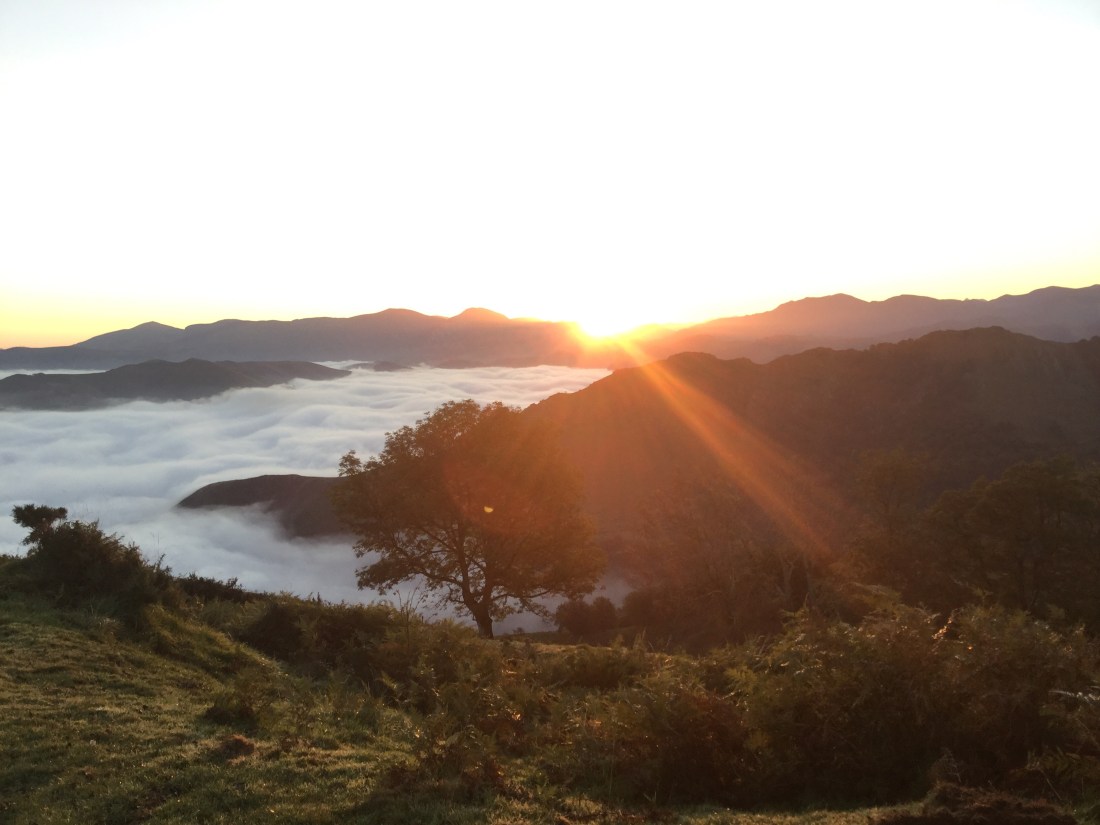
The spectacle of the morning breaking over the mountains is impossible to capture on iPhones, which click ceaselessly as 40 or so walkers leave the Orisson Refugio. The coppery tint in the sky is the ‘bride viewing light’ of my mother-tongue, a light that transforms your plainest daughters into fair-skinned houris. On the I-phone, the blushing sky looks at best washed out, at worst jaundiced. My fiddling with the camera settings produces a tacky pink like those cheap ‘artistic’ photos sold at every Indian mountain resort in the 1970s.

30005083-F512-481D-8D8B-93F832947BF3.jpeg

I am a hopeless photographer. True. But that’s not the only deficit here. The camera just doesn’t capture, what the eye sees: all at once, in one sweep, the little flower trembling under-foot and the crystaline mountain peaks a hundred miles away. At best you catch a mid-range shot while the barren hills cradling the path play havoc with your sense of distance.
You don’t need to walk to enjoy the majestic panorama. You can drive most of this road. But in a car you might miss the autumn-blooming crocus. Dull purple, shivering, sparse, the wild crocus are unobtrusive, almost secretive, as they stick their heads out of the earth, here and there, hiding in their yellow and orange stamen the world’s most precious, most fragrant spice, saffron.

DB7390D3-AD87-489B-83AB-D2E6162BD5B6.jpeg

If you drove here, you would miss too the cowbells ringing in concert, and you wouldn’t get nearly bowled over by the marching band of baa-ing sheep. Most importantly, if you drove, you might scare the mother resting with her new born foal.

434A019C-815E-4525-AE34-6DDF8614ADD5.jpeg

Thankfully, there are very few cars here – we saw perhaps four in 10 kms, including the very welcome food van selling hot drinks, bananas and biscuits. This corner of the world is not on anyone’s bucket list unless they are walkers.

The mobile phones went berserk along the way, unable to decide if we are in France or Spain. The national borders here are messy. At Fuente Roldán, Roland’s Fountain, after many dozen attempts, mine decided that we are finally, definitely, in Spain.

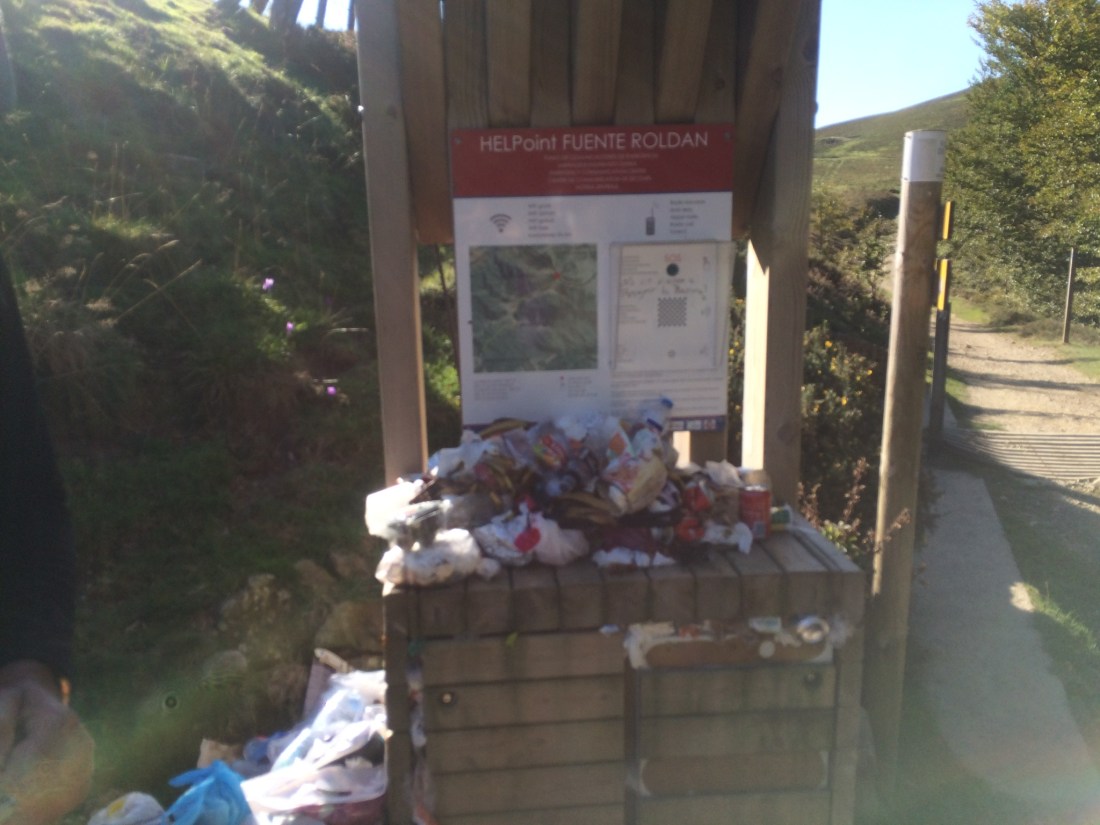
This fountain was built early in this century to serve the pilgrims and to remind them of the epic hero Roland who died in 778, somewhere around here.  The Mahabharata of French literature, Song of Roland, tells the story Charlemagne’s nephew and favourite lieutenant, the handsome (of course!) young Roland, who was felled after fighting bravely and recklessly, ignoring the advice of more experienced generals. Young Roland had been betrayed by his own step father and hopelessly outnumbered by devious and degenerate Moors. That’s what the founding text of French literature says. Basques say Roland was killed by a handful of wily mountain men, who, like all good freedom fighters, had the local knowledge to beat back a young French upstart.
9DEB860D-6EC0-452C-BC3E-511C3653B3AA

Whatever the truth or the legend, the landmark here is unedifying. The drinking water tap is welcome but you nearly miss it as you hold your nose and rush past the garbage dump. Perhaps the message here is that some histories deserve grubby memorials?

The day’s climbing is done a little before we reach this blot on the landscape.

Now, the path is lined by trees standing at awkward angles, with their trunks bizarrely wrapped around each other. Later in the hotel, I google (as you would expect) to figure out what it is that I have seen. It is a rare phenomenon called inosculation, I gather: a process by which trees naturally, graft into each other! I took dozens of photos. None looked like the real thing. When  the camera gets close, you can’t see the forest for the trees, and when I try a longer shot, you can’t see the trees for the forest!

Past the tangled woods, I turn a corner and just for a moment, the vista opens up to my left. Needle-sharp, icy blue mountain peaks pierce the horizon.

My camera battery is dead from the hour of failed bids to capture the entangled forest.

The flat battery finally releases me from the compulsion to record all things for the future. Now I have nothing to do but give in to the moment: take in the here and now with all my senses. For the walker, the moment is a lot more than the monumental views that mesmerise the eyes. The ‘here and now’ is the autumn on her skin; every fibre of the body aching from the climb; head filled with impatient curiousity about the twisted trees; adrenaline from exertion still flooding the heart and the relief palpable deep in the bones because the biggest climb of the entire 1500 kilometre Camino Frances is now behind her. What camera could record all that?

Picture Perfect


“We are so small between the stars, so large against the sky’ (Leonard Cohen)

The 27 kilometre section from St. Jean Pied-de-Port in France to Roncesvalles in Spain through the mountain pass, Col de Lepouder, is the most brutal and the most majestic of the Camino route from Le Puy to Santiago.

From Honto to Orison, the track climbs 400 metres within about two kilometres, a heart-stopping angle when going uphill.

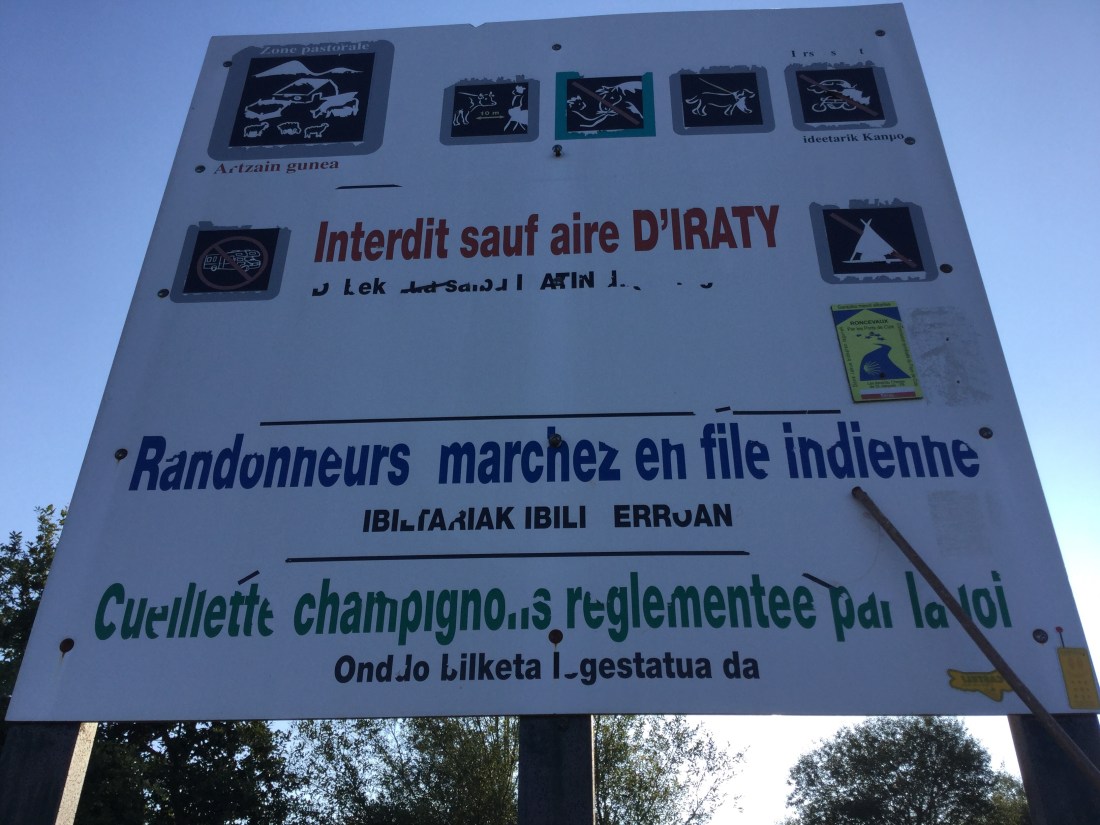
A billboard soon after Honto instructs ‘walk like an Indian’. ‘Not your kind of Indian’ says WB (Walking Buddy). The St Jean Pilgrim’s Office issues printed protocol for hikers in this area. It says, amongst other things: stick to the side of the track and walk in a single file. Apparently in mid-summer 400 pilgrims marching up the road each morning, can cause quite a pandemonium amongst sheep. These roads belong to the cattle. Pilgrims are merely tolerated. Anyway, being Indian, I just assume I am doing the right thing. Others can copy my mode of perambulation.

Accommodation between St. Jean and Roncesvalles is sparse. Many pilgrims end up walking the 1400 meters ascent and then a sharp and rocky 3 kilometres of descent into Roncesvalles, all in one day. Those who are lucky manage to find a bed in the ‘highest’ Albergue on the Camino, Refuge Orisson.

For them, the heart-thumping climb is over for the day. The dormitory accommodation (and there is nothing else until you get to Roncesvalles, 20 kilometres later) is spartan. But spectacular views in every direction.

Panoramic mountain views and picture perfect sunlight accompanied us through the eight kilometres from St Jean Pied-de-Port to Refuge Orison. Crisp cool of autumn morning with a gentle breeze eased the pain of the climb.

A slow morning. Not just because the ascent was sharp. But when every turn reveals yet another sun-drenched valley, you have to stop at every turn for just one more picture post-card shot.

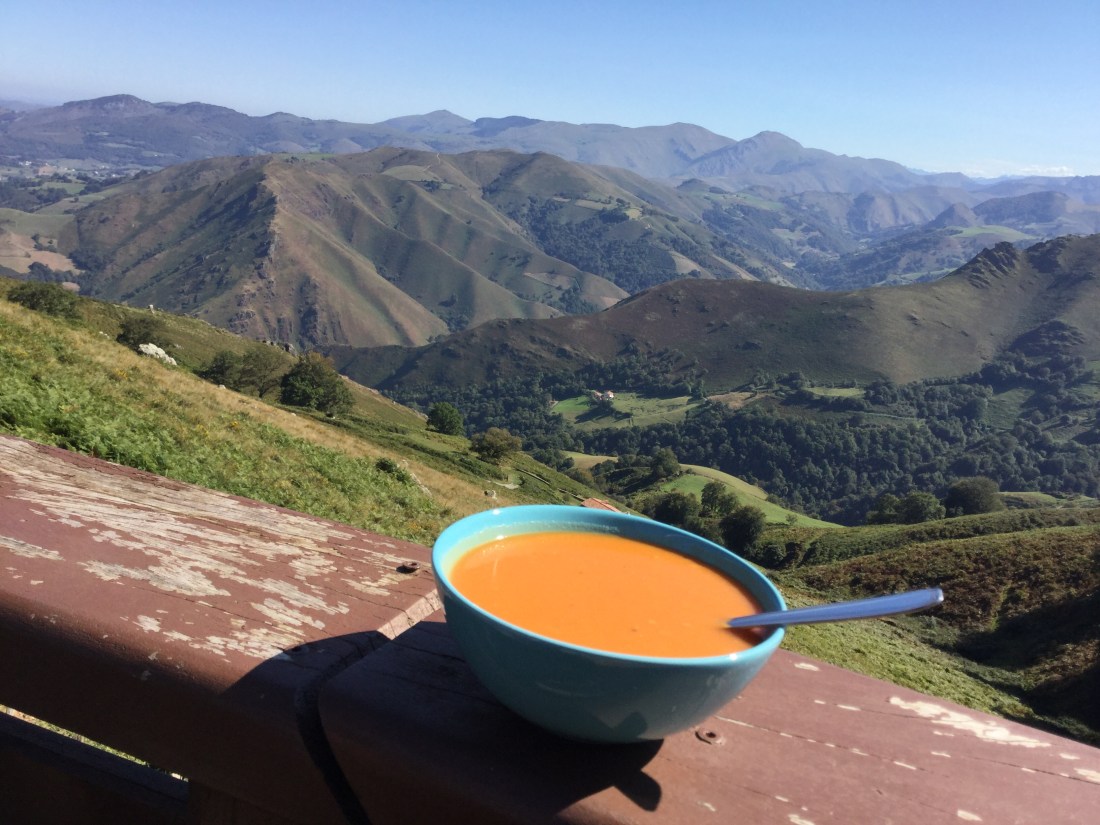
Now time for lunch. Ordered ‘pottage legumes’, from the French menu, because ‘vegetables soup’ on the English one sounds prosaic. WHAT? No Bread? This is the first time we’ve ordered anything vaguely resembling lunch in France and not got a basket of bread. You pay extra for bread, says the very efficient waitress. But the view’s for free. Feast your sense on the Pyrenees, in the al fresco seating of the cafe, absolutely free of charge.

The ‘Feel’ of the Way


Photo: Abbey Church of St. Foy, Conques, in the mist.

In round figures Santiago is 1500 kilometres from Le Puy-en-Velay. St. Jean Pied-du-Port, at the bottom of the mountain border between France and Spain, is the half-way mark. Imagine setting off to walk from Kolkata to Delhi and arriving in, say, Varanasi. Or think about walking from Banda Aceh to Pekanbaru and getting to Medan. 750 kilometres of walking deserves a pause for thought.

There are some 80 or 90 ‘departments’ (districts) in France (French walkers seemed unsure of total numbers – some said 99). The Camino (Chemin de St Jacques in France, or very commonly the Way, after the Hollywood movie of that name) passes through a dozen or so of these ‘departments’, each with its own cheese and wine and little quirks. The size of a district is prescribed to be no more than a day’s horse-ride from any point within it to its capital. Clearly this was a determination of some import prior to the advent of motorised transport, which no one has seen fit to revise in the context of technological change.

Thirty to forty days of walking brings the pilgrim from the wealthy Upper Loir Valley, through the strangely barren areas of Lower Lot to Pays Basque, the last French district, before the Way crosses into Spain’s Basque province, more or less seamlessly.

Late September, sunrise is nudging 8 a.m. Just past the Autumn Equinox, the enormous honey-blonde Harvest Moon lights up the path, for the walkers setting out before dawn. The pilgrims are travelling south-west towards the Pyrenees. If the hiker is on the right track, the sun rises just behind her left ear every morning.

Early morning in the Pyrenees-Atlantique area of France, just before we enter Basque Country, the mist sits like a rings of smoke on the the ground. Here and there, the tree foliage stands out like spiky hair above the misty grey scarf hiding the trunk. You walk in and out of puddles of mist. Later in the morning, the glassy blue snow caps of the Pyrenees are visible a hundred miles before the pilgrims will climb through the passes into Spain.

The rising sun to my left, moonlit dawn in September, the first glimpse of the Pyrénées, would have been as true a thousand years ago as it is today, though the summer heat was less intense and the path more wooded in the Middle Ages. On the other hand, in this century, satellites, mobile phones and especially the little red and white way markers of the GR 65, have made navigation easy and walkers are in no danger of being savaged by packs of wolves!

Time and technology have transformed the way we walk the Camino, of course. Nonetheless, the walker’s relationship to the world around remains visceral in a way that seems to transcend time.

In Lyon, a young engineer points to the Basilica Notre-Dame de Fourvière, towering over the landscape: ‘You see there – enormous church, dominating over the population. It’s saying like “beware little people, we the powerful are always watching you. Don’t do anything to challenge us!”’ The atheist post-colonial Indian tourist agrees readily – Churches are indeed, above all monuments to the greed and power of institutionalised religion; their glorious architectural forms mere covers for exploitation, first of the local peasantry and then of colonised populations all over the world.

As a walker on the Camino, the spire of the church is almost always the first sign of human settlement that comes into view. Things, even immense ones like cathedrals, appear only very slowly when you are walking. You see the tiniest cross on the horizon. If you are lucky and the road is flat, you might get there in 10 minutes. More likely, the path will go up and down and around a hillside, and the church will disappear a few times before becoming a real, fixed location, that you can actually depend on.

Usually a church means a village, which in turn holds out the promise of a cafe or a grocery, clean water to refill bottles, to throw over your burning face, or wash the mud off your knees where you stumbled. Even when the church is a mere shell, abandoned by whatever community once surrounded it, its porch will provide relief when the weather is inclement. In the Middle Ages of course the Church was pretty much the only institution that stood between the pilgrim and death from illness and starvation. Even today, in the middle of a 20 or 30 km walk, the sight of a church inevitably warms the heart. That moment’s sense of relief is not tempered by the intellectual critique that seemed so convincing to the tourist in Lyon, just two days before the start of the hike!

About 5 weeks into our journey, we had walked 10 kilometres one morning, before catching the first glimpse of a town. As always, a medieval church peering over the hill ahead alerted us to the impending coffee and tart for a kilometre or two before we got there. The 12th century building is now a museum. Monday mornings can be dead in many small towns. But Lectour was jumping. The patisserie invited with the smell of freshly bake croissants and provided the world’s best apple turn-overs. Town square was crowded, with bikes and cars buzzing around; people eating and drinking coffee al fresco. There was even a ‘petit casino’ – mini mart. The public toilets were spotless and there were welcome signs of ‘eau potable’ (drinking water) at the entry point to the town and again at exit.

Three hours later when the temperature climbed to 29, this town would have been palpably different. The slow 50 meter climb up to it would have felt like a nightmare. Outdoor cafes would have lost their charm. By 1 the bakery would be shut. The mid-day sun would have wiped out the shadow of the old church building over the town square, which would seem either deserted or too crowded for comfort.

When you are a tourist, you see a place, read the information to learn about this particular place which you have driven or flown in to see. It is already special and valorised as a ‘must see’ before you arrive. When you walk, you feel a place, as a step along the road. The road which brings you there is more important than the place per se. A travel writer is for ever trying to capture the ‘feel of a place’. For the walker that feel depends as much on the place as the state of her blisters or the weight of his backpack or the angle of the sun.

And the walker is by definition transient. The pilgrim never stays long enough to feel a place except as a brief moment in time. A different home every night. The traditional pilgrim hostels in Spain won’t let anyone stay for more than a night. Each town a one-night stand, fickle as the walker is.

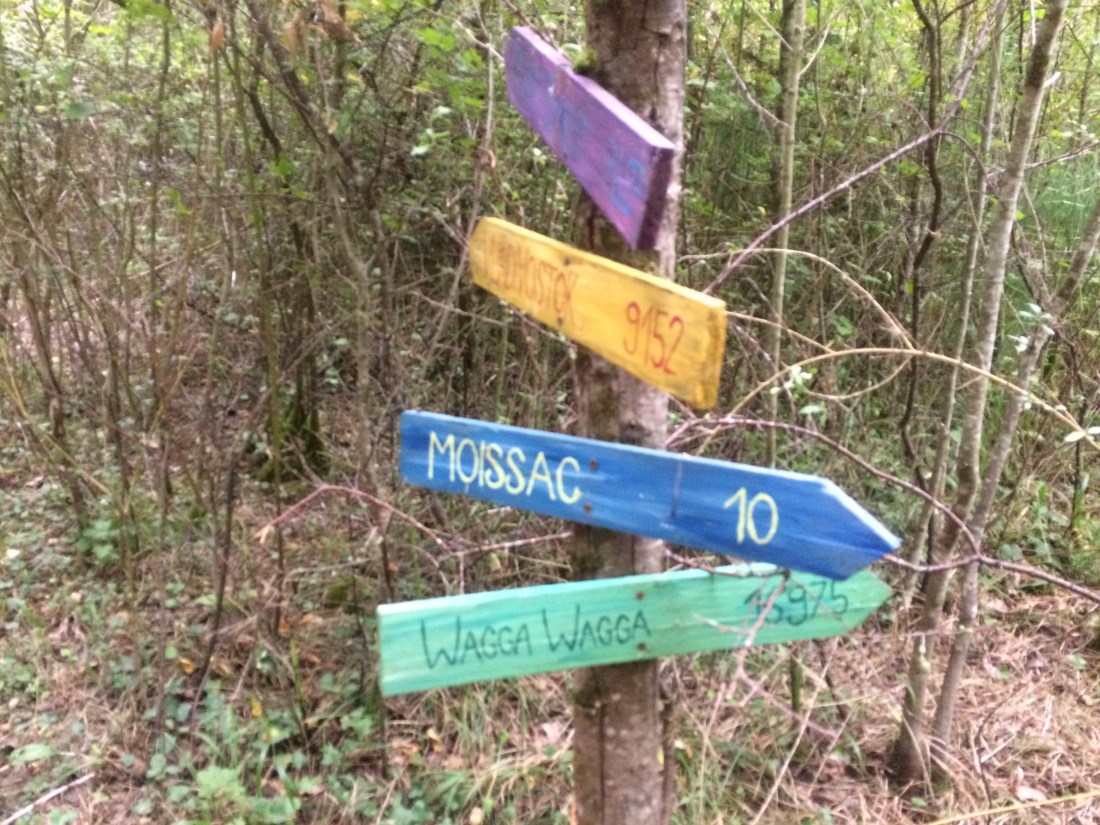
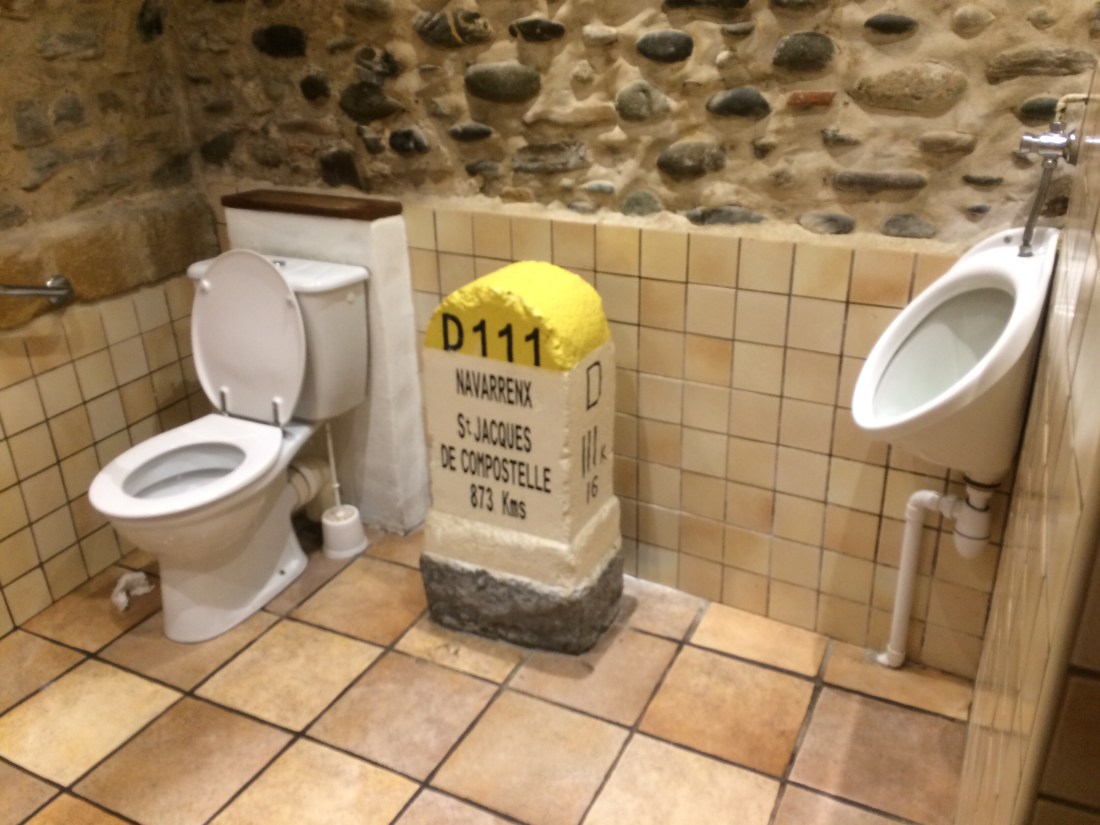
Even milestones are unstable on the Camino. For three days in a row, we saw markers claiming to be a 1000 kilometres from Santiago! There are milestones scattered along the way marking distances to everywhere from Bali to Goa to Wagga Wagga!

Photo: Wagga Wagga 16975 m or kms?! Signpost in a squatter commune near Moissac.

Yes, milestones are a joke here. You can flush ‘em down the toilet.

img_6163

Photo: Cafe just outside the fortified town of Navarrenx.

But over time, some locations have taken on a sort of ritual significance – St Jean Pied de Port is one of them. This startlingly beautiful walled town, on the bank of the River Nive, surrounded by mountains is the starting point for many contemporary pilgrims. In summer, on average 400 pilgrims take off from here towards Santiago, each day. Now in autumn, those numbers have dropped to about 250, the Pilgrim Office tells us.

As we walk down St Jean’s cobbled main street, Rue de la Citadelle, a group of Koreans, who are about to start, cheer us wth ‘wow’s, as veteran walkers with 750 kms under our belt. For many who started from Le Puy, St Jean is the end point. For me the endorphin and the resulting euphoria at reaching this milestone, is tempered by the farewells to friends of the road, most of whom I will never see again, and with whom I have nothing in common other than the strange practice of walking day after day on a road paved with legends and myths for over a thousand years.

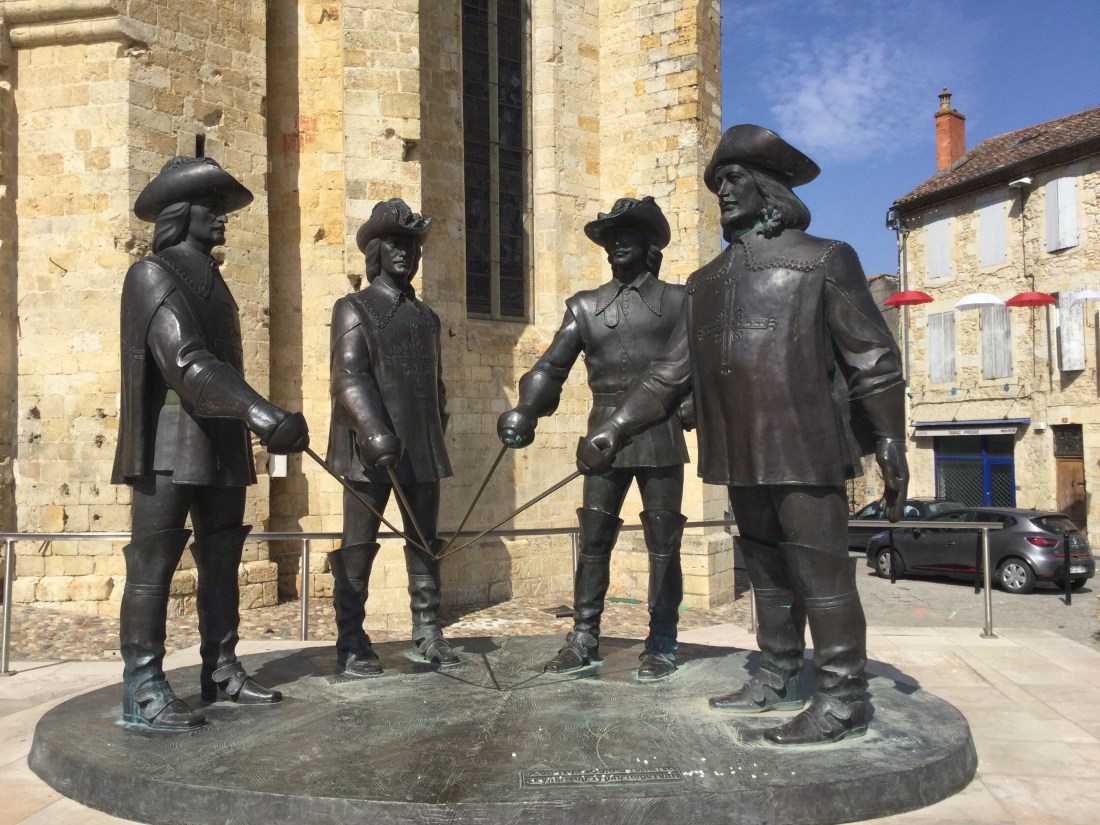
Legends: Three Musketeers and d’Artagnan at the official 1000kms from Santiago milestone

Myths? Three Musketeers still on the Way? Photo by d’Artagnan.

La Route Est Longue

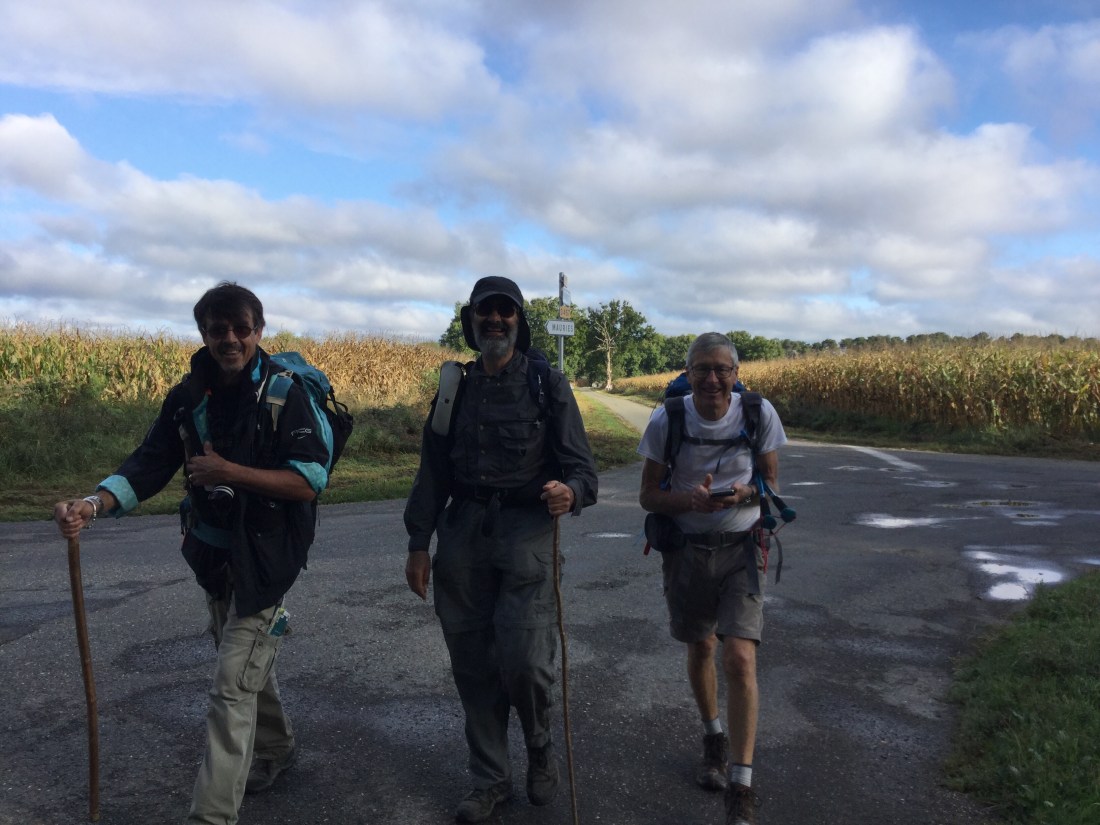
Photo: One day in August 2018, on the Chemin de St. Jacques.

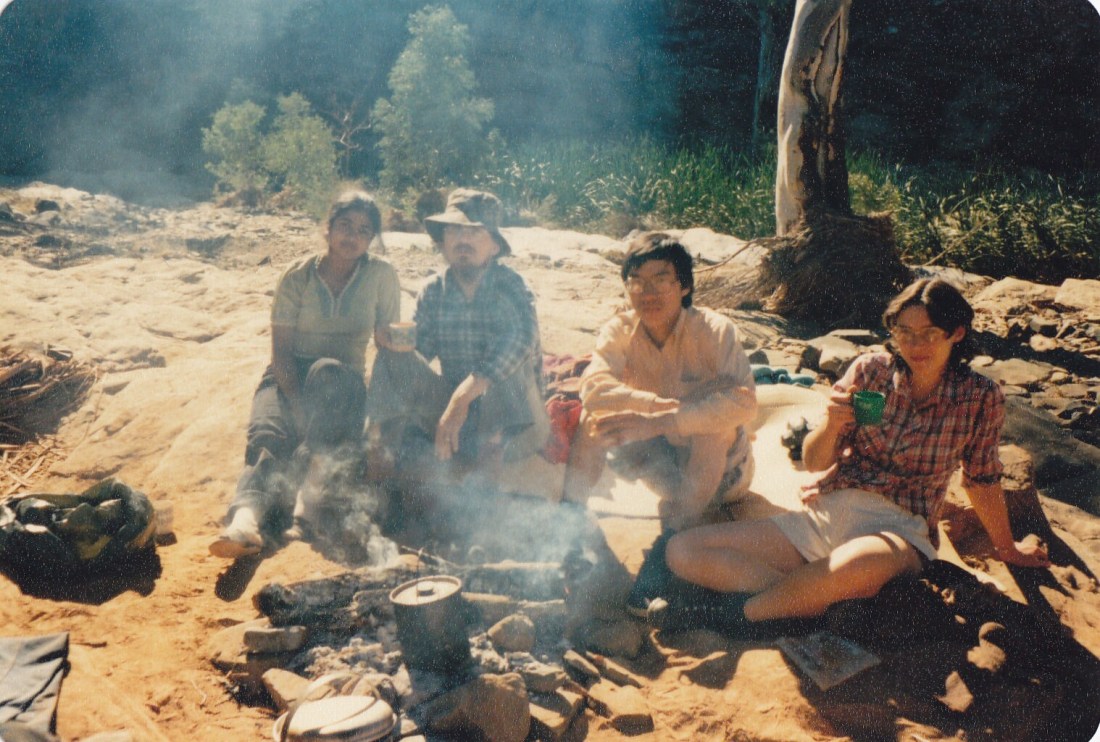
In 1978-79, American Jim introduced a young woman from Kolkata to what he called hiking (that is hours of walking and days at a time), and his long-time mate, Aussie Barbara, called ‘bush walking’. Jim and Barbara had hiked in the US, in Asia and been on heaps of bush-walks in Australia.

The Kolkata Bengalis are build for comfort not for speed or any mobility at all, really. Tagore the greatest Indian poet described his fellow-Bengalis thus:

‘Short of height and wide of girth.

Bengal’s children buttoned up.

Peacefully asleep.’

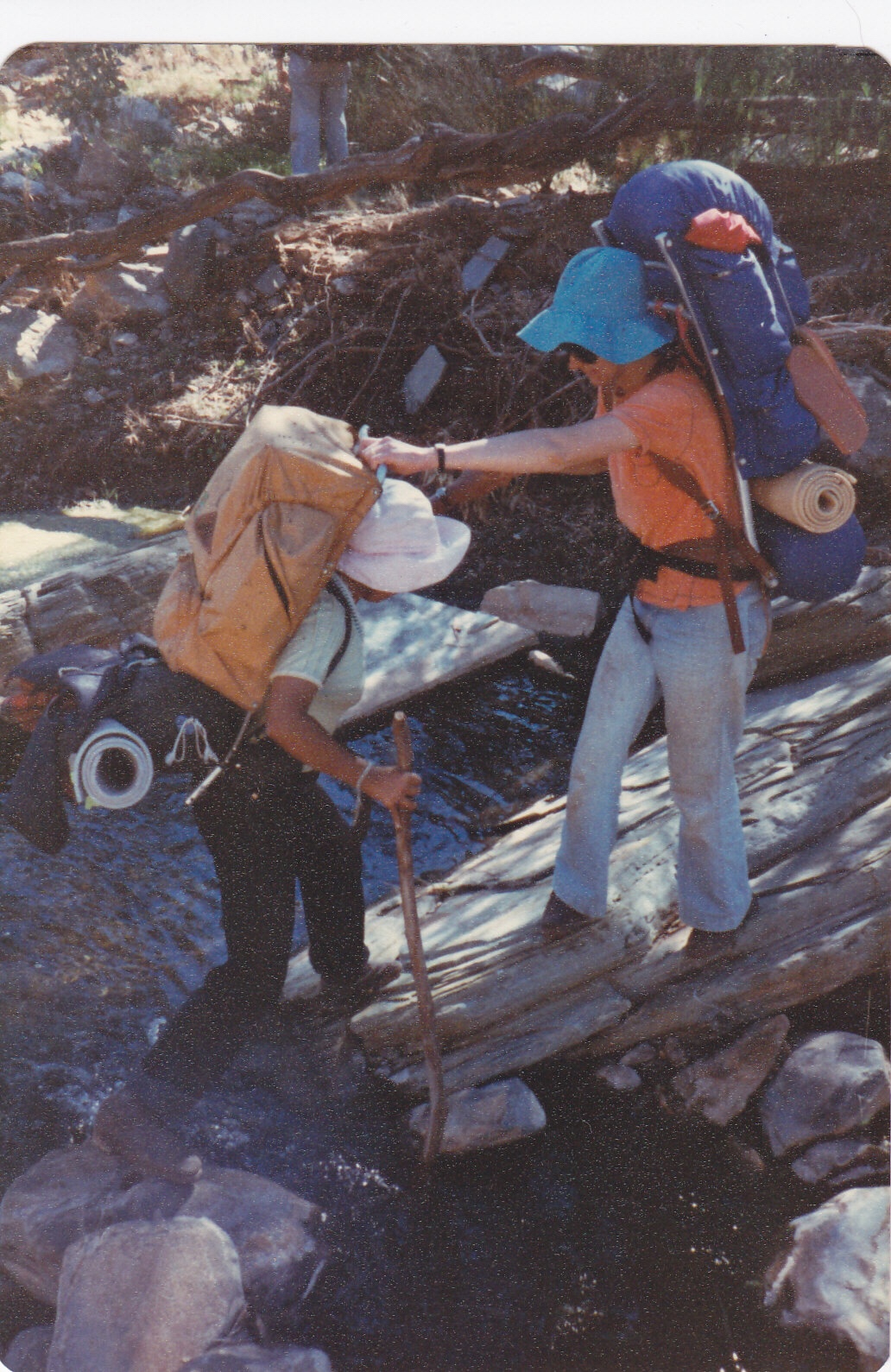
Against all odds, Jim and Barbara persuaded the Bengali girl to come on a four-day hike in the Flinders’ Ranges in South Australia. She failed to learn any bush craft. They let her off camp duties. They gave her the lightest pack. Still, while stumbling through the bush, falling over in every puddle, held up by the scruff of her neck, she caught their walking bug.

Photo: Pulled along by Barbara, Flinders Ranges, South Australia, 1978.

Jim is the older brother I never had. Many in Indonesia, Australia, and elsewhere know him as an academic who wrote and taught about 20th century Indonesia and world politics. For me he did what older siblings should do – they teach you the simple things of life. Jim taught me the pleasure of walking – walking long distances.

In the last three weeks, while I have walked about 400 kilometres on the Camino in France, Jim has been doing the real heavy lifting. He has completed the last visit to his beloved Indonesia and has begun the last leg of his unique through-hike, as the Americans call the really long wilderness walks.

In 2014, I walked 780 kms, with my own walking-buddy, from St. Jean-Pied-de-port to Santiago de Compostella. The day I limped into Burgos moaning from shin-split pain, we were overtaken by a man with a tee-shirt saying something like ‘walking for Parkinsons’. We later learnt that he was PD sufferer who was walking the Camino without support. Along the way, other walkers gathered around him, gave him the support he needed on the day, then walked on at their own pace. Each to her or his own Camino.

Jim didn’t really hike much after he lost his walking-buddy in 1996. Parkinson’s disease eventually forced him to stop walking, in the ordinary sense of the word. But he kept going with all the determination of the long-distance walker, that he was. Wisely, he found a track-angel because every hiker needs one and deserves one.

‘La route est longue’ the French say about the Camino and as a metaphor for life.

On a really long walk, the days run into each other. It is hard to remember where you stayed one night or how many kilometres you did another day or indeed what day of the week it is!

Putting one foot then another would be monotonous, except that the foot, even encased in the most expensive hiking shoes is ever-aware of the changing surface: here cautious on slippery rocks, and minutes later gratefully relaxing into silty softness. Legs tighten at even a five degree incline on the road. Hearts pound going up the mound that looked like a pimple on the topographical map.

Each step is made new by the details you can see when you move at walking pace: a tiny brown creature emerges out of foamy pupa, spiderweb hangs from the fencing wires like meters of fine silk. One day the moon shadow stays up all morning. You squint your camera into the light, but it dodges all attempts to record its unexpected presence. In some stretches of the walk autumn has already begun to lay down a carpet of leaves, but just across, spring is still in full bloom in the tiny purple and yellow flowers on the rock. Just when the heat is getting to you, the trees overhead shake off last night’s dew.

On one of those really tedious stretches of flat grey road, flecks from the sky might flutter past as blue butterflies. A dry rocky wasteland of a road. Signs for hunters all around. A man in a flack jacket. Three four-wheel drives mow down the dry grassy stretch beside the narrow track. Then two more men with guns and dogs. A shot far away. Three minutes later, a fawn doe stops you in her tracks. The one that got away, you breathe a sigh of relief.

Some days are perfect. These you recall in vivid detail. Just over a week ago now (around the time Jim went into the hospital for the last time) overnight rain had cooled the ground. We left Figeac in a soft drizzle. Along the way, the sun came out, smiling. The breeze cooled our way and pushed us up the last climb.  Most setttlements show themselves slowly, shyly. But Cajarc burst into view all at once as we reached the high ground, after 9 hours and 30 kilometers of walking.

And from long ago and far away, I can still recall my first ever hike. First night in Wilpena Pound Campsite. First gum leaf tea cooked in a ‘billy’ on the campfire (for the non-Aussie reader, if there are any, a billy is a tin can with a handle). Learning to pack the first borrowed back-pack. Jim is a bit ahead, staking out the way, calling out warnings ‘prickly bush’, ‘go round the big rock’, ‘puddle’…

Bonne Courage Mas Jim, as they say here in France, along the Way of St James.

Photo: End of a day’s walk with Jim and other walking-buddies, 1978

Blogging the Slog

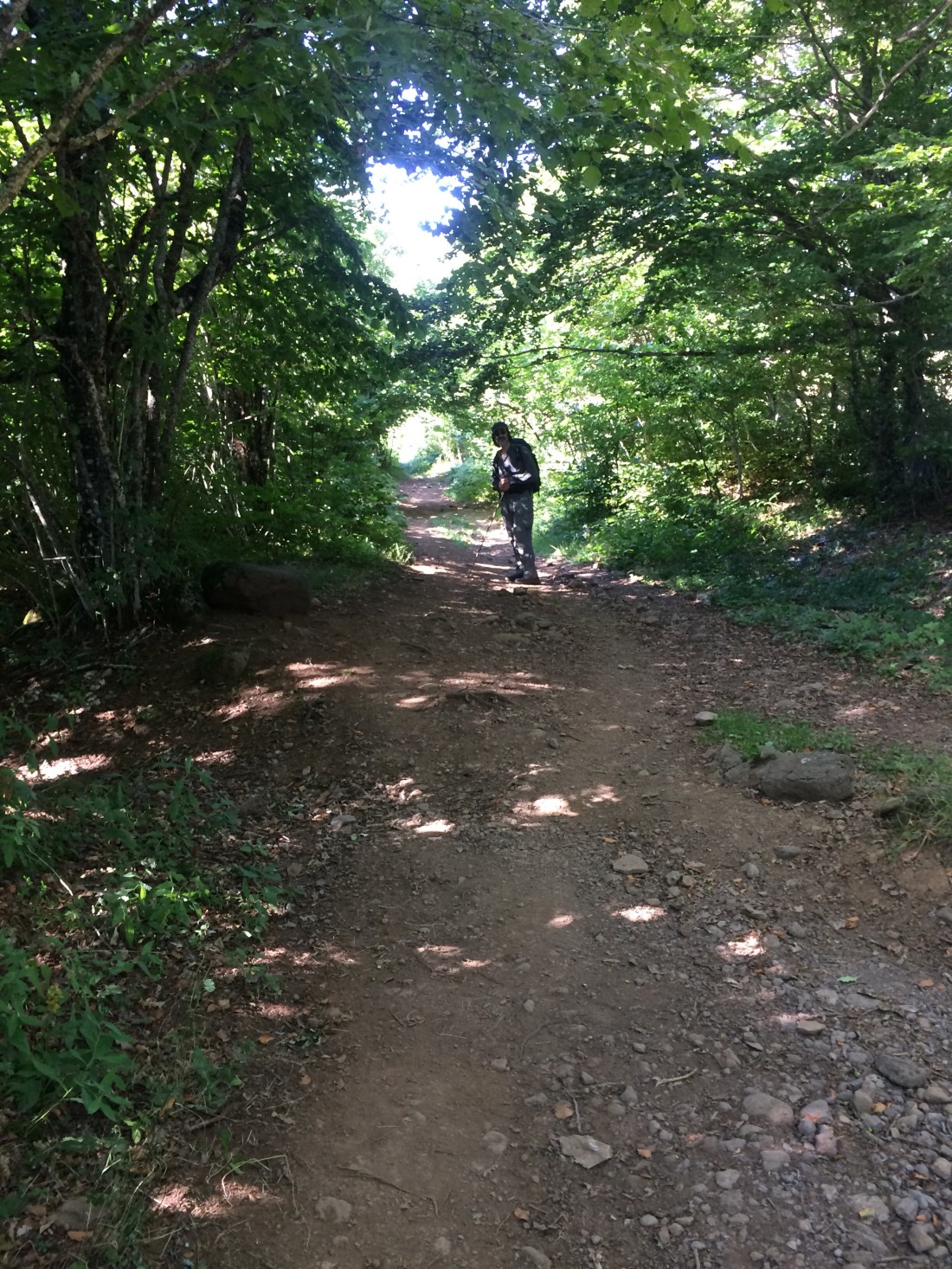
Photo: bitumen roads I loathe

Camino blogs and books are endlessly cheerful and helpful. But friend, cousin and blogger KD (not Lang, check her out at http://daytimedreamz.blogspot.in/ if you want) has asked for a blow by blow of the ‘slog’, ‘the bits you hate’. It turns out that a slog-blog is hard to write. Read on if you want to know why.

Saugues, in Upper Loir Valley, 43 kilometres from Le Puy along the GR 65 on the way to Santiago in Spain. Population – 2000. Cars – too many to count. Temperatures – rising.

A heatwave had swept through France in early August 2018. If you had walked through Saugues any time in the 20th century, the chances of getting temperatures over 30 degrees centigrade would have been nil to negligible (in Australian translation ‘Buckley’s or none’). In 2018, the mercury rose to 30 or more 12 times in August alone. At mid-day on 22 August it got up to to 31. If you don’t believe in climate change and think greenies are making this up, check out accuweather.com and NY Times on http://p.nytimes.com/email/re?location=4z5Q7LhI+KVBjmEgFdYACNmd6jwd34+mWAxqXJXikvjKUyEQPbfuA7oPETN/gXckaokVgSSO2yA=&campaign_id=61&instance_id=0&segment_id=5238&user_id=eb3d4c3f88598c8c16546fe5a3012e11&regi_id=73312224ries)

From Le Puy the GR 65 passes through the Massif Central, the French highlands. Most days involve climbs and descents. On day three we climbed out of Monistrol through beautiful forests and on to a plateau, which rolled along for about 7 kilometers then descended 150 meters into a parched and dusty track with no shade. By now the mid-day sun is right overhead.

First sign of Saugues, the settlement which for hours had held out the promise of lunch, water, rest, was an ad for a patrol station! Unique. Never have I ever, in hikes across 4 continents seen a patrol station being advertised on a walking trail. Next, a 30 meter high wooden monstrosity, adervertising Saugues’ main attraction, the Museum of the Fantastic Beast of Gévaudan (Musée fantastique de la Bête du Gévaudan), not to be missed if you like being scared to death by four floors of display about giant wolves, which killed a hundred or more people in this area from 1764-70. Even if you give the museum a wide birth, you are accosted by images of these ogres in the main drag of the city and farewelled at the last round-about out of town by a grotesque metal sculpture of the creature standing across the cowering body of a female victim.

Hotted up cars, and their inevitable consequence, wrecks and service stations, complete the horror that is Saugues. No rest here for the wicked or the weary. So with mercury still rising, we leave town at 2, not anticipating that the remaining 11 kilometres to Le Villeret is going to be on flat, unvarying bitumen roads, with no trees. In retrospect I wondered if this torment was discreetly implied in Maggie Ramsay’s self-published My Camino Frances, which rather politely writes off the day as ‘not having much scenery’.

The next key moment in the slog is best described from the point of view of a 30 something French man washing a mechanical plough with a power hose on a concrete yard, 20 meters off the road. He dodges furiously as a small female, the colour of slow-roasted egg plants rushes into his pressure hose with a tall man the colour of sun-dried tomatoes, hot on her heels. The Tomato man is screaming ‘ je suis désolé monsieur! Ma femme tres chaud’ and other things that make even less sense than ‘I am desolate sir, because my wife is very hot.’ The young Frenchman manages to make the barest sense of what is going on, the woman is drenched to the skin and both strange creatures stagger off dripping with ‘Merci beaucoup.’

Half an hour later my clothes are dry and I am starting to feel the familiar heat-stroke symptoms again: rashes all over my back and waves of nausea. This time a trough of water, recently used by passing herds, by the side of a highway provides the necessary wet respite. Hindus believe cow-dung is sacred, so I am sure a bit of cow spittle can’t hurt. Still another hour, one foot then another, one foot then another…Villages appear in the distance like mirage and disappear. The road is always there, one step ahead, ashen, burnt out, cinder.

It’s 4 p.m. Google map shows we have done over 20 km. I know the end is nigh: death or the auberge where we are booked for the night. At Le Falzet, an old building is getting a make-over. A spout with a welcome sign of ‘au potable’ appears for the first time since we left Saugues. It’s been two hours and a life time since I have seen clean water. One final wetting of tee-shirt and we are off to our delightful rest for the night, Auberge Le Deux Pelerins (the Two Pilgrims Place).

Later in the evening, bathed, cooled, and two home made fruit liquors later, I wonder why so little is written about the contemporary pilgrim’s woes. Most of my dozen or so dinner companions have done the same 23 kilometers, in the same 30 degrees heat. Most did not think it was the worst day’s walk. Beautiful, 20 year old Elle (not her real name – but she looks a bit like a super model) likes walking in the heat. It reminds her of summer walks with her father. She finds the last hour of each day a drag – her feet hurt after about 4 hours of walking. But by the time she wakes the next morning, she recalls only the delicious food and the delightful host of the auberge and she walks again.

Cecile (all names are fake of course) is my age. And like me she is a bad sleeper. She hates those morning when she has just fallen asleep at 4 a.m and the alarm goes off at 6. But she sets off nonetheless with the hope of a better night’s sleep to come. ‘It is like childbirth,’ she says. ‘You forget labour pain – a mother’s brain is designed to forget. Otherwise, no one would have a second baby. Same with the Chemin. Every day you have pain. Every night you forget!’ She gets a round of knowing laughter from the women.

Photo: the daily happy ending at dinner

That is the first problem with trying to blog the slog – when you are that exhausted, you can’t write things down. The next morning, you can’t really remember. There are no photos to jog your memory either – if you still have the energy to take photos, you are nowhere near the end of your tether. So I keep trying in every conversation, to find variations on the theme of ‘when the hike is a slog’, ‘the hard bits of the day’, ‘what parts of this do you hate’ and so on

A week later, I talk to Philip, the only Malaysian I have ever seen on any of my many long-distance hikes and also the man with the whitest teeth. At 48, Philip has pretty much ‘climbed every mountain. And forded every stream’. His nightmare is a day of sub-zero temperatures. Weird. I recall walking in across the French border into Spain in February 2014, as snowflakes floated down all over our rain gear – delight. Nightmares, it seems, are highly individual.

Books and blogs provide distances, temperatures, elevations. Many calculate scales of difficulty on the basis of objective criteria. But the slog-scale is too personal to be standardised or even usefully shared. My system overloads very quickly with heat and bitumen. Those with bad knees suffer whenever a path descends. Philip the smiling Malaysian hates the cold. For Cecile the slog scale operates inversely with the amount of sleep the night before.

To misquote the most famous of opening lines: ‘Happy pilgrims are all alike; every overwrought pilgrim is unhappy in her very own way.’ (Tolstoy, well, not exactly.)

Holy Mary Mother of God! She’s Black!!

Ursula Le Guin could have written her ‘Epiphany’ in Le Puy:

Mrs Le Guin has found God.

Yes. But she found the wrong one!

Absolutely typical…

And …‘she is black’.

In Le Puy’s Cathedrale Notre Dame a small black female form has more or less taken over from the white-bloke God typically presented in institutionalised faiths. In Le Puy, the powerful Black Madonna sits remote and distant on the huge black and gold background of the High Altar. She is so small and so black that you can barely see her face or that of her black baby son poking like a mask out of the centre of his mother’s robe. And every day of the summer months at a special mass at 7 in the morning she blesses a hundred or more pilgrims setting off on journeys across France and Spain towards Santiago.

Mrs Le Guin could have found the black-she-God at some 180 holy sites in France and another 400 or more sites across Europe. Most of these black Mamas seem to pack quite some miraculous Grrrrl Power.

Le Puy is one of the oldest Marian shrines, going back perhaps to the First Century. But the current sculpture is a replica from the late 1800s. Historians agree that the original statue was probably an Egyptian carving brought to Le Puy before the 11th century. Records from late 1700s say that she was made of wood, bandaged up like a mummy and had been painted over and over again. That Madonna and Child was burnt down during the French Revolution, reportedly, with the arsonists chanting ‘Down with the Egyptian’.

So let me extend Ursula Le Guin’s ‘Epiphany’. When a black(ish) woman (NB: Krishna is etymologically the female form of ‘Dark’ in Sanskrit) goes walkabout, she finds, quite correctly, that God is female, black, of indeterminate age (what woman tells you her correct age?) and origin, a migrant, doing what she can to fit into the local culture and who has been idolised and burnt down at the whim of men.

Nothing to see here.

There was more to see at Lyon’s Basilica Notre-Dame de Fourvière. Built in 1880 (or thereabouts) to bless French war efforts against Germany, it towers over the city, dwarfing the much older Lyon Cathedral in the centre of the old city. Notre dame de Fourvière is now deliberately international and multi-lingual with ‘hail Mary’ inscribed along it’s entry stairwell in many world languages, including several Asian and African ones. On display too are newly cast Mary figurines from around the world, including some beautiful black ones.

A family of Tamils who live in Germany draw my attention to the ‘Notre Dame de la Sante de Vailankanni’. Wiki tells me that Vailankanni a small town in Tamil Nadu and one of India’s own largest Catholic pilgrimages. It draws 20 million pilgrims a year, beating Rome hands down it would seem! The Vailankanni Madonna replica has been installed in Lyon, wearing a white sari with red and gold border emulating the Hindu Goddess of wealth, Lakshmi and just like the goddess Lakshmi in most modern representations, Sante de Vailankanni has the colour of a pukka memsahib, perfect peaches and cream! The Tamil family and I crack jokes about the Indian Barbie, though deep down every Indian woman is conditioned to dream of white skin. But, in a land where black Madonnas ooze power and passion, and white girls abound, the poor pale creature from deep dark Southern India can only disappoint, particularly as she stands next to the beautiful, politically correct, post-modern, dark brown, Italian contribution to the Mother of God gallery in Lyon’s number 2 Church.

Down in the heart of city, in the medieval Lyon Cathedral, I finally find something a skeptic can believe in. A huge photograph of ‘Sante Teresa de Calcutta’ looms out of a chapel, currently under construction. In Calcutta, her adopted home and my city of birth, Mother Teresa seemed quite human, and yet needed no Papal sanction to be recognised as a mother and a saint by the deprived and the destitute of the city. Here, in this grand old building she is instantly recognisable as the icon cast in the heat, poverty, and contradictions of the third world. Her life simply defies ordinary logic. A girl born in 1910 somewhere in the Ottoman Empire, somehow found her way to India at the age of 19. She never saw her own mother again. She spent the next 70 years working for the wretched of the earth, and is now adored as a Saint in the grandest edifices of the Western world.

Even the crustiest skeptic feels a little bit of a miracle when an old nun from her home town in India appears as a Saint in a glorious tourist venue in a glamorous French city! Hallelujah Santa Teresa of Calcutta and thanks for reminding me of my real home.

J’utilise Google Translator

Photo: Long walk up to Cathedrale Notre-Dame du  Puy.

With no more French between us than ‘Parlez vous Anglais, Madame’, my Walking Buddy (henceforth WB) and I are off to hike the GR 65, the Camino from Le Puy-en-Velay.

In Le Puy’s Chambre d’hotes L’Epicurium’, WB (whose French is vastly better than mine) does well establishing that he is indeed the Australian with a booking for two nights, until time comes to say thank you: ‘Terimakasih Monsieur’ says WB. I don’t think you can expect a hotelier in small town near the Loire valley in France to speak Indonesian!

But never fear; they say ‘the Camino provides’. Here in Le Puy it provides an English speaking host whose vast experience of Northern Territory and Sydney convinces him that I am ‘the real Australian’ and not Indian as I am claiming to be. There are more Australians coming to his hotel today and what’s more in our lovely room, in amongst the books left behind by visitors past is the Aussie novel, Jasper Jones. Jasper’s creator, Craig Silvey lives somewhere in our neighbourhood in Fremantle. And who better to send us off on our ‘walkabout’ in distant lands, than Jasper Jones the canny, adventurous, mysterious, mythical, ‘real Australian’!

Australian presence is notable on the Way. Indians, not so much. An American nun at Le Puy’s Notre Dame Cathedral says that in her two years she has seen more than 10,000 pilgrims set off from here, ‘I never noticed any Indians.’ One or two might have slipped past unnoticed, but Indians are rarely so inscrutable. As a statistical Hindu, atheist-Indian-Australian, I am an unusual beast on a medieval Catholic pilgrimage, a road laid in large part to expand and defend Christendom.

Over the summer months close to a thousand peregrines depart from Le Puy weekly. Most will walk a couple of hundred kilometres to one of the many holy sites scattered along the way to Santiago de Compostela in Galicia, North West Spain. Depending on which precise route you follow, Santiago is about 1600 kilometres from here. We will go as far as we can in three months because three months is all that Australians can have, visa-free, in the EU zone.

The Australian Department of Foreign Affairs and Trade (DFAT) website notes special ‘bilateral’ arrangements with individual European governments, allowing Australians to stay in the EU for longer periods. But they must have forgotten to tell the Europeans that. WB and Google Translate (henceforth GT) have written to pretty much every European Consular authority in Canberra, quoting the DFAT website. None appeared to be aware of any special agreement.

So three months it is. ‘As far as we can go’ isn’t a real target. I need ‘realistic targets’, ‘achievable goals’. Two decades in institutional roles dominated by ‘Strategic Planning’ has turned a mild character flaw into a mental illness. So the uncertainty over destination is unnerving me.

I am trying to draw on my Indian heritage. In the Bhagavat Gita the Great Lord Krishna tells the Great Warrior Arjuna to ‘perform all actions appropriate for a prince, while in your heart, renouncing any thought about results’. Right action for its own sake, means is as important as the end – that sort of stuff. So I’m telling myself that cliche that every travel writer quotes and no one quite knows who first said it:

The journey IS the destination.

Perhaps this Camino will be a lesson in accepting uncertainties.

The Camino provides

I first heard that from Louis (not his real name) in 2014 while walking the Camino Frances route in Spain. Louis was walking the same 780 kms from St Jean Pied de Port to Santiago, for the 7th time. He was 36. Soon after we met Louis told me he had been diagnosed with schizophrenia at 17, and lives with his mother in a ‘very small apartment’ near Paris. The first time he walked the Camino, he felt so well, he gave up taking his medicines. Since then, Louis has walked the Camino for a month each year, and that one month in the year he isn’t sick.

We walked on and off with Louis for nearly 500 kms. By the time we got into Santiago, he seemed to be showing some of the signs of the disease he had described in the course of the long hours on the road. Or perhaps he was feeling the euphoria that is every pilgrim’s due when s/he reaches the end of the journey. Or he might have been high on the cheap red wine which comes free with every Spanish meal. No, he said, ‘It is time to go back.’

In a medical sense, the Camino doesn’t cure diseases. But the road makes you feel strong. It proves to you that you are in good health: because if you are walking hours a day, day after day, week after week, how could you possibly be ill?

….

‘Ok. Great placebo. Better than vitamins. So what’s to write home about?’ bestie and fellow academic AM, threw out a challenge when I mused about ‘perhaps doing a blog.’

‘Half of our generation seems to be walking and blogging. There is a huge over production of publications in all formats. Why would you write when you could read? No shortage of great literature!’

She is right. Camino blogs and books abound. But mostly they are about Camino Frances, starting in St.Jean Pied de Port, moving west to east along the top of Spain. There are very few accounts in English of the section from Le Puy in France, due south along GR 65 to St Jean Pied-du-Port right on the border with Spain.

For this section, the most commonly used guide book in English is the LightFoot Guide to the Via Podiensis. The funniest is the novel, Two Steps Forward. One wants to be useful to others, but there may be more compelling reasons to write.

Some of the great writers of travel say that you need to write to understand your surrounding. Nobel laureate V.S. Naipaul (he’s been in the news lately since he died) puts it like this: ‘On my early walks, because I was writing about Africa, I saw Africa,’ In the Enigma of Arrival, he weaves walking through the Wiltshire countryside with writing and later in the novel, with books and paintings to understand the changing lives of the surrounding community. ‘So much of this I saw with the literary eye, or with the aid of literature.’ Naipaul writes.

Flying half way across the world from Australia to France just to go for a very VERY long walk for 3 months does sound a tad odd. But in this century, several thousand Australians have walked the Camino de Santiago or some part of it. Precise numbers are hard to get. But by all accounts our numbers are growing. Some are here because they have found God. Others are walking rather than waiting for Godot. And along the way, just like in the play, there are the bedraggled, the weary and the philosophical. Many of us are writing to explain the magic to ourselves and to any readers might who come on the hike from the comfort of their home computers.